Reviewed by KSB PPF Product and Quality Control Team
If you’ve been sourcing paint protection film for any length of time, you’ve probably heard both terms. Suppliers mention PCDL as a premium material. Some describe PCL as the standard. A few use both without clearly explaining what they mean or why it matters.
This article cuts through the terminology. It explains what PCDL and PCL actually are, how they differ in practice, and — more usefully — how to use this knowledge when evaluating PPF products and talking to suppliers.
What PCL and PCDL Actually Are
Both PCL and PCDL are polyols — the flexible backbone component of the TPU polymer. In TPU chemistry, this backbone is called the soft segment, and its chemistry significantly affects how the finished film behaves over time.
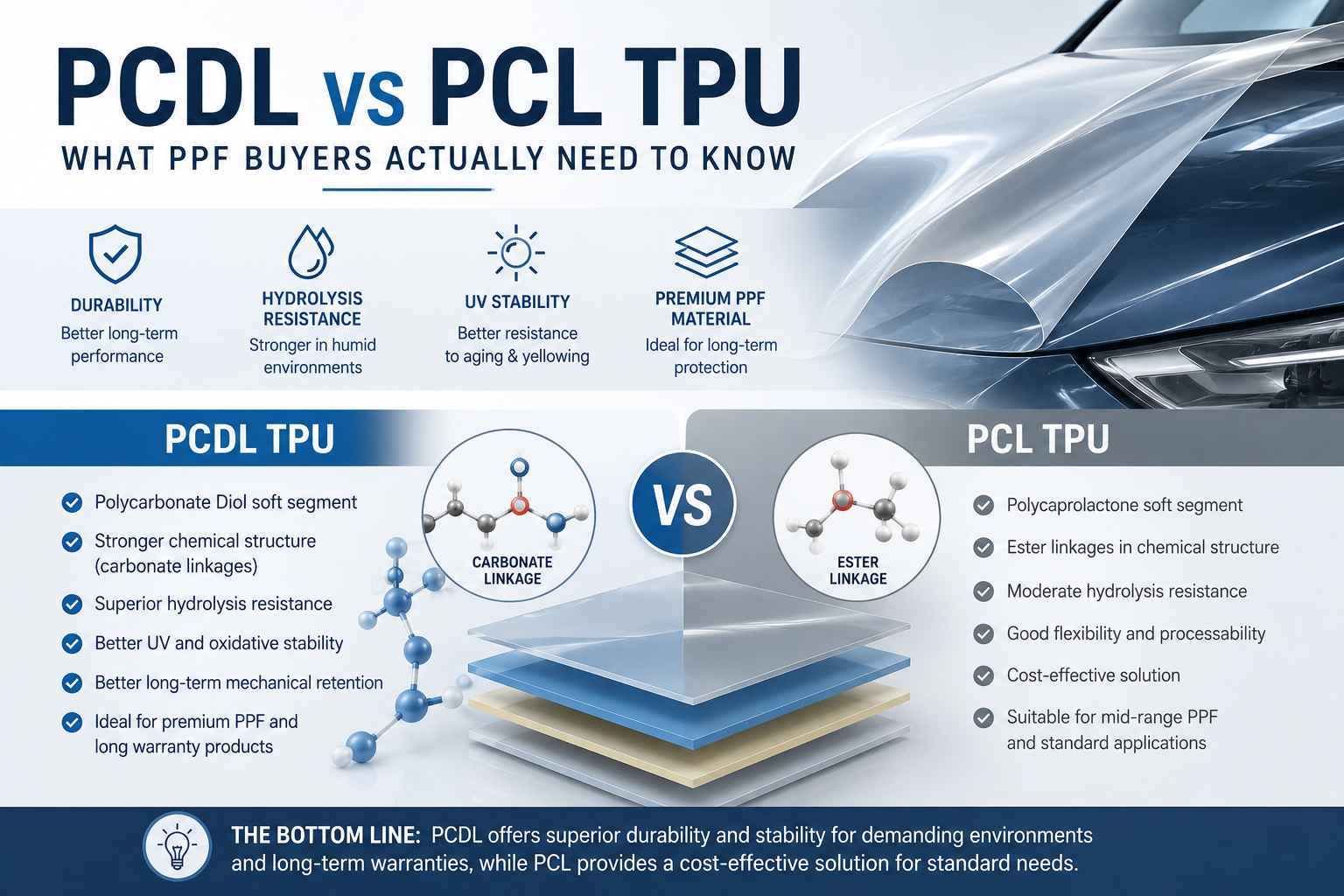
Polycaprolactone (PCL) is a polyester-type polyol. It’s been widely used in PPF and other flexible polyurethane applications for years. PCL offers a reasonable combination of flexibility, optical clarity, and processing ease, which is why it became a standard material in mid-market PPF production. The tradeoff is that PCL contains ester linkages — chemical bonds that are vulnerable to hydrolytic degradation. In the presence of moisture and heat over time, these bonds can break down, gradually affecting the film’s mechanical and optical properties.
Polycarbonate diol (PCDL) uses a carbonate linkage instead of an ester linkage. Carbonate linkages are more chemically stable — they resist hydrolysis more effectively and hold up better under prolonged UV and oxidative exposure. PCDL-based TPU is used in applications where long-term durability matters: premium PPF, industrial protective films, and other products that need to perform reliably over extended service periods.
Neither is exotic. Both are established materials with well-understood properties. The difference is in what each one does over time, under real-world exposure conditions.
How the Chemistry Difference Plays Out in Practice
The distinction between ester and carbonate linkages is a chemistry detail. What matters to a PPF buyer is what that difference means for product performance.
Hydrolysis resistance Hydrolysis is the degradation of polymer chains by water — accelerated by heat and humidity. PCL-based films are more susceptible to this process than PCDL-based films. In high-humidity markets — Southeast Asia, coastal regions, areas with significant rainfall — hydrolysis resistance is a relevant factor in how long a film maintains its mechanical integrity and optical clarity.
This doesn’t mean PCL-based films fail quickly in all conditions. A well-formulated PCL film with appropriate stabilizers can perform adequately in moderate climates. But for markets with sustained humidity and heat, PCDL offers a more durable foundation.
UV and oxidative stability PCDL’s carbonate linkage is also more resistant to oxidative degradation. Over years of UV exposure, this contributes to better retention of film properties — clarity, flexibility, and surface performance. Combined with appropriate UV stabilizers, PCDL-based TPU generally ages more slowly than PCL under equivalent outdoor conditions.
It’s worth noting that UV stability in the finished film also depends heavily on the isocyanate chemistry. Aliphatic TPU — regardless of whether it uses PCL or PCDL as the soft segment — resists UV-induced yellowing significantly better than aromatic TPU. Both factors matter, and a well-specified film addresses both.
Long-term mechanical retention As a film ages and the polymer degrades, it loses mechanical properties — tensile strength, elongation, elastic recovery. PCDL-based films generally retain their mechanical properties longer under accelerated aging conditions. For a PPF brand carrying a 7- or 10-year warranty, this matters. The film needs to still be performing within acceptable parameters at the end of the warranty period, not just at installation.
Processing and formulation PCL is generally easier and less expensive to process. It has a well-established supply chain and a long history in PPF manufacturing. PCDL is more complex and costs more. Some manufacturers have more experience with one than the other, which can affect how well either material is actually utilized in a finished product.
What PCDL Doesn’t Automatically Fix
PCDL is a better soft segment for demanding PPF applications. But the soft segment is one component of a multi-layer film construction. It doesn’t determine everything on its own.
A PCDL-based film with a weak top coat, poor UV stabilizer loading, or an inadequate adhesive system can underperform a well-constructed PCL-based film. The soft segment matters, but it doesn’t override the rest of the construction.
Specifically:
The isocyanate type still matters. Aliphatic vs. aromatic isocyanate chemistry affects yellowing behavior more directly than the soft segment in most outdoor conditions. A PCDL film built on aromatic isocyanate will still yellow under UV exposure. For transparent outdoor PPF, aliphatic chemistry is essential — and it’s a separate specification from the soft segment.
The UV stabilizer package still matters. HALS (hindered amine light stabilizers) and UV absorbers protect the polymer from photodegradation. Their type, combination, and loading level affect how well any TPU — PCL or PCDL — holds up under UV exposure. A PCDL film with minimal stabilizer loading is not automatically better than a PCL film with a well-designed stabilizer package.
The top coat still matters. The outermost layer is what’s directly exposed to UV, abrasion, staining, and weathering. A quality top coat significantly extends effective service life regardless of the base TPU chemistry.
Manufacturing quality still matters. Thickness consistency, optical clarity, layer adhesion, and process control affect real-world performance independently of raw material specification.
The point is not that PCDL doesn’t matter — it does. The point is that a supplier claiming PCDL as a headline feature while leaving the rest of the construction unspecified is not giving you the full picture.
How to Use This When Talking to Suppliers
Knowing the difference between PCDL and PCL gives you a more useful basis for supplier conversations. Here’s how to put it to work.
Ask about the full soft segment specification, not just the label. PCDL covers a range of molecular weights and carbonate contents, each with different performance characteristics. A supplier worth working with can describe not just that they use PCDL, but what grade and why it suits their film construction. The same applies to PCL — asking about molecular weight and how it affects film flexibility tells you whether the supplier understands their own product.
Ask what isocyanate chemistry is used alongside the soft segment. This is equally important and sometimes overlooked. Confirm whether the film uses aliphatic or aromatic isocyanate. For any transparent outdoor PPF, the answer should be aliphatic.
Ask for aging test data, not just material claims. The best way to evaluate whether PCDL actually delivers better performance in a specific film is accelerated aging test data — xenon arc weathering, hydrolysis resistance testing, mechanical property retention after aging. Ask for reports, not certificates. A supplier who has done the testing can provide results. One who hasn’t will provide assurances.
Match the material specification to your market requirements. If you’re selling into a high-humidity, high-UV market with long warranty periods, PCDL is the appropriate specification and worth the premium. If you’re building an entry-level product for a moderate climate with shorter warranty commitments, a well-formulated PCL-based film may be adequate and more cost-effective. The right answer depends on what you’re actually selling and where.
Don’t accept vague answers to specific questions. “Premium TPU” is not a material specification. “High-grade polyurethane” tells you nothing. If a supplier can’t tell you whether their soft segment is PCL or PCDL, that’s information — it suggests either they don’t know or they don’t want to disclose it. Neither is reassuring.
A Practical Comparison
| PCL-Based TPU | PCDL-Based TPU | |
|---|---|---|
| Soft segment type | Polyester (ester linkage) | Polycarbonate (carbonate linkage) |
| Hydrolysis resistance | Moderate | Stronger |
| UV / oxidative stability | Adequate with stabilizers | Generally better retention |
| Long-term mechanical retention | Moderate | Generally better |
| Typical application | Mid-range PPF | Premium PPF |
| Raw material cost | Lower | Higher |
| Suitability for high-humidity markets | Depends on full construction | More appropriate |
| Suitability for long warranty periods | Depends on full construction | More appropriate |
Note: Actual performance depends on the complete film construction, not the soft segment alone.
Which One Is Right for Your Product?
There’s no universal answer, but there are some clear guidelines.
Choose PCDL-based TPU when:
- Your target market has high humidity, high UV, or both
- You’re carrying a warranty of 7 years or longer
- You’re positioning as a premium brand and the product needs to support that claim
- Your customers are in markets where competitors are already specifying PCDL
PCL-based TPU may be adequate when:
- You’re building an entry-level product with shorter warranty commitments
- Your target climate is moderate — low-to-medium humidity, moderate UV
- The rest of the film construction (top coat, stabilizers, adhesive) is well-specified
- Cost efficiency is a priority and the market positioning supports it
In either case, the soft segment specification should be confirmed in writing, supported by material data, and aligned with the warranty terms you’re offering to your customers.
Frequently Asked Questions
Can I tell from looking at a film whether it uses PCDL or PCL? No. The soft segment chemistry isn’t visible. You need to ask the supplier directly and request supporting documentation — material data sheets or test reports that confirm the specification.
Is PCDL always worth the higher cost for PPF? For premium-grade film in demanding markets with long warranties, yes. For entry-level products in moderate conditions, the cost premium may not be justified by the application. The right answer depends on your product positioning and target market.
A supplier claims their film uses PCDL but can’t provide test data. Should I trust it? A material claim without supporting documentation is an unverified claim. For a specification as specific as PCDL, a genuine manufacturer should be able to provide a material data sheet or test report confirming it. If they can’t, treat the claim as unconfirmed.
Does PCDL replace the need for UV stabilizers? No. UV stabilizers (HALS and UV absorbers) are a separate part of the formulation and address a different degradation mechanism. PCDL improves intrinsic hydrolysis resistance and oxidative stability; UV stabilizers slow photodegradation. A well-specified film needs both.
We’re sourcing PPF for multiple markets with different climates. Should we specify different constructions? Potentially, yes. A product line with a PCDL-based premium film for high-UV, high-humidity markets and a well-formulated PCL-based product for moderate conditions can be a sensible approach. This is worth discussing with your supplier when planning your product range.
Sourcing PCDL-Based PPF for Your Brand?
If you’re building a PPF product line and want to understand which film construction suits your target market and warranty requirements, we’re happy to walk through the options.
Tell us your target market, warranty period, preferred thickness and finish, and estimated volume. We’ll recommend a suitable construction, explain the specification, and provide samples with full technical documentation.
Request PPF Samples | Get an OEM Quotation | Talk to a PPF Specialist
Reviewed by KSB PPF Product and Quality Control Team.
This article reflects general industry knowledge and KSB’s product experience. Performance outcomes depend on complete film construction and end-use conditions.
Get a Free Sample or Quote
Looking for a reliable window film supplier? Contact us today for fast response and professional support.