Two paint protection films can use the same broad TPU description and behave very differently on a vehicle.
One may install cleanly, retain gloss, and keep stable edges. Another may show orange peel, hold installation marks, stain easily, or lift around difficult curves. The difference rarely comes from one specification.
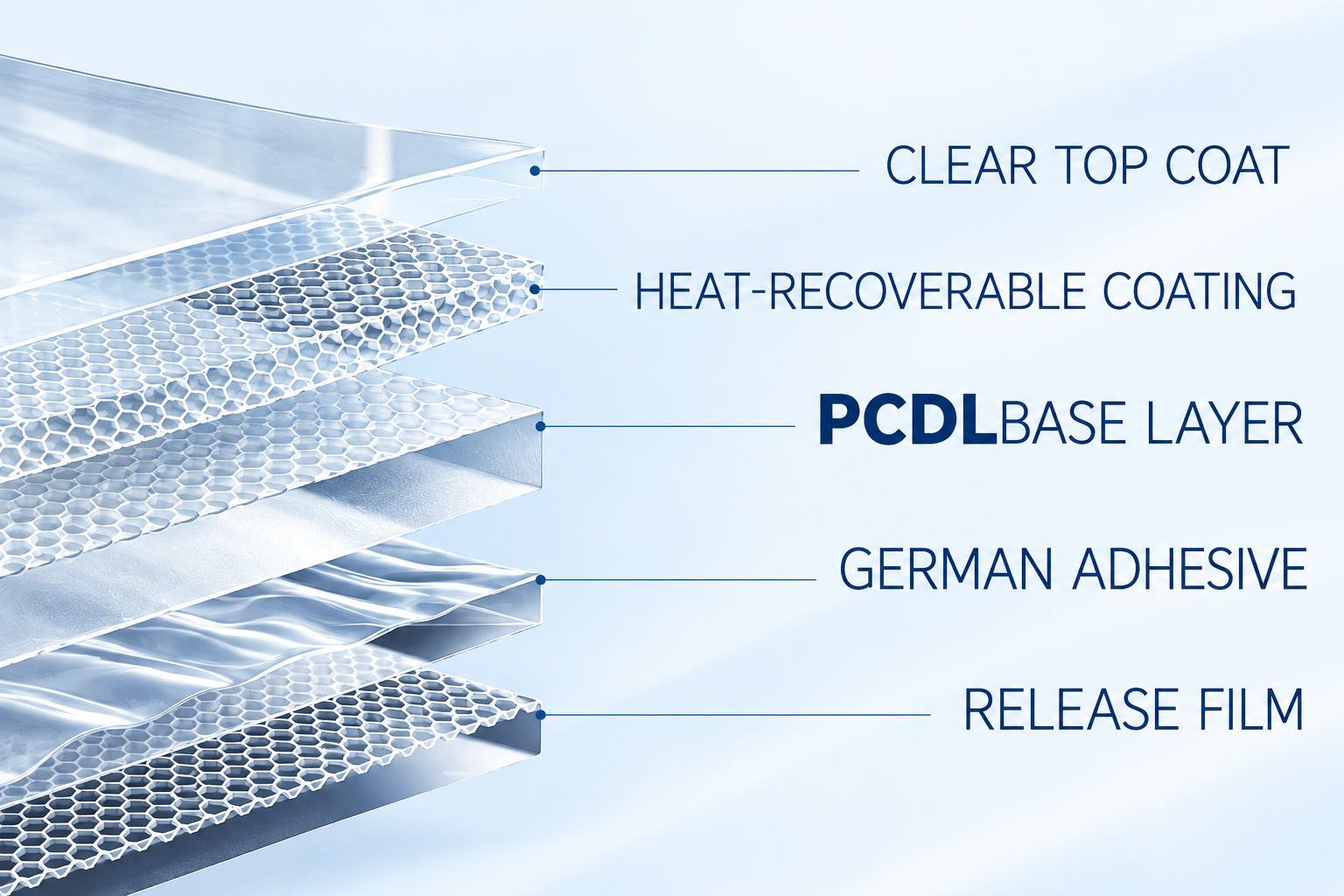
A high-quality PPF is a matched multilayer system. The base film, topcoat, adhesive, stabilizers, and manufacturing process must work together. Buyers also need evidence that the finished construction performs consistently, not only that its raw materials sound premium.
The following six areas provide a practical framework for evaluating PPF.
Base Film
The TPU substrate forms the mechanical foundation of most premium clear PPF.
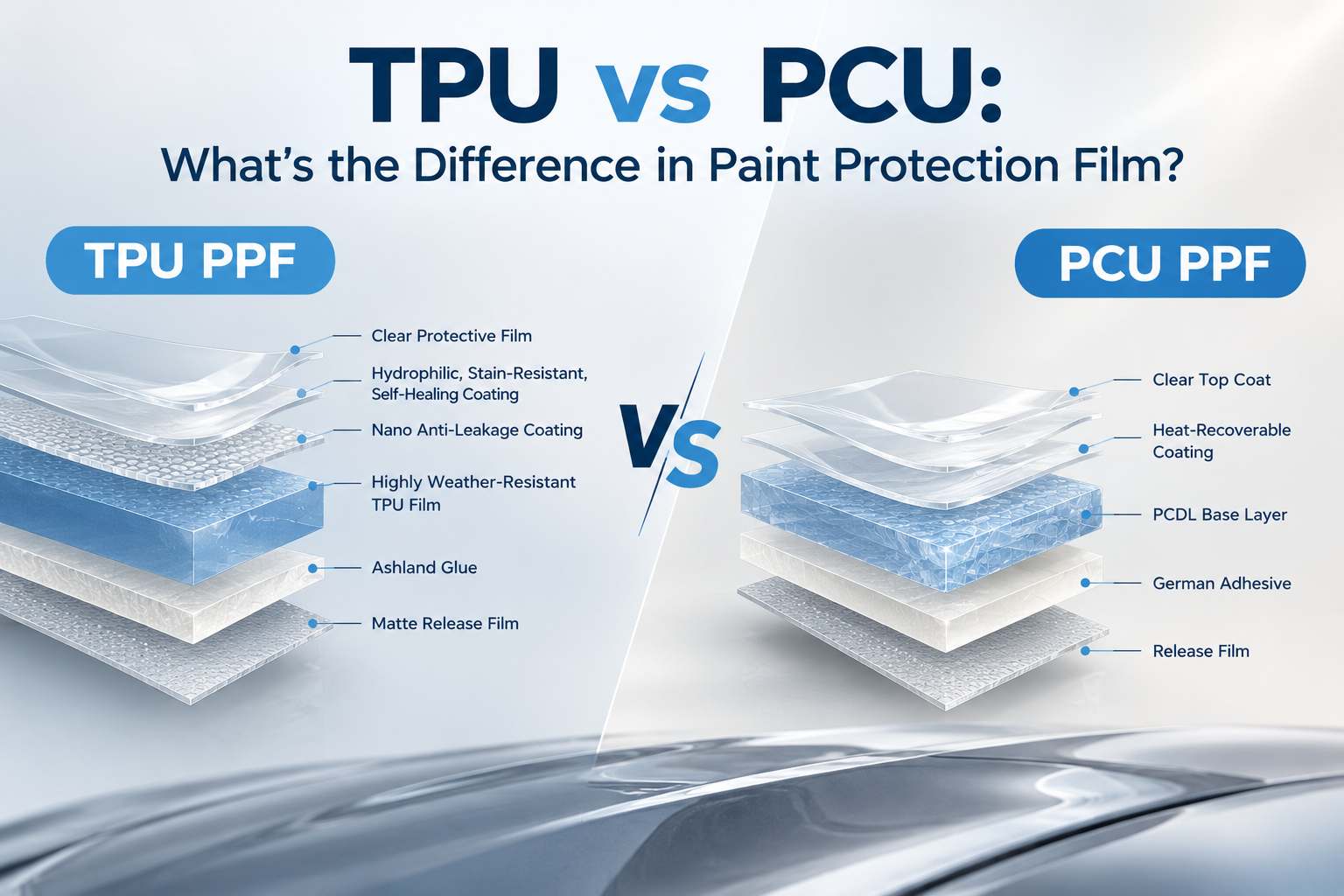
Common discussions focus on whether the soft segment is PCL based or PCDL based. That is useful information, but the actual TPU also depends on isocyanate chemistry, hard-segment content, molecular weight, additives, film formation, and process control.
A suitable base film needs to combine:
• Clarity
• Flexibility
• Tensile strength
• Elongation
• Elastic recovery
• Tear and abrasion resistance
• Stable bonding with the coating and adhesive layers
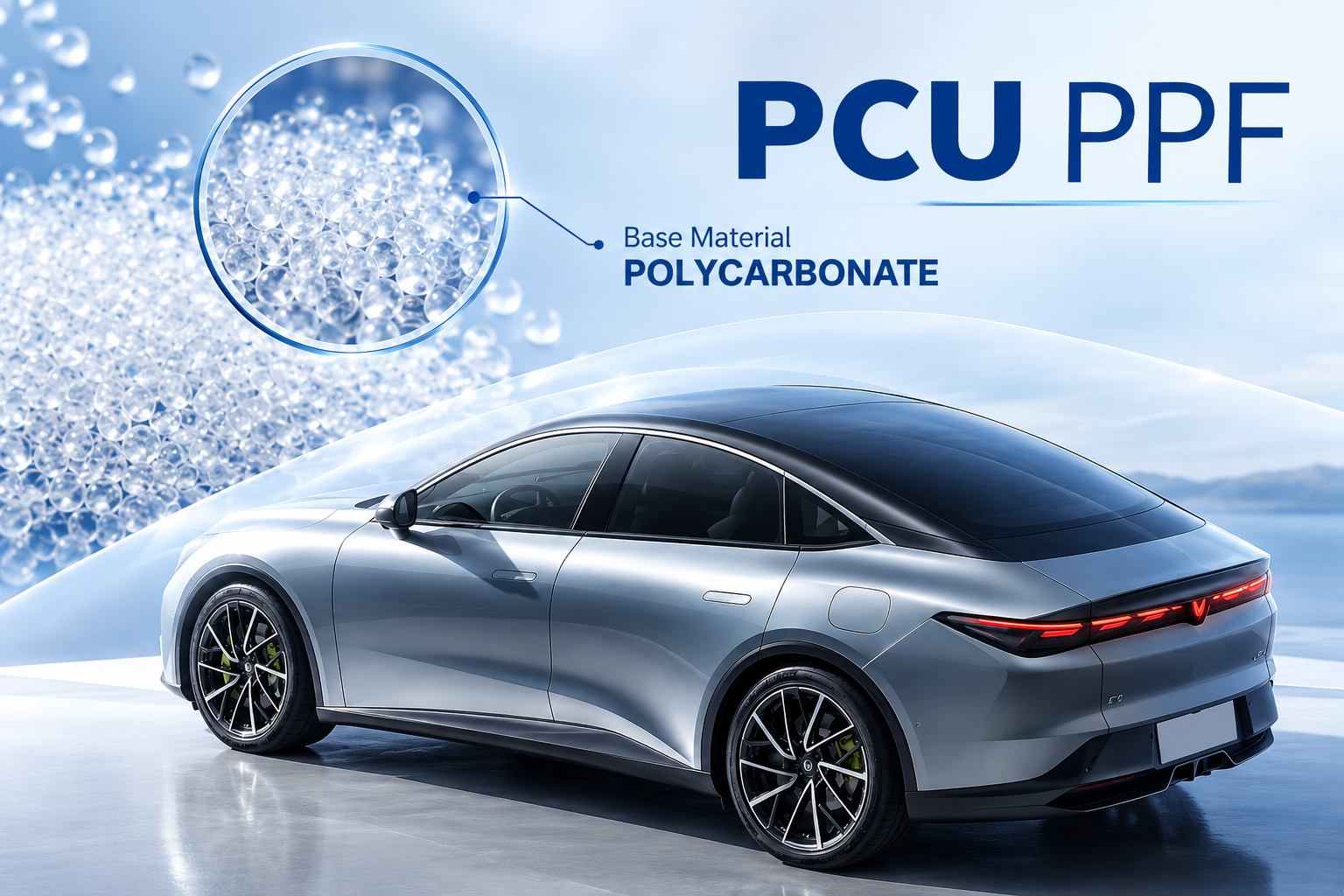
For clear outdoor PPF, buyers should confirm that the polyurethane system is designed for light stability. PCDL-based TPU may offer attractive hydrolysis and environmental-resistance properties, while PCL-based TPU can provide strong mechanical balance and mature processing. Neither label proves finished-film quality.
What to Check
Ask for the exact substrate description, not only the word TPU. Review thickness, tensile, elongation, haze, and aging retention. Confirm whether the data applies to the raw base film or the complete coated PPF.
Topcoat
The topcoat is the film’s working surface. It faces sunlight, washing, road contamination, minor abrasion, chemicals, and repeated cleaning.
Many features that end users associate with premium PPF are topcoat functions:
• Scratch recovery or self-healing
• Hydrophobic behavior
• Stain resistance
• Chemical resistance
• Surface smoothness
• Gloss retention
These properties involve trade-offs. A very soft coating may recover from light marks easily but may not offer the best stain or chemical resistance. A harder surface may resist abrasion well but require more heat for recovery. The coating must also adhere reliably to the TPU substrate and remain flexible during installation.
Self Healing
The term self-healing needs test conditions. Ask what type and depth of scratch was used, how the mark was made, what temperature triggered recovery, and how long recovery took.
A warm-water demonstration can be useful, but it does not show long-term coating stability. Repeat the test after accelerated aging or chemical exposure if durability is important.
Hydrophobicity
Water beading is easy to demonstrate and easy to overvalue. Contact angle can help compare surfaces, but high initial beading does not prove stain resistance, coating durability, or long service life.
Check whether the hydrophobic effect remains after washing, abrasion, weathering, and chemical exposure.
Adhesive
PPF normally uses a pressure-sensitive adhesive designed to bond to automotive paint while allowing wet installation.
Installers experience adhesive quality directly. They notice how easily the film moves, anchors, squeegees, and settles. A substrate with excellent laboratory properties can still become a difficult product if the adhesive is poorly matched.
Important adhesive characteristics include:
• Initial tack
• Repositionability
• Final peel strength
• Edge holding
• Resistance to lift lines
• Minimal glue distortion
• Compatibility with slip and tack solutions
• Clean removal under stated conditions
More tack is not always better. Excessive initial tack can make repositioning difficult and increase adhesive marks. Tack that is too low may contribute to edge lifting or delayed bonding. The goal is a controlled installation window followed by stable adhesion.
What to Check
Ask for peel test conditions and dwell time. Then install the film on flat, compound-curve, and edge areas. Reinspect after 24 to 72 hours, because adhesive behavior changes as moisture leaves and the bond develops.
Mechanical Properties
Thickness, tensile strength, and elongation appear on many PPF data sheets. They are useful only when the numbers are defined consistently.
Thickness
Confirm whether the value includes:
• Topcoat
• TPU substrate
• Adhesive
• Temporary protective film
• Release liner
The release liner should not be counted in installed-film thickness, but unclear data sheets sometimes mix layer definitions. Micrometers and mil values should also be checked for correct conversion.
Tensile Strength and Elongation
Tensile strength describes the stress a specimen withstands under the stated test. Elongation at break describes how far it stretches before failure.
Neither number predicts installation by itself. Test direction, specimen shape, speed, temperature, and film thickness affect the result. Modulus and elastic recovery may be just as important for real conformability.
Professional buyers should compare data produced with the same method, then confirm the result on real panels.
Optical Properties
PPF is installed over a finished paint surface, so optical quality is part of product quality rather than a cosmetic extra.
Check:
• Gloss
• Haze
• Transparency
• Image clarity
• Orange peel
• Surface uniformity
• Contamination or coating defects
• Color shift over dark and light paint
Gloss and haze are measurable, but panel inspection remains important. View samples under sunlight, workshop LEDs, and angled lighting. Dark paint reveals texture and distortion more clearly than a transparent sample on its release liner.
Optical consistency across the roll also matters. Inspect the beginning, middle, and end of a sample roll when qualifying a new supplier.
Weathering and Aging
PPF ages through several mechanisms at once. UV, heat, oxygen, water, road chemicals, thermal cycling, and mechanical stress can affect different layers.
Useful evaluation may include:
• Xenon-arc or fluorescent-UV exposure
• Heat and humidity aging
• Water immersion or hydrolysis testing
• Thermal cycling
• Chemical and stain resistance
• Color or yellowness change
• Gloss and haze retention
• Tensile and elongation retention
• Adhesive peel after aging
The most useful report measures properties before and after exposure. A statement that a film passed 1,000 hours has limited value unless the cycle, irradiance, temperature, condensation or spray conditions, specimen construction, and pass criteria are defined.
Accelerated test hours should not be translated directly into outdoor years unless the supplier has established and validated that correlation.
Manufacturing Consistency
A good sample is not enough for a distributor building a product line.
Production control affects:
• Thickness tolerance
• Coating weight
• Surface defects
• Adhesive uniformity
• Width and roll length
• Liner release
• Batch color and gloss
• Slitting and winding quality
Ask how the manufacturer records lot numbers, inspects finished rolls, handles nonconforming material, and verifies changes in raw-material batches. Consistency is often the difference between a product that tests well once and a product that can support repeat orders.
Example How KSB Evaluates PL75 Construction
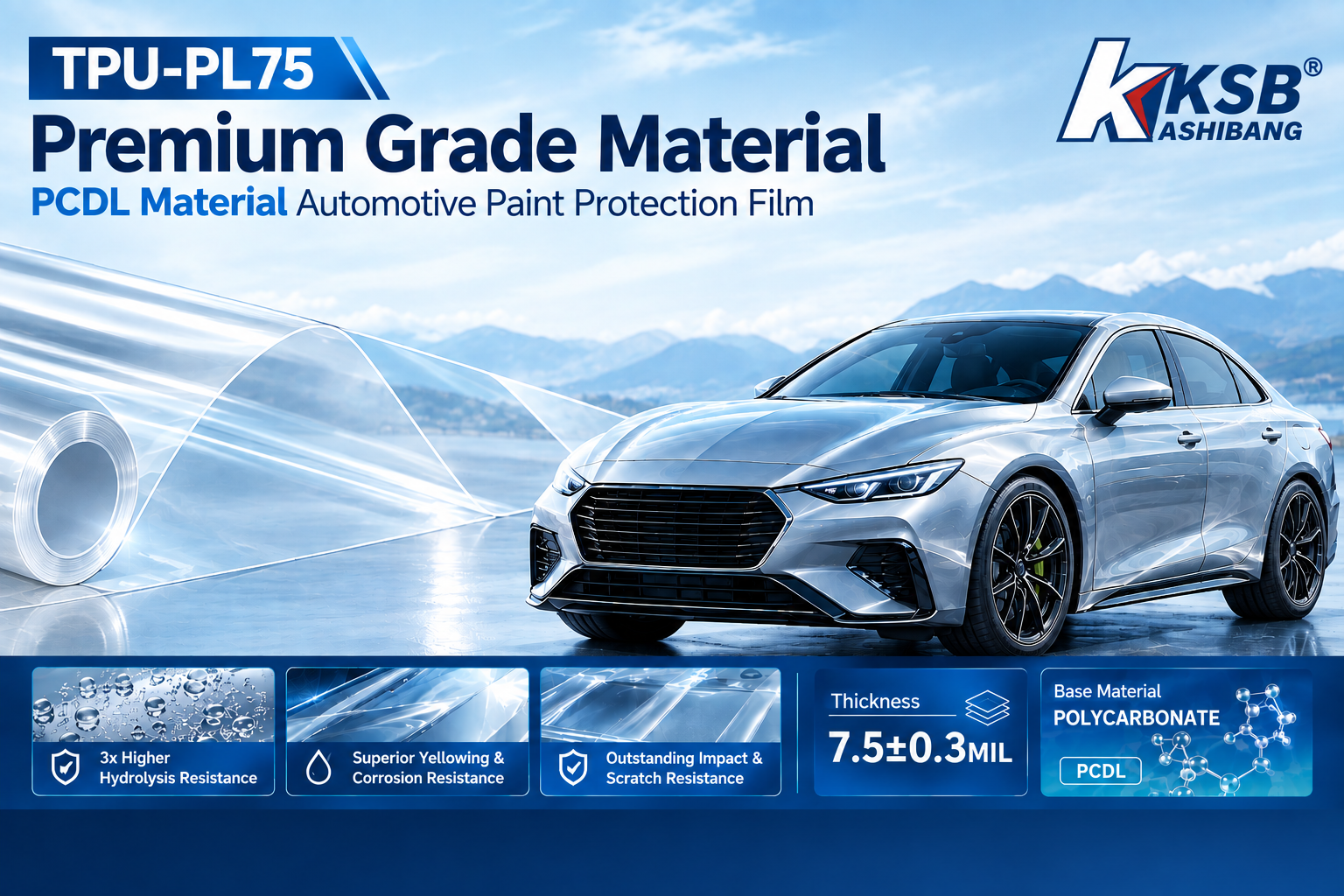
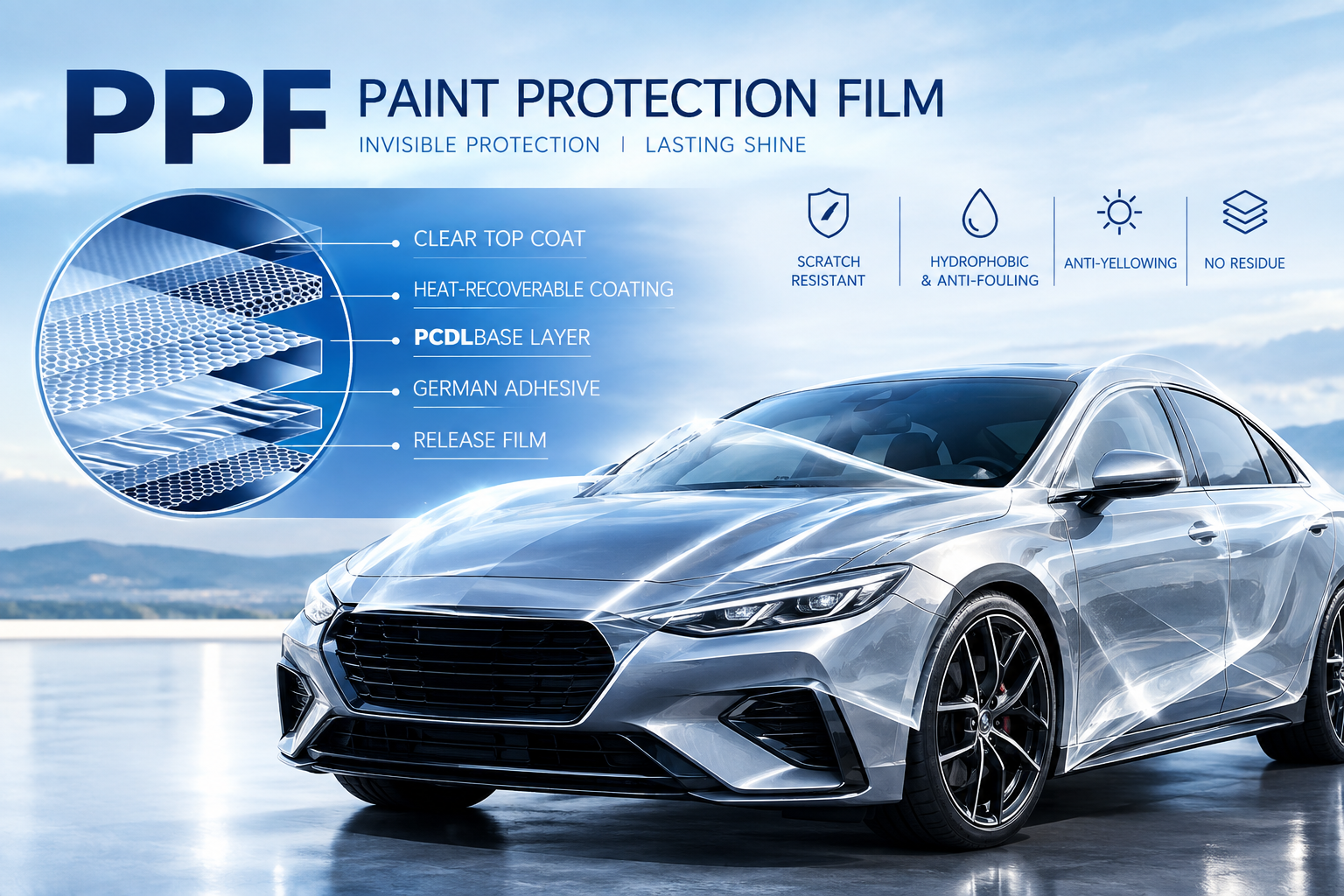
KSB PL75 provides a practical example of evaluating a film by its complete construction rather than by the PCU label alone.
The current PL75 specification identifies:
1. Protective film
2. Self-healing topcoat
3. PCDL-based TPU substrate
4. German adhesive system
5. Release liner
Published product data includes:
| Specification | KSB PL75 |
| Product thickness | 7.5 plus or minus 0.3 mil |
| Tensile strength | 32.8 MPa |
| Elongation | 350 percent |
| Gloss | At least 98 |
| Surface | Hydrophobic |
| Recovery | Heat and self-healing |
| Warranty | 10 years under the stated warranty terms |
These values give a buyer more to review than the substrate name alone. They still need test methods, tolerance definitions, aging data, warranty conditions, and sample installation to be interpreted properly.
For example, 350 percent elongation indicates substantial extensibility, but the installer also needs to know how the film recovers and behaves under practical stretch. A gloss value of at least 98 is useful, but panel texture and haze should still be inspected. A 10-year warranty should be read for climate, installation, maintenance, coverage, and exclusions.
The same evaluation should be applied to every PPF, including KSB products.
A PPF Buyer Checklist
Before approving a product for distribution or private labeling, collect the following:
Product Documentation
• Full layer construction
• Substrate chemistry
• Total installed-film thickness
• Technical data sheet with test methods
• Safety and compliance documents required by the destination market
• Written warranty terms
Laboratory and Quality Data
• Tensile strength and elongation
• Gloss and haze
• Weathering conditions and before-and-after results
• Yellowing or color-change data
• Topcoat scratch, stain, and chemical tests
• Adhesive peel and aging behavior
• Lot and inspection records
Installation Evaluation
• Flat panel application
• Bumper or compound-curve application
• Repositionability
• Stretch and recovery
• Squeegee marks and lift lines
• Edge holding after settling
• Surface appearance under different lighting
• Removal test when relevant
No single result replaces the others. A strong PPF combines sound material selection, balanced layer design, repeatable manufacturing, and evidence from both testing and installation.
Frequently Asked Questions
What is the most important layer in PPF
There is no single answer. The substrate provides the mechanical foundation, the topcoat controls many surface properties, and the adhesive determines installation and bonding. A weakness in any one can limit the complete film.
Does thicker PPF mean better quality
Not automatically. Thickness can improve impact protection, but it may also affect conformability and installation. Layer quality, optical appearance, mechanical behavior, and consistency remain important.
Is PCDL based PPF always premium
PCDL-based TPU can be a premium substrate choice, but the label does not establish topcoat quality, adhesive performance, optical control, or durability on its own.
What PPF tests should a distributor request
Request mechanical, optical, topcoat, adhesive, weathering, humidity, chemical, and color-retention data with the test conditions. Combine the documents with real installation trials.
Can a warranty prove PPF quality
A warranty shows the supplier’s written commitment under defined terms. It does not replace test data or field evaluation. Review coverage, exclusions, climate limits, installation requirements, and the remedy offered.
Further Reading
On this site:
- How Paint Protection Film Is Manufactured — See how materials and production processes affect PPF quality.
- PPF Adhesive Explained: Why Glue Quality Matters — Understand how adhesive performance affects installation and durability.
- Decoding PPF Coating Film: Self-Healing vs. Instant-Healing Technology — Compare coating technologies and their impact on PPF performance.
- Yellowing Test Standards: What QUV Accelerated Weathering Tells B2B Buyers — Learn how accelerated weathering tests help evaluate long-term performance.
- How to Choose TPU for Paint Protection Film — Explore how TPU selection influences the properties of finished PPF.
Get a Free Sample or Quote
Looking for a reliable window film supplier? Contact us today for fast response and professional support.