When choosing automotive window film, most buyers look first at VLT, infrared rejection and UV rejection.
But these numbers do not tell the whole story.
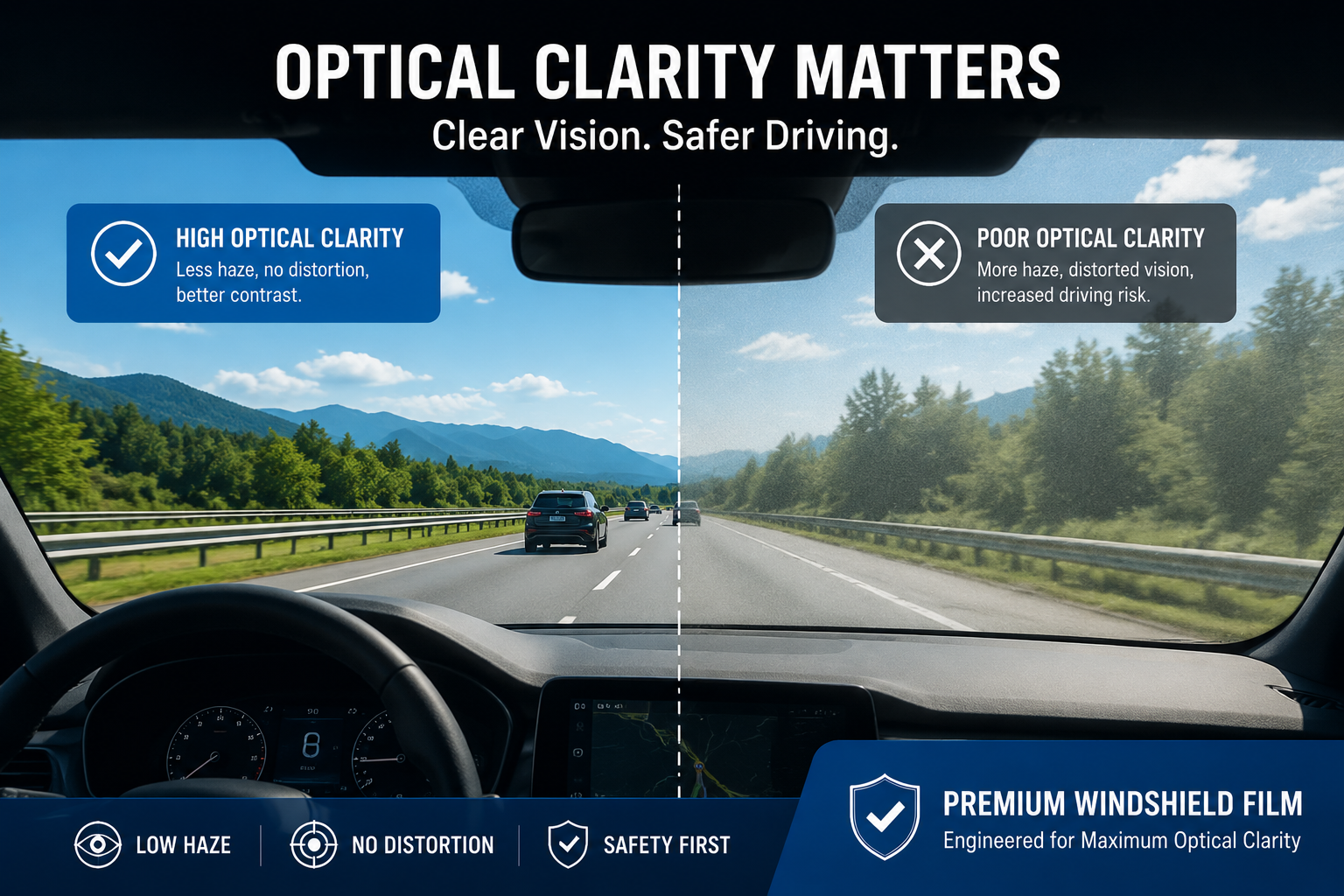
Two films with similar VLT and heat-rejection specifications can look noticeably different from inside the vehicle. One may provide a clean, natural view through the glass, while another can appear slightly hazy, especially at night, in rain or under strong sunlight.
This difference is largely related to the film’s optical clarity, haze, internal reflection, substrate quality and coating uniformity.
Cat Eye Window Film is designed around these optical characteristics.
Rather than referring to one specific film material, “Cat Eye” describes an optical-performance positioning focused on high clarity, low haze, reduced glare and comfortable visibility.
This means a Cat Eye Film can be made using nano ceramic technology or sputtering technology, depending on the required performance and product design.
In this guide, we’ll look at what Cat Eye Window Film is, how it works, and which specifications matter when evaluating it.
What Is Cat Eye Window Film?
Cat Eye Window Film is an automotive window film developed to combine solar control with improved optical clarity.
Its key characteristics typically include:
- Low haze
- High optical clarity
- Reduced internal reflection
- Infrared rejection
- UV protection
- Stable optical performance
One important distinction is that Cat Eye Film is not a single manufacturing technology.
Terms such as nano ceramic and sputtered film describe how the functional layers of a window film are produced.
“Cat Eye,” on the other hand, is used to describe the film’s visual and optical performance.
Therefore, both of the following are possible:
Nano Ceramic Cat Eye Film
and
Sputtered Cat Eye Film
The manufacturing technologies are different, but both can be engineered toward low haze and high visual clarity.
Why Does Cat Eye Film Look Clearer?
Clarity is not determined by VLT alone.
When light passes through automotive glass and window film, part of the light travels directly through the material while some is scattered or reflected.
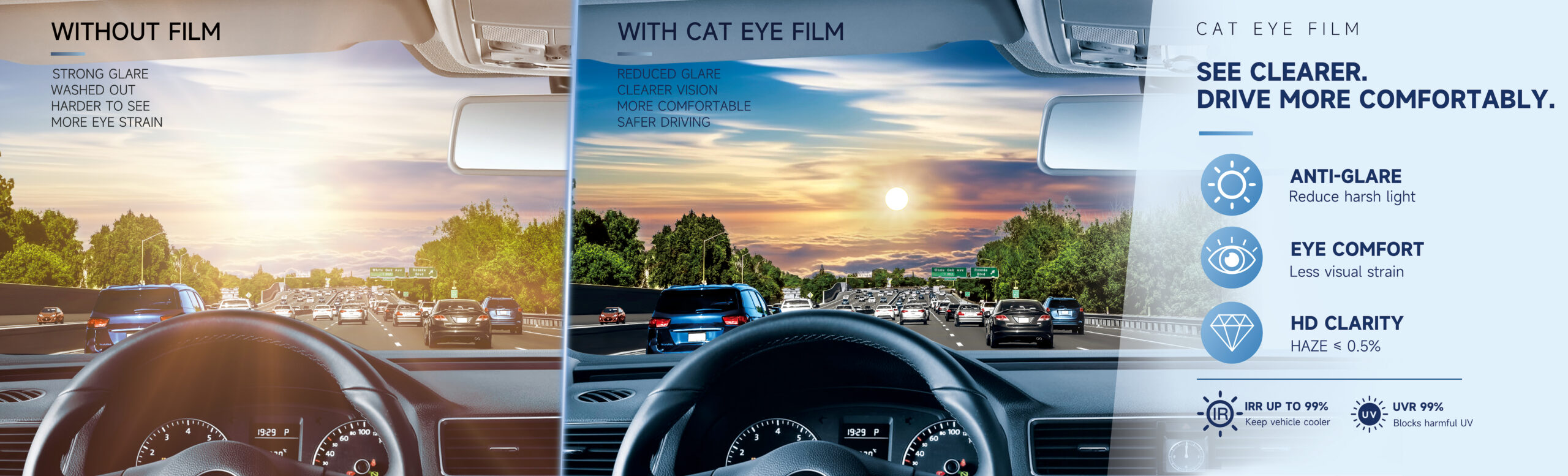
Excessive scattering can make the view appear slightly cloudy or washed out.
Internal reflection can create another problem: reflections from the dashboard, interior lights or other objects inside the vehicle may become visible on the glass.
For this reason, an ultra-clear automotive film needs to control several optical properties at the same time.
Three are particularly important:
Haze
Visible light transmission
Internal visible light reflection
This is also why simply comparing IR rejection percentages is not enough when evaluating a high-clarity automotive window film.
What Does ≤0.5% Haze Mean?
Haze is one of the most useful specifications for understanding the optical clarity of a window film.
In simple terms, haze measures the amount of transmitted light that becomes scattered as it passes through a material.
Higher haze means more light scattering.
Lower haze generally means a clearer view through the film.
For KSB Cat Eye Film, the finished film can achieve:
Haze ≤0.5%
The optical-grade PET substrate used for selected ultra-clear constructions can have a haze level below:
0.25%
But the substrate is only part of the equation.
Adhesive quality, functional particles, particle dispersion and coating uniformity can all influence the haze of the finished window film.
This is why haze should be evaluated on the complete film construction, not only on the PET base material.
Want to understand this specification in more detail?
Read: What Is Haze in Window Film and Why Does It Matter?
Internal link to your next Blog.
Haze and VLT Are Not the Same Thing
This is a common point of confusion when comparing automotive films.
VLT (Visible Light Transmission) measures how much visible light passes through the film.
Haze measures how much of that transmitted light is scattered.
They describe different optical properties.
For example, a high-VLT windshield film allows a large amount of visible light to pass through. But if the film has poor optical uniformity or relatively high haze, the view through the glass may still appear less clear.
Conversely, a darker film can have good optical clarity even though its VLT is lower.
So when sourcing a film for applications where visibility is important, buyers should consider VLT and haze together, rather than treating VLT as a measure of clarity.
How Does Nano Ceramic Cat Eye Film Work?
Nano ceramic window films use ceramic-based functional materials to control solar energy without relying on a conventional metallic appearance.
For an ultra-clear ceramic film, simply adding nano ceramic material is not enough.
The size and distribution of the functional particles matter.
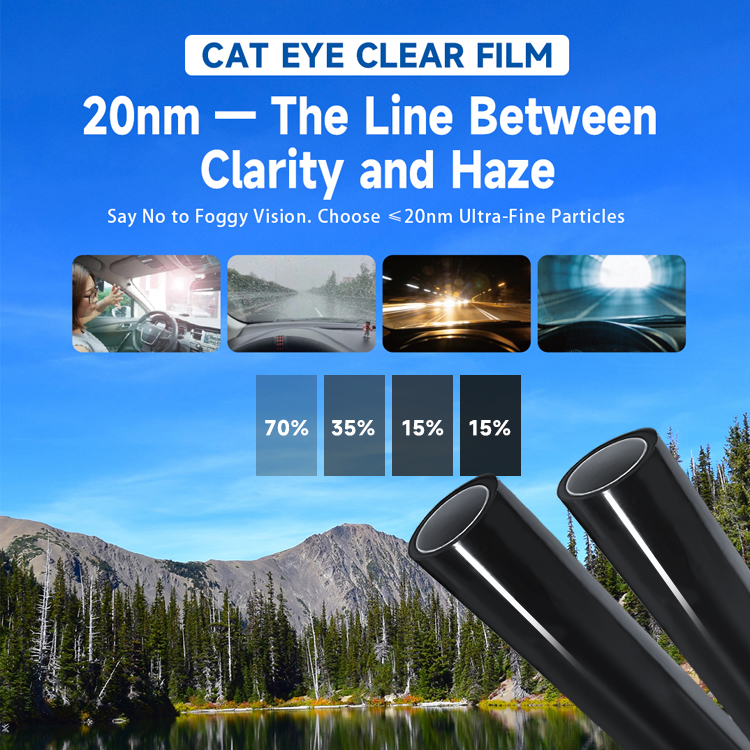
In selected KSB ultra-clear constructions, nano-scale functional materials with particle sizes below 20 nm are used together with controlled dispersion and precision coating processes.
The objective is to keep the functional material evenly distributed throughout the coating.
Why does this matter?
If particles or coating components are not uniformly dispersed, they can increase visible-light scattering and affect optical consistency.
A simplified structure looks like this:
Optical-Grade PET
↓
Nano-Scale Functional Material
↓
Controlled Nano Dispersion
↓
Precision Coating
↓
Reduced Light Scattering
↓
Low Haze + High Clarity
Particle size alone, however, should not be used to judge film quality. The final result also depends on dispersion, coating uniformity, PET quality, adhesive and the complete film construction.
Can Cat Eye Film Be Sputtered?
Yes.
A Cat Eye Film does not have to be ceramic.
Sputtering is another technology used to manufacture high-performance solar-control window films.
During sputtering, functional materials are deposited onto the film substrate in controlled layers. The resulting construction can be engineered for strong solar-control performance while maintaining good optical properties.
This gives manufacturers different ways to design a Cat Eye Film depending on the required balance between:
VLT
IR rejection
TSER
Reflectivity
Appearance
and optical clarity.
For example, KSB currently offers both ceramic and sputtered constructions within its ultra-clear automotive film range.
If you’re comparing these technologies for your product line, see:
Nano Ceramic vs. Sputtered Window Film: What’s the Difference?
Internal link to Blog #3.
Why Is Low Internal Reflection Important?
Haze is not the only factor that affects what a driver sees through automotive glass.
Internal reflection also matters.
At night, light from the dashboard, center display or other illuminated surfaces inside the vehicle can reflect from the glass.
During daytime driving, strong ambient light can also make reflections more noticeable.
For selected Cat Eye Film constructions, visible-light internal reflectance can be controlled to approximately:
6%
Reducing internal reflection helps minimize distracting reflections while maintaining a more natural view through the glass.
This characteristic is particularly relevant for applications where visual quality is a priority, including windshield and front-side-window installations where permitted by local regulations.
What About Heat Rejection?
Optical clarity does not mean giving up solar-control performance.
Depending on the construction and VLT, KSB Cat Eye Film options can provide:
IRR up to 99%
UVR up to 99%
along with different levels of total solar energy rejection.
However, there is an important distinction buyers should understand:
IRR is not the same as TSER.
IRR measures infrared rejection according to a specified test method or wavelength range.
TSER (Total Solar Energy Rejected) describes the proportion of total incident solar energy rejected by the glazing system under the applicable measurement method.
Therefore, a film advertised with “99% IR rejection” should not automatically be interpreted as rejecting 99% of total solar heat.
For professional buyers, comparing VLT + IRR + TSER + haze + reflectance provides a much more useful picture of overall film performance.
Where Is Cat Eye Window Film Used?
Cat Eye Film is especially relevant when the customer wants solar control without noticeably compromising visibility through automotive glass.
Typical applications include windshields, front side windows, rear side windows, sunroofs and premium automotive tinting packages, subject to local automotive tint regulations.
Windshield applications place particularly high demands on optical quality because the driver constantly looks through the glass.
Small differences in haze, distortion or internal reflection that may be less noticeable on rear glass can become much more apparent when looking through a windshield for long periods.
This is why high-VLT windshield films should not be evaluated only by their light transmission and IR rejection numbers.
Optical quality matters too.
Cat Eye Film vs. Regular Nano Ceramic Film
The two terms should not be treated as direct opposites.
A Cat Eye Film can itself be a nano ceramic film.
The difference is mainly in how the product is positioned and what optical characteristics are emphasized.
| Feature | Standard Nano Ceramic Film | Cat Eye Film |
|---|---|---|
| Ceramic technology | Common | Available |
| Sputtered construction | Not typically described as ceramic | Available |
| Heat rejection | Important | Important |
| UV rejection | Important | Important |
| Haze | Varies by construction | Key specification |
| Optical clarity | Varies | Primary design focus |
| Internal reflection | Varies | Important design consideration |
| Windshield visibility | Product-dependent | Key application consideration |
So a more useful question is not:
“Is Cat Eye Film better than ceramic film?”
but:
“What technology and optical specifications does this particular Cat Eye Film use?”
What Should Professional Buyers Check?
If you’re sourcing ultra-clear automotive window film for distribution, private labeling or professional installation, don’t evaluate the product from one headline number.
Ask the supplier for the complete specification sheet.
At minimum, compare VLT, haze, UVR, IRR, TSER, visible-light reflectance, film thickness and warranty.
For high-clarity products, also ask about the PET substrate and finished-film haze rather than relying only on terms such as “HD,” “ultra clear” or “nano.”
Physical samples are equally important.
A useful evaluation should include viewing the installed film under daylight, direct sunlight, nighttime lighting and wet/rainy conditions, rather than judging clarity only from a small sample indoors.
For distributors building their own automotive film range, this also makes it easier to determine whether different VLT options deliver consistent appearance and optical quality across the series.
KSB Cat Eye Window Film Options
KSB develops automotive window films for distributors, wholesalers and private-label brands.
Our current Cat Eye Film range includes both sputtered and ceramic constructions, with multiple VLT options for different markets and automotive applications.
Selected specifications include:
VLT: approximately 4%–76%
IRR: up to 99%
UVR: up to 99%
Haze: approximately 0.41%–0.68%, depending on model
Thickness: 2 mil
Standard Size: 1.52 × 30 m
Warranty: up to 8 years
For projects requiring particularly low haze, KSB can recommend suitable constructions based on the required VLT, heat-rejection target and application.
For distributors and private-label buyers:
Contact KSB for the full specification sheet, available VLT options, sample testing and OEM/private-label information.
CTA: Request Specifications & Samples
FAQ
What is Cat Eye Window Film?
Cat Eye Window Film is an automotive window film positioned around high optical clarity, low haze, reduced glare and solar-control performance. It is not limited to one manufacturing technology.
Is Cat Eye Film nano ceramic?
It can be. Some Cat Eye Films use nano ceramic technology, while others use sputtered constructions. “Cat Eye” describes the intended optical-performance characteristics rather than a single material category.
What does 0.5% haze mean in window film?
Haze measures transmitted-light scattering. A haze value of 0.5% means a small proportion of transmitted light is being measured as scattered under the applicable test method. Lower haze generally contributes to clearer visibility, although overall optical quality also depends on the complete film construction.
Is VLT the same as clarity?
No. VLT measures the amount of visible light transmitted through the film, while clarity is also influenced by haze, distortion, reflection and coating quality.
Is Cat Eye Film suitable for windshields?
High-clarity, high-VLT versions can be designed for windshield applications. Actual installation requirements depend on local laws governing windshield tint and visible light transmission.
Does 99% IR rejection mean 99% heat rejection?
No. IRR and TSER measure different aspects of solar-control performance. Professional buyers should review both values and the test conditions when comparing films.
Is ceramic or sputtered Cat Eye Film better?
They are different film technologies and can be designed for different performance requirements. Buyers should compare the complete specifications—including VLT, haze, IRR, TSER, reflectance and appearance—rather than choosing based only on the technology name.
Further Reading
On this site:
- What Is Nano Ceramic Window Film?— Understanding nano ceramic technology, performance, and key benefits
- Window Film Market Trends in 2026— Key market developments, product trends, and industry opportunities
- Top 7 Window Film Manufacturers in China (2026 Verified List)— Verified guide to leading window film manufacturers in China
- Top Questions to Ask Before Choosing a Window Film Supplier— Key questions for evaluating window film suppliers and product quality
Looking for Ultra-Clear Automotive Window Film?
If you are a window film distributor, wholesaler, automotive tint brand or professional installer, KSB can provide Cat Eye Film in different VLT and technology options for your market.
Available support includes product samples, technical specifications, wholesale supply and OEM/private-label solutions.
Request a Cat Eye Film Sample
Compare the clarity, haze and appearance before choosing the right series for your market.
Get a Free Sample or Quote
Looking for a reliable window film supplier? Contact us today for fast response and professional support.