Last updated: May 28, 2026 | Reading time: ~10 minutes
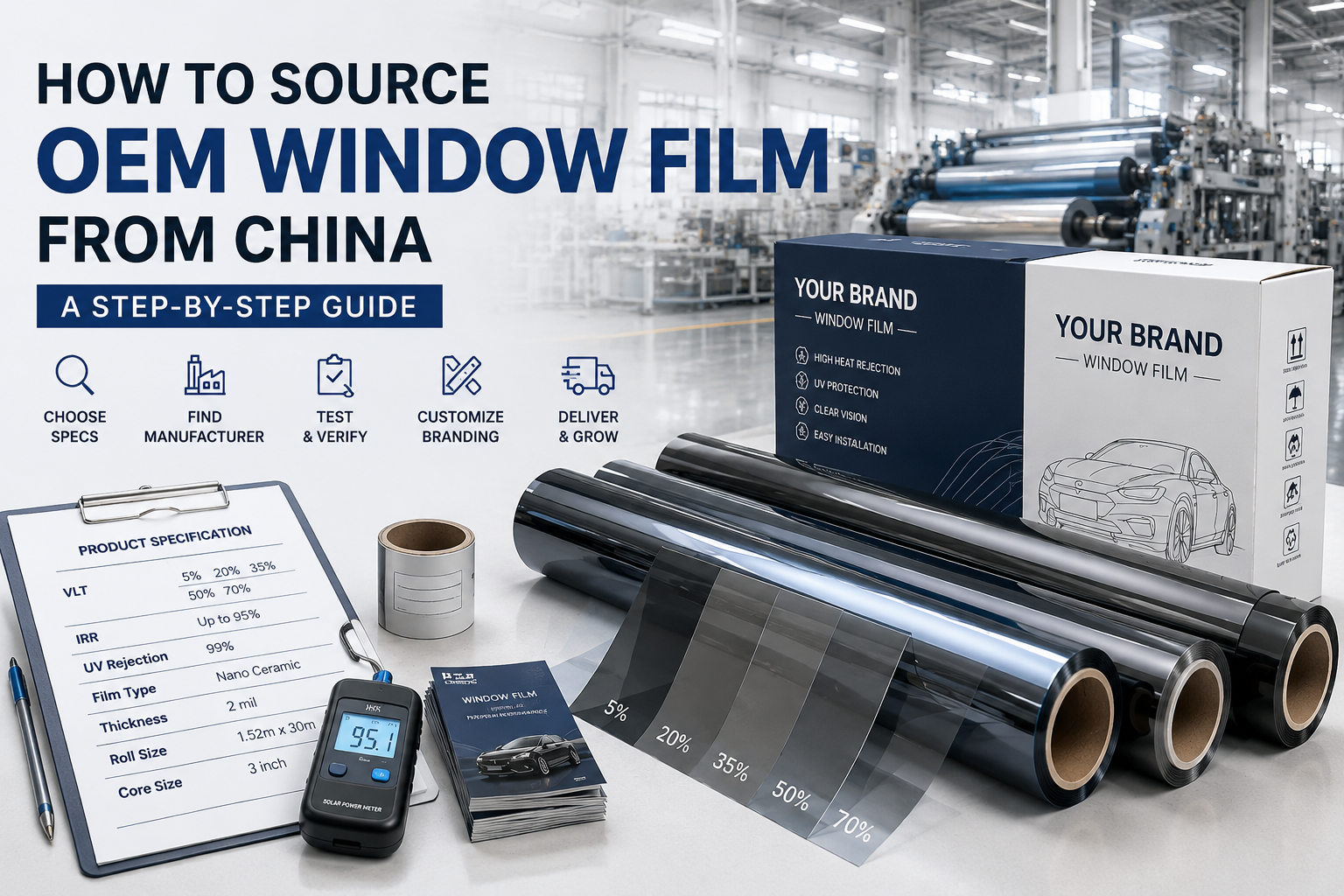
A lot of distributors start the same way: they find a decent product, sell it under a supplier’s brand, and do fine — until a competitor shows up with the exact same film at a lower price, or the supplier raises MOQs, or the relationship just quietly stops working. At that point, the idea of having your own brand starts to feel less like a luxury and more like something you should have done two years ago.
OEM window film is not complicated. But there’s a gap between “I want my logo on the box” and actually building a private-label product line that holds up — consistent specs, reliable supply, packaging that doesn’t look like it was designed in five minutes. This guide walks through how to do it properly.
What OEM Window Film Actually Means
OEM stands for Original Equipment Manufacturer. In the window film context, it means a factory produces film to your specifications and ships it under your brand — your logo, your packaging, your product names, your spec sheets. You own the brand relationship with your customers. The factory stays invisible.
This is different from white-label, where the factory has a standard product and you just put your sticker on it. True OEM gives you more control: you can request specific VLT values, adjust adhesive formulations, choose core sizes, specify roll lengths, and design packaging from scratch. White-label is faster to start but limits how differentiated your product actually is.
For most distributors and regional importers, the right answer sits somewhere in between — a factory that will customize within its existing product range rather than engineer something from the ground up. That’s realistic, cost-effective, and still gives you enough differentiation to build a real brand.
Step 1: Get Clear on What You Actually Need
The most common mistake at this stage is going to a factory with “I want a ceramic film” and expecting them to fill in the rest. The more specific you are upfront, the fewer surprises later.
Work out your product spec before you contact anyone:
- VLT (Visible Light Transmission): What percentage of visible light do you want the film to pass? Common grades in automotive are 5%, 20%, 35%, 50%, 70%. For architectural, you might need 10%, 30%, 50%, 65%, plus a clear safety film at 90%+.
- IRR (Infrared Rejection): What heat rejection performance do you need to claim? This drives a lot of purchasing decisions in hot climates. Know whether you’re selling on VLT or on IRR.
- Film type: Dyed, carbon, ceramic, nano-ceramic, hybrid. This affects price tier, performance, and what customer segment you’re targeting.
- Roll dimensions: Width (standard automotive is 0.5m and 1.52m; architectural typically 1.52m) and length per roll. Decide based on how your customers install and what’s standard in your market.
- Core size: 3-inch and 1.5-inch cores are most common. Ask what installers in your market prefer.
- UV rejection: Most quality films hit 99%+. If yours doesn’t, that’s a conversation with your factory.
Write this down as a rough spec sheet before you send a single inquiry. It signals to the factory that you’re a serious buyer and cuts through a lot of back-and-forth.
| Film Type | Heat Rejection | Clarity | Price | Typical Market |
| Dyed | Low | Medium | Low | Entry |
| Carbon | Medium | Good | Medium | Mid-range |
| Nano Ceramic | High | Excellent | High | Premium |
Step 2: Find Manufacturers Worth Talking To
Not every factory that says “OEM available” actually has the capability to deliver it well. Here’s how to separate the real ones from the noise.
Factory vs. trading company: This matters more for OEM than for standard wholesale. A trading company can sell you film, but they can’t modify a formulation, solve a production consistency issue, or give you honest lead times when capacity is tight. For OEM, you need a direct relationship with the people who actually make the film.
How to tell the difference: ask for their factory address, look it up on Google Maps, ask for photos of their production line. A factory will answer these questions without hesitation. A trading company will hedge.
Production capability to verify:
- Do they run their own sputtering or coating lines, or do they buy substrate and add adhesive only?
- What’s their annual production capacity? (This affects whether they can scale with you)
- Do they have an in-house QC lab with spectrophotometers and adhesion testing equipment?
OEM-specific questions to ask early:
- What’s the minimum order quantity for OEM (typically higher than standard wholesale)?
- Can you provide custom packaging design, or do I need to supply print-ready artwork?
- What’s the lead time from spec confirmation to first shipment?
- Have you done OEM for buyers in my market/region before?
That last question isn’t about references — it’s about whether they understand local market requirements, like whether European buyers need REACH documentation or whether certain Middle East markets have import labeling requirements.
Step 3: Request Samples and Test Them Properly
Anyone can send you a sample. The question is whether you actually test it or just look at it and decide it seems fine.
What to test before committing to OEM production:
- VLT: Verify with a light transmission meter, not by eye.
- IRR performance: Use a solar spectrum meter or send to a third-party lab. This is the number you’ll be putting on your packaging — make sure it’s real.
- UV rejection: Most quality films are 99%+. If a supplier’s sample doesn’t hit this, that’s a hard pass.
- Adhesive quality: Apply to glass and check for bubbles, edge lifting, or inconsistent coverage. Let it sit for a few days and check again.
- Scratch resistance: Run a fingernail across the coated surface. Not scientific, but it tells you something about surface hardness.
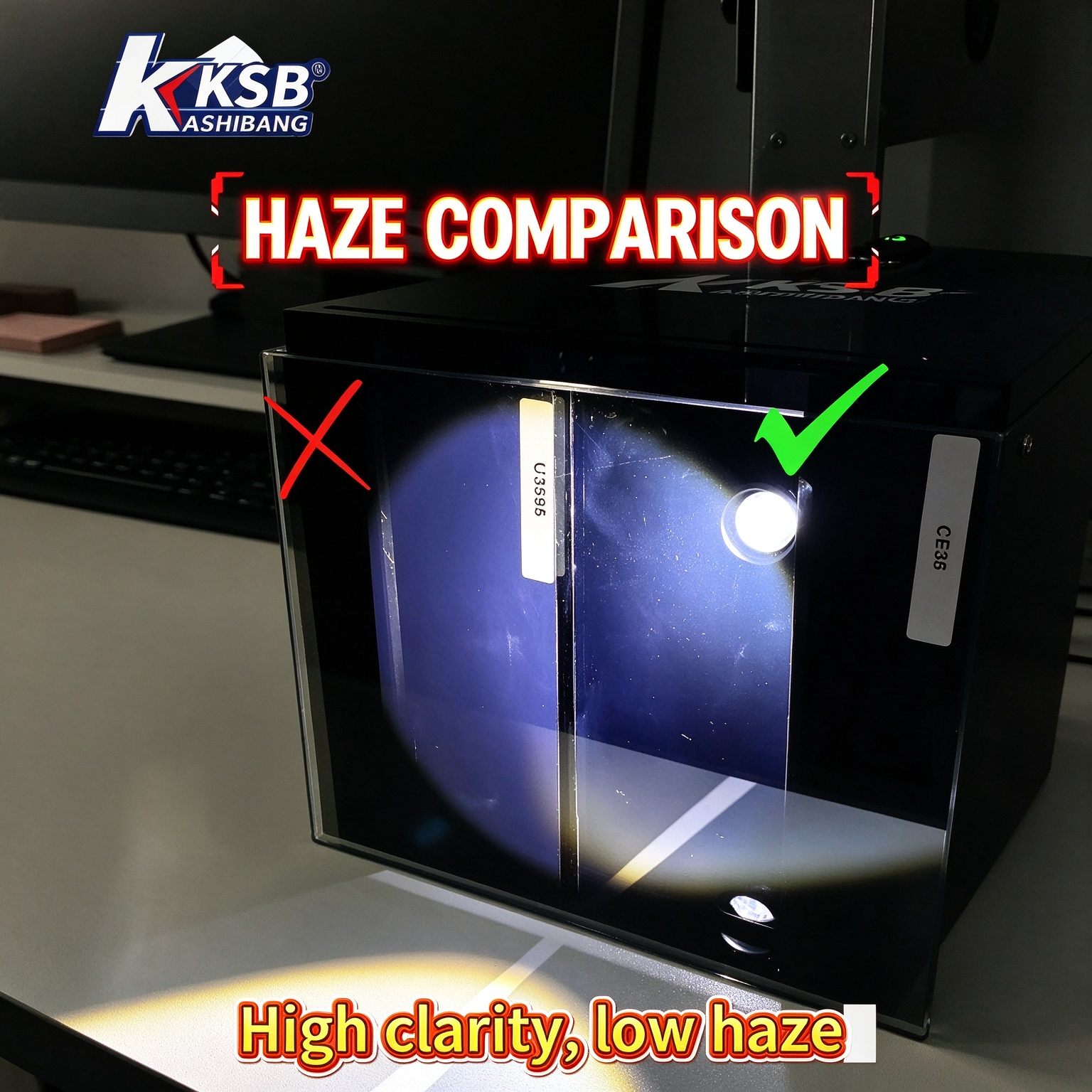
- Clarity and haze: Look through the film at a light source. Haze is more obvious on lighter VLT films. A little is normal; a lot means the coating isn’t right.
If you’re moving to OEM at meaningful volume, spending $200–400 on a proper third-party lab test (SGS, Intertek, BV) is worth it. You’ll have documentation to back your product claims, which matters when a customer or their insurance company asks questions.
Test multiple batches if you can. One good sample doesn’t mean the production line is consistent. Ask for samples from two different production runs if possible.
Step 4: Negotiate MOQ, Pricing, and Payment Terms
OEM pricing works on volume tiers. The factory has setup costs — configuring the line to your spec, printing your packaging, programming your label run — that need to be amortized across the order. This is why OEM MOQs are higher than standard wholesale.
Typical OEM minimums from China factories: Usually 500–2,000 rolls per SKU for packaging customization, sometimes lower if you’re sharing a packaging run with other buyers. Confirm what “OEM” specifically includes in the price — sometimes packaging printing is quoted separately.
On pricing: Don’t negotiate purely on unit price. The factors that actually determine whether you’re getting a good deal:
- Is this FOB or CIF? (FOB means you handle shipping; CIF means factory does and builds it into the price)
- What’s included in the per-roll price — packaging, cores, inner wrap?
- What’s the re-run lead time when you reorder? (First order is always slower)
- Are there tooling or setup fees for packaging dies or print plates?
Payment terms: Most China manufacturers want 30% deposit on order confirmation, 70% before shipment. As the relationship matures, you may be able to negotiate 30/70 with the balance on Bill of Lading. Full upfront payment on a first OEM order from a new factory is not standard — if they insist, that’s worth noting.
Step 5: Get Your Packaging and Branding Right
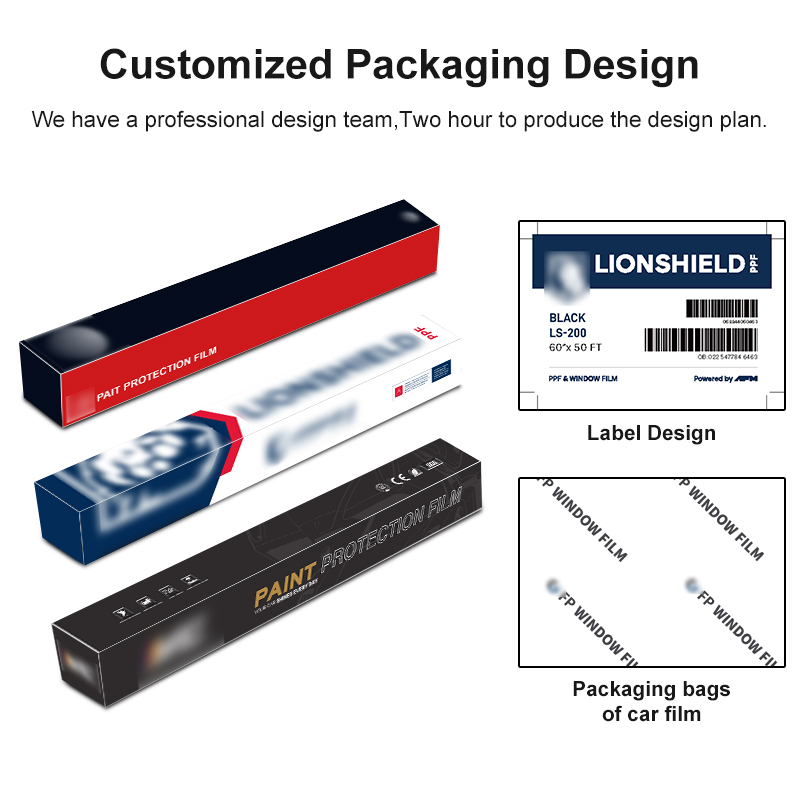
This step gets underestimated constantly. The packaging is the first thing your customer’s customer sees when they open a box. If it looks cheap or generic, it affects how they perceive the film before they’ve even installed it.
What to design:
- Core label: The label on the roll itself, visible when the outer box is opened. Needs brand name, product name, VLT, roll dimensions, production/expiry info.
- Outer box: Your logo, product line branding, key performance claims (IRR%, UV%, warranty), installation notes, and any certifications you’re authorized to display.
- Inner packaging: Some buyers add a shrink wrap or inner wrap with a brand label. Optional but adds perceived quality.
Work with your factory on print specs early. Chinese factories typically print in CMYK, and colors can shift between your screen, your proof, and the final print run. If brand color accuracy matters to you, ask for a printed proof before approving the full run.
A practical note on artwork: Provide print-ready files (PDF or AI format) with bleeds and crop marks. If you hand your factory a JPEG logo and ask them to “do something with it,” the result will match that level of effort.
Step 6: Confirm Your Compliance and Documentation Requirements
This depends heavily on where you’re selling, but don’t skip it.
For European markets: REACH compliance documentation is often required for film adhesives and coatings. If you’re selling into the EU, ask for REACH-compliant certification explicitly — not just an ISO certificate.
For Australian and New Zealand markets: AS/NZS standards apply to certain architectural film applications. Know before you label.
For the U.S. market: NFRC certification matters for architectural film in commercial glazing projects. It’s not required for all applications, but it opens doors in the commercial segment.
For all markets: Ask the factory for a current ISO 9001 certificate (check the expiry date), any relevant SGS or third-party test reports, and an MSDS/SDS for the product (required for import in many countries).
Keep copies of all of this. If customs holds a shipment or a customer asks for documentation, you want to be able to produce it same day, not start chasing a factory contact in a different time zone.
Step 7: Place Your First Order and Plan the Relationship
The first OEM order is always the most logistically intensive. Lead times are longer, communication is heavier, and you’ll likely catch a few things that need adjusting for the second order. This is normal.
Build in a proper QC step before shipment. Request a pre-shipment inspection — either your own agent in China or a third-party inspection service. For a first OEM run, this is worth the cost. Check that the packaging matches your proof, the rolls match your spec, and the count is right.
Set expectations on reorder cycles. The factory needs lead time to run your order — typically 3–6 weeks depending on their current capacity and your packaging complexity. Don’t wait until you’re out of stock to reorder. Once you know your monthly sell-through, build a reorder trigger at 2–3 months of inventory.
Treat it as a partnership, not a transaction. The factories that go out of their way for OEM customers — faster turnaround, flexibility on small reorders, heads-up when there’s a raw material issue — do so because the relationship is worth it to them. That relationship is built by communicating clearly, paying on time, and not disappearing between orders.
What to Look for in an OEM Partner Specifically
To summarize the most important factors, and be direct about it:
You want a factory that makes the film, not one that sources it. You want someone with in-house coating or sputtering lines, not just a lamination operation. You want documentation on file — test reports, certifications — not promises that they exist. And you want a contact who can answer technical questions directly, because when something goes wrong with a batch (and at some point it will), you need to solve it fast.
KSB Window Film ticks these boxes for most OEM buyers in the distributor and importer segment. Factory-direct in Dongguan, full product range across automotive, architectural, PPF and smart film, OEM and private-label capability with custom packaging, and test reports available before you commit to an order. Free sample rolls for qualified buyers.
If you’re at the point where you’re seriously evaluating OEM, the fastest next step is a conversation about specs and MOQ — not a brochure.
→ Start the conversation: Contact KSB here
Typical response time: within 24 hours.
Quick Reference: OEM Window Film Checklist
Before placing your first OEM order, confirm you’ve covered:
- [ ] Written product spec (VLT, film type, roll dimensions, core size)
- [ ] Confirmed factory is direct manufacturer, not trading company
- [ ] Received and tested physical samples
- [ ] Third-party test report obtained (or planned)
- [ ] Packaging artwork finalized and proof approved
- [ ] Compliance documentation confirmed for your target market
- [ ] MOQ, pricing, and payment terms agreed in writing
- [ ] Pre-shipment inspection planned for first order
- [ ] Reorder cycle mapped to your sell-through rate
FAQ
1. What is the difference between OEM and private label window film?
OEM window film allows buyers to customize specifications, packaging, and branding, while private label usually uses existing factory products with only logo or packaging changes.
2. How long does OEM window film production usually take?
Most OEM window film orders require around 3–6 weeks for production depending on film type, packaging complexity, and order quantity.
3. Can I order custom packaging for small OEM quantities?
Some manufacturers support flexible OEM packaging for smaller trial orders, but fully customized packaging usually requires higher MOQ levels.
KSB Window Film (Kashibang) is a window film manufacturer based in Dongguan, Guangdong, China. This guide is written from the perspective of a manufacturer and reflects our experience working with OEM buyers across multiple markets.
Get a Free Sample or Quote
Looking for a reliable window film supplier? Contact us today for fast response and professional support.