How to Identify Real TPU from Fake TPH/PVC Paint Protection Films
Published: July 24 2026 · 8 min read · Category: PPF Quality
About this article: KSB Window Film manufactures genuine aliphatic TPU paint protection film. As a manufacturer, we regularly receive inquiries from importers who’ve been burned by counterfeit or misrepresented PPF. This guide gives four practical field tests that any buyer can use before placing a bulk order.
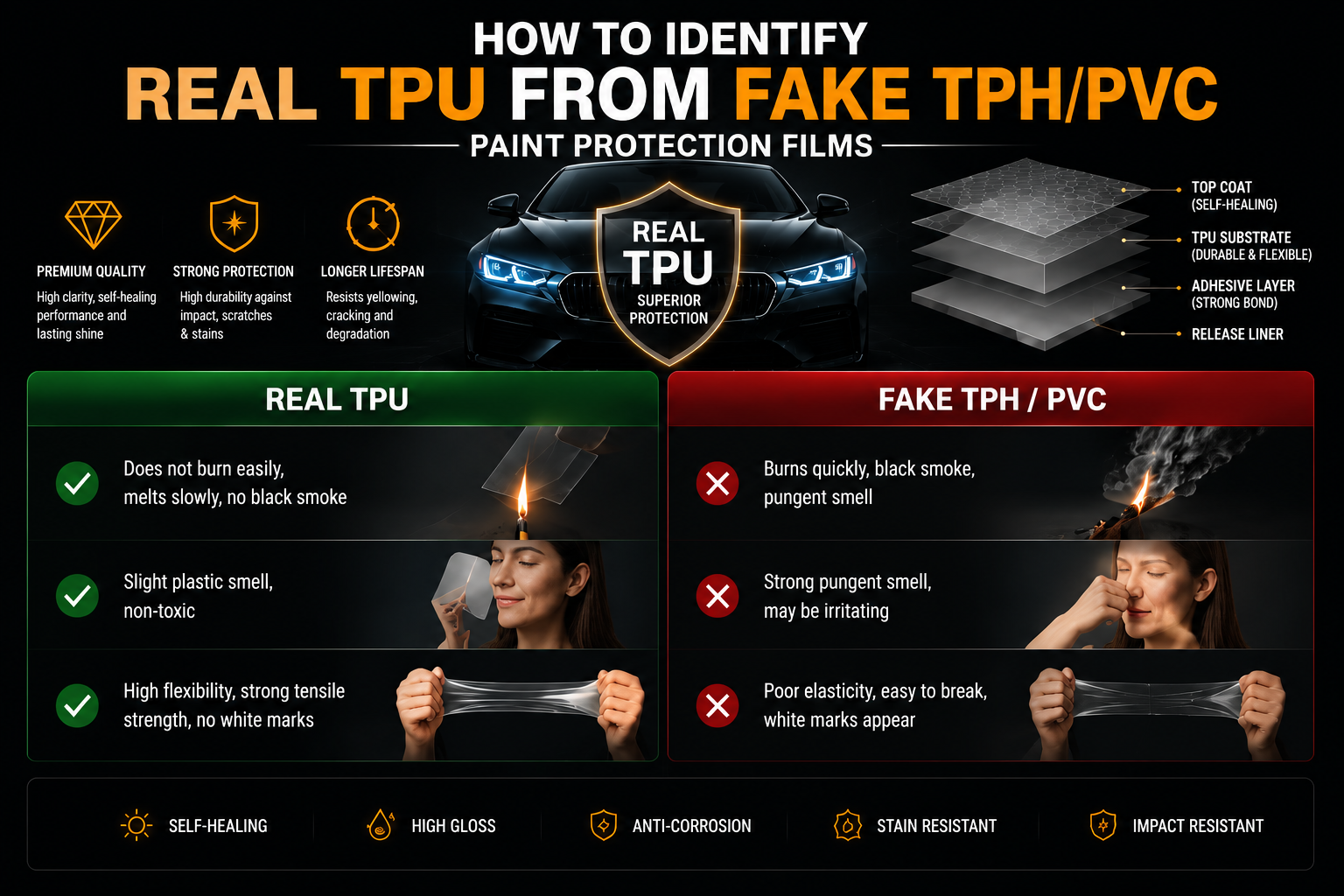
Visual comparison of real TPU paint protection film versus fake TPH/PVC alternatives for automotive protection.
The PPF market has a problem: the term “TPU paint protection film” is applied to products that range from genuine aliphatic thermoplastic polyurethane — a high-performance, UV-stable, self-healing material — to PVC (polyvinyl chloride) or TPH (thermoplastic hybrid, a marketing term with no standard definition) products that are significantly inferior but priced to appear equivalent.
The distinction matters enormously for your business. A buyer who imports 500 rolls of film marketed as “8mil TPU PPF” and actually receives PVC or aromatic-TPU film will discover the fraud through customer complaints at 12–24 months post-installation — after warranty obligations are in effect.
These four tests can be conducted on a sample roll in any installation shop without laboratory equipment.
Why Counterfeiting Happens in PPF
The price argument: Quality aliphatic TPU costs 50–100% more per kilogram than PVC or aromatic TPU. A manufacturer replacing genuine TPU with PVC can produce at dramatically lower cost while selling at TPU prices.
The visual similarity: Fresh from the roll, genuine TPU, aromatic TPU, and PVC all look similar — clear, slightly yellowish, with a self-adhesive backing. The differences emerge over time with UV exposure, but a buyer hasn’t seen the 18-month result when they’re evaluating a fresh sample.
The specification problem: “TPU” appears on the product label and invoices. Without chemical testing, this claim is unverifiable from the outside. The four tests below change this.
Test 1: The Stretch and Recovery Test
Basis: Genuine aliphatic TPU is highly elastic — it can be stretched significantly and recovers to its original length quickly. PVC is less elastic and recovers more slowly. TPH materials vary.
Procedure:
Cut a 25cm strip of PPF from the sample roll
Gently stretch it to approximately 150% of original length (pull to 37.5cm)
Hold for 5 seconds
Release
Results interpretation:
Genuine aliphatic TPU: Rapid, complete recovery to original length within 3–5 seconds. You can feel the elastic spring-back.
Aromatic TPU: Similar recovery but may be slightly slower
PVC: Slow, incomplete recovery. The strip remains stretched, showing permanent deformation. May feel stiffer and less elastic in the stretch.
Enhanced version: Use a ruler and measure the length 30 seconds after release. Genuine TPU recovers to within 5% of original length. PVC typically remains 10–25% longer than original.
Test 2: The Burn Test
Basis: Different polymers burn and melt differently. TPU and PVC have distinct combustion behaviours that are recognisable with practice.
Safety: Conduct outdoors or with good ventilation. Use forceps to hold the sample. Have water available.
Procedure:
Cut a small (2cm × 2cm) piece of PPF, remove the release liner
Hold with metal forceps and ignite with a lighter
Observe flame colour, smoke colour, and drip behaviour
Remove from flame and observe extinction behaviour
Results interpretation:
Genuine TPU (aliphatic or aromatic): Burns with a blue flame with slight yellow at the tip. Black smoke. The melt drips and self-extinguishes relatively quickly when removed from the flame. Mild odour (not sharply chemical).
PVC: Burns with green-tinged flame (from chlorine). Dense black smoke. Acrid, sharp chemical odour (hydrogen chloride gas — note this is harmful in concentrated doses, ventilate well). May sputter. Does NOT self-extinguish readily when removed from flame.
Polyethylene (PE): Burns like a candle with a clean blue/yellow flame. Clear drips. Waxy odour. Very different from TPU.
Important: This test requires some practice to interpret consistently. Test known samples of genuine TPU first to calibrate your observation against a known reference.
Test 3: The Solvent Smell Test (Aromatic vs Aliphatic)
Basis: Aromatic TPU contains aromatic hydrocarbon chemistry that produces a faint sweet/aromatic odour when freshly cut or scratched. Aliphatic TPU has minimal odour.
Procedure:
Cut a fresh edge on the sample roll
Hold the cut edge close to your nose and breathe in
Alternatively, gently warm the cut edge with a heat gun (50°C surface) and smell
Results interpretation:
Aliphatic TPU: Very minimal odour — slight plastic smell at most. No sweet or aromatic chemical notes.
Aromatic TPU: A faint sweet, slightly amine-like chemical odour, particularly on fresh cuts or when warmed.
PVC: A distinct chemical odour, sometimes described as plasticky/vinyl. More pronounced when heated.
Limitation: This test is subtle and requires olfactory calibration against known reference samples.
Test 4: The Adhesive Residue Test
Basis: Quality aliphatic TPU PPF uses PSA adhesive formulated for clean removal. PVC and low-grade film adhesives tend to leave more residue.
Procedure:
Apply a 30cm × 30cm piece of the PPF to a clean painted surface or bare metal test panel
Wait 72 hours for adhesive cure
Remove the film by heating to 60°C surface temperature with a heat gun and peeling slowly at 45°
Results interpretation:
Quality TPU (with good PSA): Film removes cleanly in one piece. Little to no visible adhesive residue. Any trace residue removes with IPA wipe.
Low-quality adhesive (common with PVC or budget TPU): Adhesive transfers to the substrate, requiring aggressive residue removal. May leave a ghost pattern on the substrate.
What to Do If Tests Indicate Mismatch
If your samples fail one or more of these tests — particularly the stretch test (PVC behaviour) or the burn test (green flame or severe odour) — the material is likely not genuine TPU as described.
Next steps:
Request the TPU material safety data sheet from the supplier — it should identify the base polymer as polyurethane (not PVC or polyolefin)
Consider commissioning an independent laboratory test (FTIR spectroscopy identifies polymer type definitively — cost $100–$200 per sample)
FAQ
Can FTIR testing definitively identify TPU vs PVC?
Yes. Fourier Transform Infrared (FTIR) spectroscopy produces a molecular “fingerprint” that uniquely identifies polymer type. TPU and PVC have completely different FTIR spectra. This test can also distinguish aliphatic from aromatic TPU based on the diisocyanate fingerprint. Cost: $100–$200 per sample at commercial analytical labs.
What should I do if I’ve already ordered bulk product that fails these tests?
Document the failures with video/photos. Contact the supplier with the evidence. Request material SDS and test reports. If the supplier cannot provide documentation consistent with the marketed product, you have grounds for a commercial claim.
KSB Window Film provides TPU material SDS, FTIR test confirmation, and QUV data with every sample order. Our material is genuine aliphatic TPU — we welcome verification.