Published: June 22, 2026 · 8 min read · Category: Sourcing Guide
If you’ve spent any time requesting quotes from window film suppliers, you’ve already noticed it: two rolls of film with nearly identical spec sheets, one priced at $12 per roll and another at $38. Same dimensions, same stated VLT, same “nano-ceramic” label on the box.
The price difference is not a mistake. And it’s not always explained by brand markup.
Some of it reflects real differences in raw materials, manufacturing process, and quality control. Some of it reflects differences in supplier type and supply chain structure. And some of it — if we’re being honest — reflects the fact that window film pricing is opaque enough that both buyers and sellers have learned to exploit that opacity.
This guide breaks down exactly what drives price variation in window film, so you can tell the difference between a supplier charging more because the product is genuinely better and one charging more because they’re betting you won’t know the difference.
The Biggest Driver: Film Technology Tier
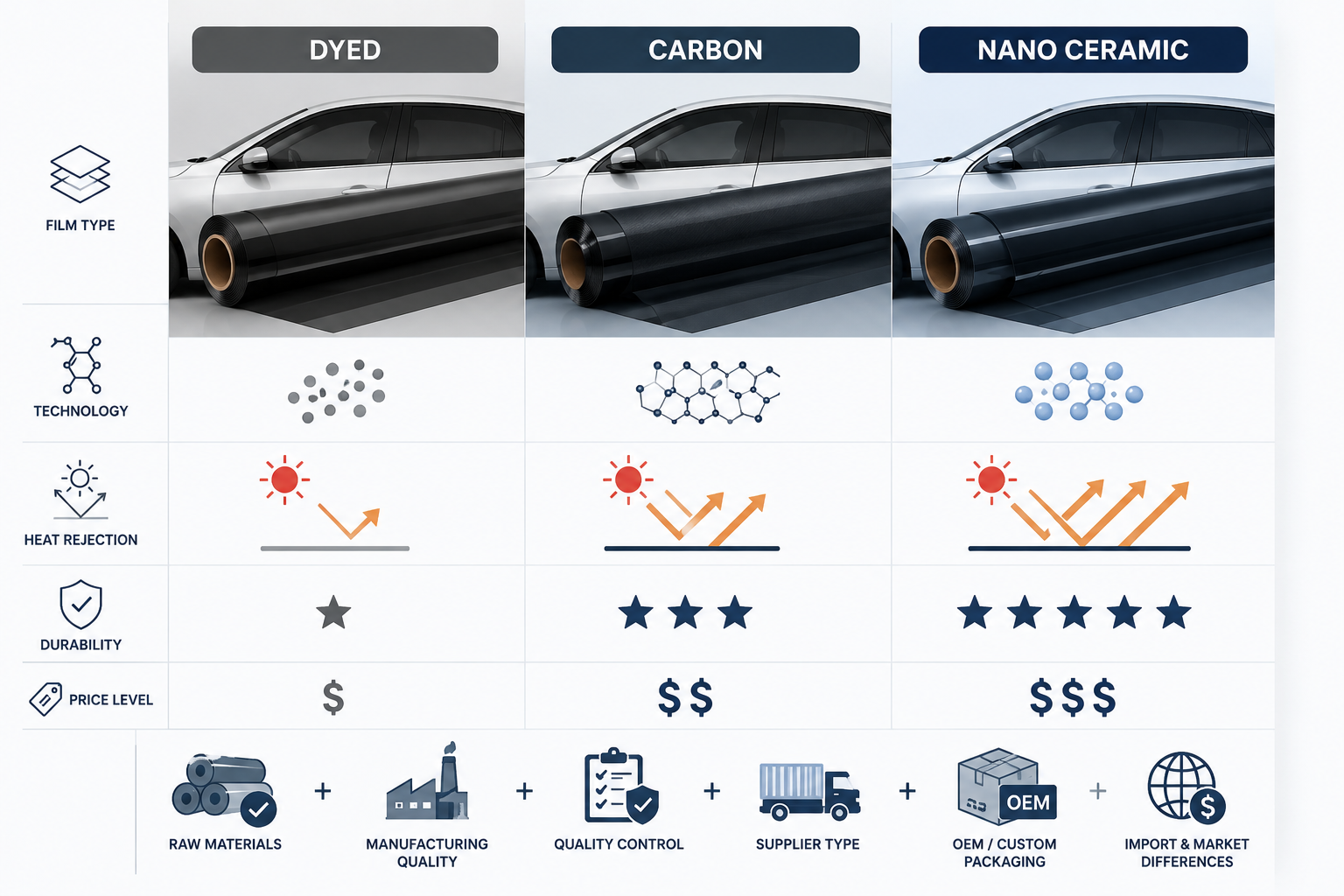
The single largest factor in window film pricing is what the film is made of and how it’s produced.
Dyed film sits at the bottom of the price range — not because it’s poorly made (a well-made dyed film outperforms a poorly made ceramic film), but because the manufacturing process is the least capital-intensive. No sputtering equipment. Lower raw material cost. The performance ceiling is also lower — dye-based films absorb rather than reflect heat, limiting IR rejection capability and long-term durability compared to higher tiers.
Carbon film sits in the mid-range. The carbon coating provides better heat rejection than dye alone, more stable color over time, and no signal interference from metallic content. Production involves more complex coating processes than dyed film, which is reflected in the price.
Nano-ceramic film occupies the premium tier. The ceramic nanoparticle technology — whether applied by sputtering or precision wet coating — requires significantly more sophisticated manufacturing capability, more expensive input materials (titanium nitride or similar ceramic compounds vs. organic dyes), and more rigorous process control to achieve consistent performance. These costs are real, and they show up in the price.
The problem: “Nano-ceramic” has become a marketing term that manufacturers apply to products at multiple price points, some of which don’t deliver nano-ceramic level performance. A film labeled nano-ceramic at $12/roll may have a thin, inconsistently applied ceramic layer that performs comparably to a quality carbon film — or less. Third-party test reports, not label copy, are the only way to know what you’re actually buying.
See How Nano Ceramic Window Film Is Made for the technical detail on what separates genuine nano-ceramic production from the label-only version.
Raw Material Quality
Within each technology tier, raw material selection creates meaningful cost and quality differences.
PET base film: Premium PET from Toray, SKC, or Mitsubishi Chemical costs more than generic domestic alternatives. The difference shows up in optical clarity, dimensional stability (the film stays flat and consistent during and after installation), and coating adhesion. Budget manufacturers specify whatever PET they can source at the lowest price. This choice is rarely disclosed in marketing materials but is easy to ask about directly.
Adhesive chemistry: This is where a lot of silent cost-cutting happens. Pressure-sensitive adhesive formulations span a wide price and performance range. A high-quality acrylic PSA with good UV stability, temperature resistance, and clarity costs more than a basic adhesive. The difference shows up in how the film installs, whether it develops edge lifting in temperature extremes, and whether it stays optically clear after years of exposure.
Hard coat formulation: The scratch-resistant coating on the exposed surface of the film affects how it handles cleaning and daily wear. Harder, more durable coatings cost more to apply and require more precise cure process control.
None of these material differences are visible in a catalog spec sheet, and few suppliers volunteer the information unprompted. But they explain a substantial portion of the price gap between otherwise similar-looking products.
Manufacturing Infrastructure and Process Control
A factory with a properly configured sputtering line, inline optical inspection systems, a functioning QC lab, and a documented quality management system is more expensive to operate than a factory without those things.
That cost is reflected in the product price — which means a supplier offering a significantly lower price for what appears to be the same product is either operating with lower-cost infrastructure, lower-cost materials, or lower process quality. Sometimes all three.
This isn’t an argument that you should always pay more. It’s an argument that you should understand what the price difference is buying you, specifically.
Questions that get at manufacturing quality without asking “why is your quality good?”:
- What’s your defect rate on finished rolls, and what’s your process when a roll fails final inspection?
- What inline monitoring do you use during the coating process?
- Can I see your QC lab and the equipment you use for in-house testing?
- How frequently do you sample production runs against your finished goods spec?
A factory that can answer these in operational detail has the infrastructure behind the price. One that gets vague is telling you something.
Supplier Type: Factory vs. Trading Company vs. Brand
Three layers of supply chain exist in the window film market, each with different cost structures.
Direct factory pricing removes the distributor margin. At sufficient volume, factory-direct pricing is almost always the lowest landed cost available. The tradeoff is higher MOQs, less flexibility in product range, and more responsibility on the buyer for managing the import process.
Trading company pricing adds a margin layer — typically 10–20% over factory cost — for the services the trading company provides: lower MOQs, broader range, export documentation management, English-language account management, and a buffer on quality issues. For buyers whose volume or bandwidth doesn’t justify direct factory relationships, this premium is often worth it.
Brand pricing adds another layer — for the brand equity, marketing, warranty infrastructure, and distribution network that established brands have built. When a professional installer in the US pays a premium for a major brand’s film versus a Chinese private-label equivalent, they’re partly paying for the product, partly for the brand’s certification and warranty structure, and partly for the fact that their customers recognize the name.
Understanding which layer you’re buying from helps you evaluate whether the price premium is justified for your specific use case.
Volume and Price Tiers
Window film pricing is volume-sensitive in ways that create significant unit cost variation even within the same supplier relationship.
A manufacturer might price a standard carbon automotive film as follows:
- 100 rolls: $11.20 per roll
- 300 rolls: $9.40 per roll
- 600 rolls: $8.10 per roll
- 1,200+ rolls: $7.20 per roll
A buyer ordering 100 rolls is paying 56% more per unit than a buyer ordering 1,200 rolls for what is, nominally, the same product. Both are paying the “right” price for their volume level — but when their products compete in the same market, their cost structures are entirely different.
This volume sensitivity is one of the core reasons larger distributors have structural margin advantages over smaller ones — not because they’re better at buying, but because their volume puts them in a different pricing tier. It’s also why getting the volume math right before you build your pricing model matters enormously.
Import Costs and Market Differences
The same film at the same FOB price can land at significantly different costs in different markets, because import duties, freight rates, and compliance costs vary.
US buyers have faced Section 301 tariffs on Chinese-manufactured goods, with window film affected at various rates depending on HS code classification. These tariffs can add 7.5–25% to the FOB cost — a 20% tariff on a $9/roll FOB price adds $1.80 per roll before you’ve paid freight or customs broker fees.
EU buyers have different duty structures and compliance costs (CE marking, REACH documentation) that affect the effective landed cost.
Australian buyers face their own tariff schedule and additional compliance considerations around AS 2080 for automotive applications.
Two buyers in different markets sourcing from the same supplier at the same FOB price may face landed costs that differ by 20–30% purely due to import cost differences. This is why landed cost — not FOB price — is the only basis for meaningful price comparison.
The full landed cost calculation methodology is in How to Compare Window Film Quotes from Different Suppliers.
OEM vs. Stock Pricing
Custom-branded or custom-specification products carry a premium over stock items for straightforward reasons: higher setup costs, dedicated packaging design and printing, potential product development costs for OEM specs, and lower effective production volumes per SKU.
The premium is typically 10–25% over equivalent stock product pricing, depending on the level of customization. At sufficient volume, this premium shrinks or disappears because the custom run amortizes setup costs over more units.
Private label (custom branding on a stock formulation) is the lower end of this premium. OEM (custom formulation plus custom branding) is the higher end. The business logic for each is covered in OEM Window Film vs Private Label: Which Is Better?
What “Too Cheap” Actually Looks Like
A supplier quoting 30–40% below market rate for a product claiming to be equivalent deserves scrutiny, not automatic enthusiasm. Here’s what typically explains that kind of gap:
Different raw materials than claimed. Generic PET instead of premium. Basic dye layer instead of actual ceramic coating. Economy adhesive that installs fine initially but fails in field conditions over time.
No actual quality control infrastructure. Lower overhead, yes — but no inline inspection, no QC lab, no SGS testing, no batch documentation. Product that passed the first few orders because someone was paying attention, and drifted on subsequent ones because no system was in place to prevent it.
A trading company quoting factory prices. Some trading companies quote at or near factory cost to win the first order, then either can’t maintain the price or squeeze quality to preserve their margin on repeat orders.
A new entrant dumping to build volume. Not inherently bad — but a factory that’s learning its process while you’re its first international customer carries risks that an established exporter doesn’t.
None of these is a reason to automatically disqualify a low-priced supplier. They’re reasons to do your verification thoroughly before committing. Use the Window Film Factory Audit Checklist and the verification process in How to Verify a Window Film Factory Before Placing an Order to find out what’s behind the price.
FAQ
1: Why are some window films much more expensive than others?
Window film prices vary due to differences in film technology, raw materials, manufacturing quality, and production processes.
2: Is nano ceramic window film worth the higher price?
Nano ceramic film provides better heat rejection, UV protection, durability, and signal-friendly performance compared to standard dyed films.
3: Do raw materials affect window film quality?
Yes. PET base film quality, adhesive systems, and hard coating materials directly impact clarity, durability, and installation performance.
4: Why do OEM and private label window films cost more?
Custom branding, packaging, special specifications, and lower production volumes increase setup and manufacturing costs.
Trying to evaluate whether a quote you’ve received reflects real quality or just aggressive pricing? Contact us — we help buyers understand what’s behind supplier pricing and whether specific products deliver what they claim.
Further Reading
On this site:
- How to Compare Window Film Quotes from Different Suppliers — Building a landed-cost comparison across competing quotes
- How Nano Ceramic Window Film Is Made — Understanding what the technology premium actually reflects
- Window Film Quality Control Process: How Manufacturers Ensure Consistency — What good manufacturing looks like behind the price
- How to Verify a Window Film Factory Before Placing an Order — Verification process for evaluating low-price suppliers
- Understanding Window Film MOQ — How order volume affects per-unit pricing
External:
- Freightos Freight Rate Index — Track ocean freight rate movements that affect landed cost
- USTR Section 301 Tariff Information — Current status of US tariffs on Chinese goods affecting window film importers
- Customs Info Database — Import duty rates by HS code and destination country
Get a Free Sample or Quote
Looking for a reliable window film supplier? Contact us today for fast response and professional support.