Published: June 2, 2026 · 9 min read · Category: Sourcing Guide
You’ve done your research, shortlisted a few Chinese manufacturers, and now you’re staring at a question that comes up in almost every sourcing conversation:
Should I go OEM or private label?
Both terms get thrown around loosely — sometimes interchangeably — which only adds to the confusion. In this guide, we’ll break down exactly what each model means in the context of window film, what the tradeoffs look like in real sourcing scenarios, and how to decide which route actually fits your business.
No fluff. Just the stuff that matters when you’re placing real orders.
First, Let’s Get the Definitions Right
The terms OEM and private label are often used as if they mean the same thing. They don’t — at least not in manufacturing.
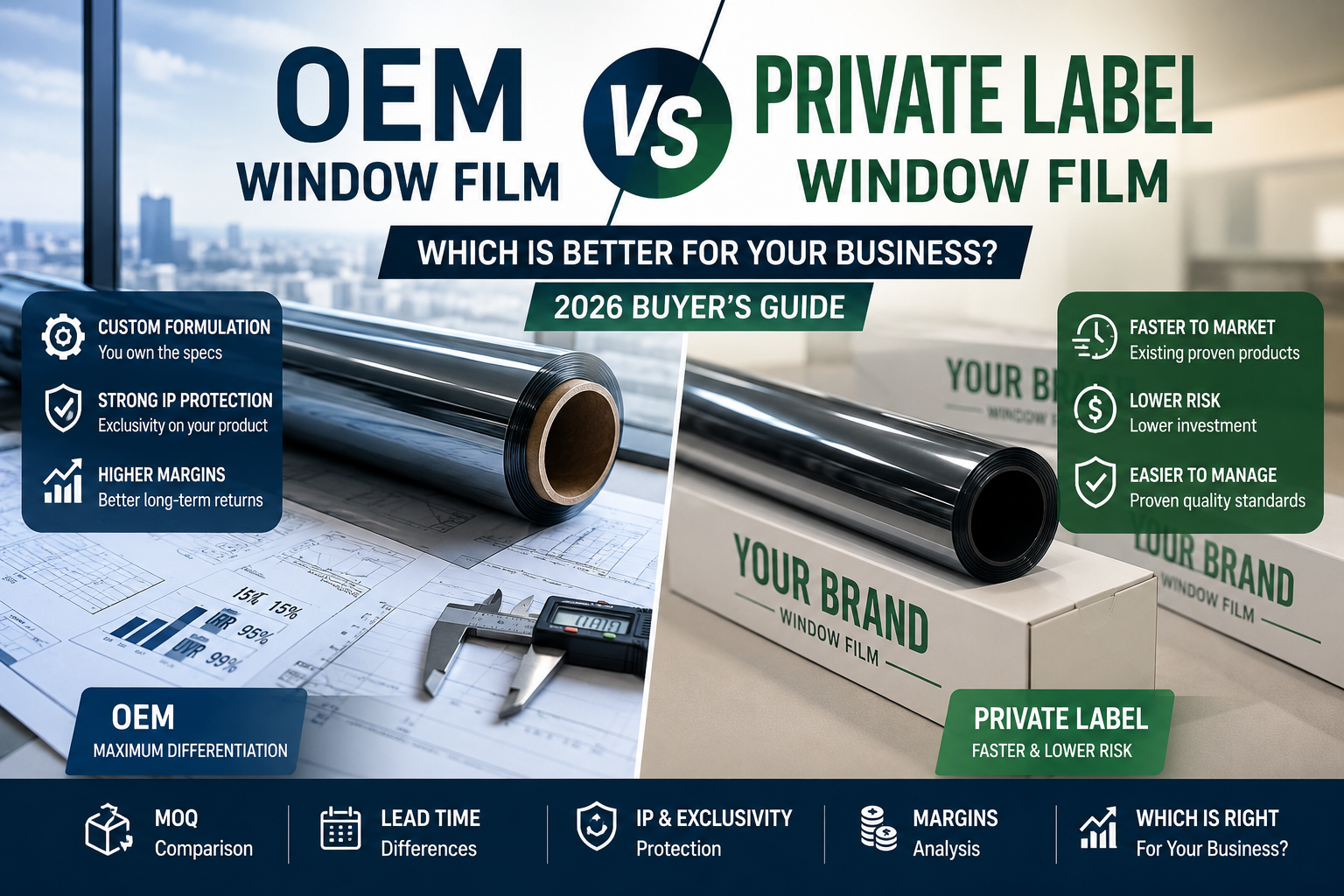
OEM (Original Equipment Manufacturer) In window film sourcing, OEM typically means the manufacturer produces film to your specifications. You control (or co-develop) the formula: the base PET film, the coating layers, the adhesive chemistry, the VLT percentage, the IR rejection targets. The product is engineered to a brief. You own the spec. The manufacturer builds it.
Private Label Private label is simpler and faster: the manufacturer has an existing product — already formulated, already tested — and you put your brand name on it. You’re not changing the film. You’re changing the box, the roll label, and the documentation.
The difference matters more than most buyers realize upfront.
The Case for OEM Window Film
OEM is the right call when differentiation is the goal — and when you have the volume and patience to justify the development process.
You Control the Product Spec
With OEM, you’re not selling what everyone else sells. If your market wants a high-IR-rejection nano-ceramic film at a specific VLT that nobody else offers in your region, OEM lets you build it. You define the performance parameters, work with the manufacturer’s R&D team to hit them, and run third-party verification (SGS, Intertek, or similar) before committing to production.
This is particularly valuable in competitive markets where buyers have become sophisticated. When a professional installer asks for your technical data sheet, you can hand them something that actually differentiates your product — not a relabeled spec sheet from a factory catalog.
Stronger IP Position
The formulation data and lab results belong to your account. Most reputable manufacturers will sign an exclusivity agreement for OEM products — meaning they won’t sell the same spec under another brand without your permission. That’s a real competitive moat, especially if you’re building a distribution brand in a specific vertical (automotive performance, commercial construction, marine, etc.).
Higher Margins Over Time
Yes, OEM has a higher upfront cost. Development samples, testing cycles, tooling for custom packaging — it adds up. But once you’ve locked in a spec and a supplier relationship, your cost per roll tends to land lower than private label at equivalent volumes, because you’ve removed the manufacturer’s margin buffer that’s baked into off-the-shelf products.
The Downsides
Let’s be honest about the tradeoffs:
- Minimum order quantities are higher. Most OEM programs at serious factories start at 500–1,000 rolls per SKU, sometimes more for custom formulations.
- Lead times are longer. Expect 6–10 weeks for initial development, plus production lead time. This isn’t a model for buyers who need stock in 30 days.
- You carry more risk. If the spec doesn’t perform as expected in the field, the liability conversation is more complex than with a private label product.
The Case for Private Label Window Film
Private label is genuinely underrated. For most distributors and resellers entering the window film market — or expanding into a new product category — it’s the smarter starting point.
Speed to Market
The product already exists. It’s been tested. The factory knows how to make it consistently. Your job is to agree on a roll label design, place your order, and start selling. For businesses that need inventory in 60 days or less, private label is the only realistic option.
Lower Risk, Lower Capital Outlay
You’re not funding R&D. You’re not running development samples. You’re not waiting for lab results. Private label lets you validate market demand with real sales before you commit to OEM-level investment. Think of it as a pilot program — test the market, build the customer base, then consider OEM once you know the volume is there.
Access to Proven Formulations
Here’s something buyers don’t always appreciate: a well-established private label product from a reputable manufacturer has often been through years of real-world performance testing. Installers have put it on thousands of cars and buildings. The adhesive behavior is understood. The delamination rate is known. You’re inheriting all of that field data, even if your name is on the box.
Easier to Manage Quality
Because the formulation is fixed, quality benchmarks are clearly established. Incoming inspection is straightforward — you’re checking against a known standard, not evaluating something new. For buyers without a dedicated QC team, this matters.
The Downsides
- You’re selling what others sell. If a competing distributor uses the same factory and the same base product, the only differentiation is your brand and your service. In commoditized markets, that’s a thin edge.
- Less control over formulation changes. If the manufacturer updates the base film or changes an adhesive supplier, you may not hear about it until something goes wrong in the field.
- Exclusivity is harder to protect. Some manufacturers will give you a brand exclusivity agreement for private label, but in practice — especially with popular SKUs — multiple buyers often end up with similar products under different labels.
Side-by-Side Comparison
| Factor | OEM | Private Label |
|---|---|---|
| Product differentiation | High — you own the spec | Low — shared base product |
| Time to first shipment | 8–14 weeks (incl. development) | 3–6 weeks |
| Minimum order quantity | Higher (500–1,000+ rolls/SKU) | Lower (often 100–300 rolls) |
| Upfront cost | Higher (dev + tooling) | Lower |
| IP protection | Strong (exclusivity on spec) | Limited |
| Margin potential (long-term) | Higher | Moderate |
| QC complexity | Higher | Lower |
| Best for | Established brands, high-volume distributors | New market entrants, product testers |
So Which One Is Actually Better?
Neither — and that’s not a cop-out answer.
The right model depends on where you are in your business cycle and what problem you’re trying to solve.
Choose OEM if:
- You’re an established distributor with consistent volume (3,000+ rolls/year)
- You’re competing in a market where technical differentiation drives purchasing decisions
- You have the internal capability (or the right supplier relationship) to manage a development process
- You’re building a brand you plan to protect and scale over multiple years
Choose private label if:
- You’re entering the window film category for the first time
- You need inventory in market within 60 days
- Your volume doesn’t yet justify OEM minimums
- You want to test product-market fit before committing to a custom formulation
And consider a hybrid approach: Many experienced buyers start with private label to build volume and customer relationships, then transition specific SKUs to OEM once they understand exactly what their market wants. It’s not an either/or decision — it’s a sequencing question.
What to Ask Your Manufacturer
Whether you’re going OEM or private label, the quality of the conversation with your supplier is what determines the outcome. Here are the questions that matter:
For OEM:
- What is your minimum run quantity for a custom formulation?
- Do you have in-house coating R&D, or do you work with external labs?
- What exclusivity terms do you offer on custom specs?
- Can you provide SGS or Intertek test reports for the developed product before mass production?
- What does your development-to-production timeline look like?
For Private Label:
- What are your best-selling SKUs, and which markets do they perform well in?
- What exclusivity can you offer on private label products in my region?
- How do you handle formulation changes — will you notify me before they happen?
- Can I see current third-party test reports for the products I’m considering?
- What is your minimum order for branded rolls?
A Note on Certifications (Both Models)
Regardless of which route you take, the certification requirements for your target market don’t change. If you’re selling into the United States, FTC guidelines apply to VLT and UV rejection claims. EU distributors need to think about CE marking and relevant EN standards. Some markets — Australia, the Middle East — have their own requirements.
The difference is that with OEM, you’ll need to run certifications on your specific product. With private label, you’re often relying on the manufacturer’s existing test reports — which is fine, as long as those reports reflect the actual product you’re receiving, not a sample run from two years ago.
Ask for reports dated within the last 12 months. If they can’t provide them, that’s your answer.
FAQ
1.What is the main difference between OEM and private label window film?
OEM window film allows buyers to customize product specifications and formulations, while private label uses existing factory products with customized branding and packaging.
2.Which option is better for new window film distributors?
Private label is usually better for new distributors because it requires lower MOQ, lower upfront investment, and faster time to market.
3.Can I switch from private label to OEM later?
Yes. Many distributors start with private label products to build sales volume and later move selected SKUs to OEM once they understand market demand and achieve stable order quantities.
Ready to Explore OEM or Private Label Options?
Whether you’re just getting started or you’re an established distributor looking to upgrade your product line, the manufacturer relationship is everything. We work with buyers across North America, Europe, Australia, and the Middle East to connect them with verified Chinese window film manufacturers — based on their specific volume, application, and market requirements.
Fill out our sourcing inquiry form and we’ll match you with suitable OEM or private label partners within one business day. No middleman markup, no pressure — just a straight conversation about what makes sense for your situation.
Further Reading
Internal:
- Top 7 Window Film Manufacturers in China (2026 Verified List) — How to evaluate Chinese suppliers before you place your first order
- Window Film Wholesale: A Practical Buyer’s Guide for Distributors — How to choose suppliers, compare products, and avoid costly sourcing mistakes
- How to Source Window Film from China: A Step-by-Step Guide — The complete process from RFQ to first shipment
External:
- IWFA (International Window Film Association) — Industry standards body for the professional window film market
- SGS Testing & Certification — Third-party testing and verification for window film products
- Intertek Product Testing — Alternative third-party lab used by many Chinese manufacturers
- FTC Energy Guides — US regulatory guidance relevant to performance claims on film products
Get a Free Sample or Quote
Looking for a reliable window film supplier? Contact us today for fast response and professional support.