Ceramic Tint vs Carbon Tint: Which Window Film Should You Choose?
Published: July 29, 2026 · 7 min read · Category: Window Film Guide
About this article: KSB Window Film produces both carbon-series and nano ceramic window film in Dongguan, China. We’ve observed how these two technology tiers perform across climates and markets — from Middle East heat load applications to European urban installers — and this comparison reflects that production and export experience.
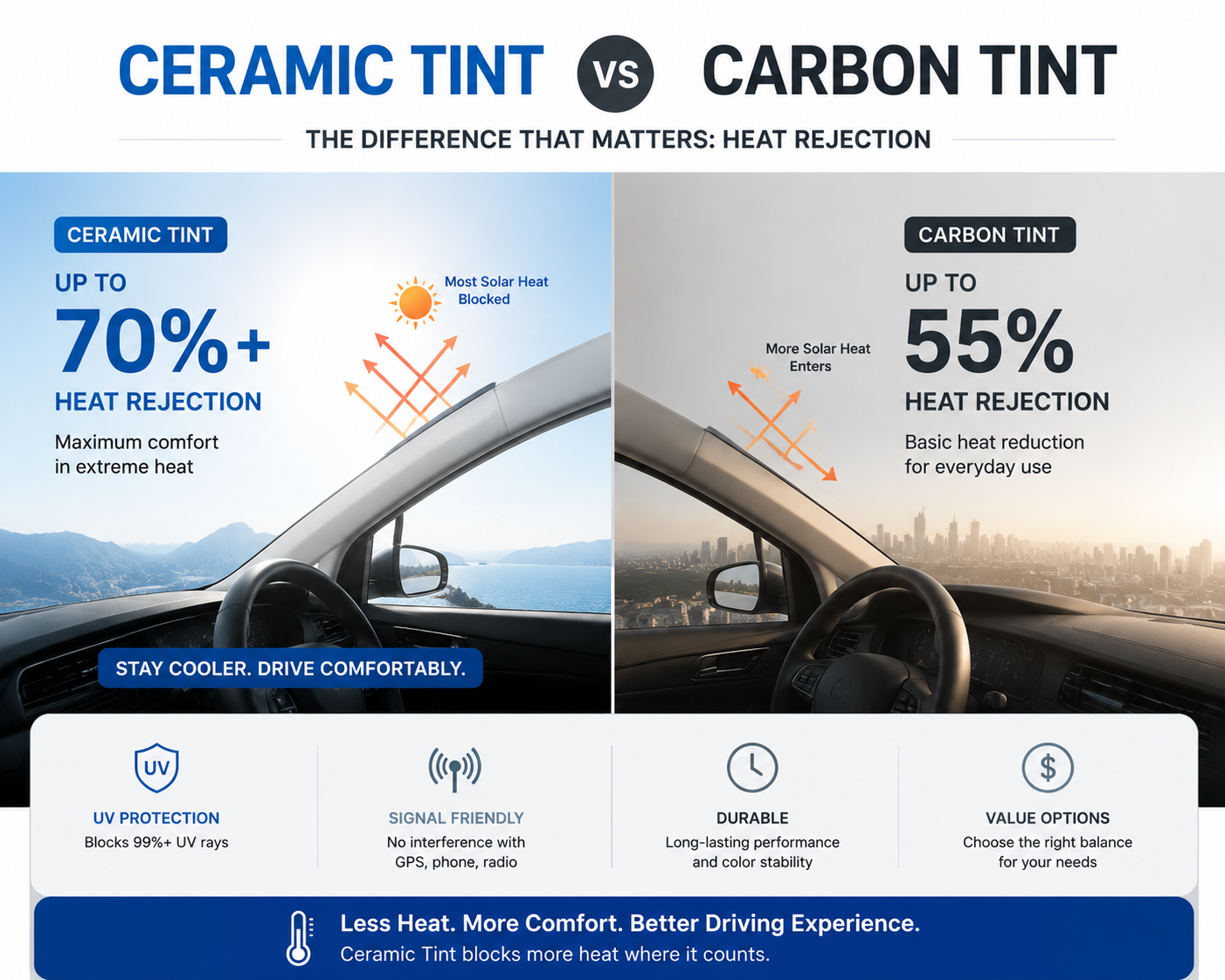
Side-by-side comparison of ceramic tint and carbon tint highlighting performance differences in heat rejection, cost, and real-world usage scenarios
If you’ve walked into a tinting shop recently and asked for their recommendation, there’s a good chance the conversation came down to two options: ceramic tint or carbon tint. Both are genuine steps up from dyed film. Both are signal-transparent. Both look good and last well. The choice between them shapes the rest of the conversation — and it’s a choice that’s worth understanding before you’re sitting in a shop under time pressure.
This is a straightforward guide to that decision.
The One-Sentence Version
Carbon tint is the reliable, affordable choice. Ceramic tint costs more and blocks significantly more heat. Which one you need depends on your climate, your budget, and how long you plan to keep the vehicle.
What Each Technology Does
Carbon tint uses carbon particles in the film’s coating layers to absorb solar radiation. Carbon is a broad-spectrum absorber — it catches UV, visible light, and infrared. It’s non-metallic (so no signal interference), color-stable (carbon doesn’t fade or shift like organic dyes do), and provides genuinely good solar performance at a reasonable price.
Ceramic tint uses ceramic nanoparticles — typically titanium nitride or similar inorganic compounds — engineered to selectively absorb and reflect infrared radiation while passing visible light more efficiently. The “nano” part matters: particle sizes in the 5–100nm range are smaller than visible light wavelengths, so they don’t scatter light, which is why ceramic film can achieve high heat rejection while remaining optically clear.
The result is a film that targets infrared heat more precisely than carbon, delivering better TSER (Total Solar Energy Rejected) at equivalent visible light transmission.
Heat Rejection: Where Ceramic Is Noticeably Better
The practical difference between carbon and ceramic is most apparent in heat rejection.
A quality carbon film at 35% VLT typically achieves 45–55% TSER. A quality ceramic film at the same VLT typically achieves 60–70%+ TSER. In real-world terms, that gap is felt on a hot day — getting into a car parked in direct sun tells you more about the difference than any spec sheet.
The difference is most meaningful in:
Hot climates with high UV and solar intensity
Vehicles with large glass areas (SUVs, sedans with rear panoramic windows)
Front windows where legal VLT limits prevent going dark — ceramic delivers better heat rejection at higher VLT levels
In mild climates or primarily shaded/urban driving, the performance gap narrows to the point where it’s less consistently noticed.
Where Carbon and Ceramic Are Equivalent
UV protection: Both quality carbon and ceramic films block 99%+ UV. This is not a decision factor — both protect your skin and your interior materials effectively.
Signal transparency: Both are non-metallic and don’t interfere with mobile phones, GPS, Wi-Fi, or electronic toll systems.
Color appearance: Both produce clean, neutral-looking tint. Carbon film may have a very slight warmth; ceramic tends to neutral grey. In real-world installation, most people can’t tell them apart by looking.
Durability compared to dyed film: Both significantly outlast dyed film. Carbon’s stability comes from the chemically inert carbon structure. Ceramic’s stability comes from inorganic ceramic compounds. Both are measured in 7–10+ year service lives for quality products.
Price: The Most Practical Difference
Carbon film costs less to manufacture — the raw materials are cheaper and the production process less demanding. Ceramic film costs more, and that cost flows through to installation pricing.
In most markets, a full-car ceramic installation costs $100–$300 more than a comparable carbon installation. The exact gap varies by vehicle size, film brand, and installer.
How to Choose
The decision is cleaner than it might seem:
Choose carbon tint if: You’re in a mild climate, you park mostly in shade or a garage, your budget is a real constraint, or you’re tinting a vehicle you plan to sell within a couple of years.
Choose ceramic tint if: You’re in a hot climate, you park outdoors regularly, you want the best available heat rejection at the VLT levels that are legal where you are, or you’re keeping the vehicle for 5+ years and want the investment to count.
There’s no wrong answer — it’s a calibration of performance vs. price for your specific situation.
A note on product selection: If you’re a distributor or installer building out your range, KSB Window Film produces both carbon-series and nano ceramic film with current SGS test documentation available for each product. Our ceramic series is available in VLT options from 5% to 70%, with TSER data verified at full-spectrum IR measurement — the number that matters, not a single-wavelength claim.
FAQ
If I go with carbon now, can I upgrade to ceramic later?
You’d need to remove the carbon film first — film-on-film applications cause adhesion problems and compound VLT reductions that may exceed legal limits. Removal is a standard service most professional installers offer. So yes, you can upgrade later, but it involves removing the existing film.
Is ceramic tint worth the extra cost in the UK or Northern Europe?
Honestly, less so than in hot climates. In climates where summer temperatures are mild and sun intensity is lower, the extra heat rejection from ceramic is tested less frequently. UV protection (which both technologies provide equally) and color stability are the main benefits in those markets. If budget is a consideration, carbon is the more sensible call in mild climates.
Will ceramic tint affect my GPS or Bluetooth?
No. Ceramic is non-metallic and non-conductive. It has no effect on wireless signals of any kind. This is one of its advantages over older metallic films.
How dark should I go for maximum heat rejection?
Darker isn’t automatically better, especially with ceramic technology. A quality ceramic at 50% VLT can outperform a carbon film at 20% VLT on heat rejection. Focus on TSER (Total Solar Energy Rejected) and choose the darkest VLT that’s legal in your jurisdiction — but don’t assume darker film means better thermal performance without checking the specs.
Are there ceramic films that look identical to carbon films?
In normal lighting conditions, quality examples of both appear as clean, neutral tint. A trained installer or someone doing a direct comparison might notice a slight difference in optical quality — ceramic tends to slightly better clarity in the transparent view — but from outside the vehicle, at typical VLT ranges, they’re visually indistinguishable.
Try KSB Nano Ceramic and Carbon Film Side by Side
KSB Window Film can supply both ceramic and carbon series sample rolls so you or your installers can run a real-world comparison — tint meter readings, IR heat test, optical quality — before committing to a range decision.
We include current SGS test reports with all samples so you’re comparing verified performance, not just appearance.
→ Request a comparison sample pack — our export team will put together ceramic and carbon samples at your target VLT within 3–5 business days.