Winter-Proof PPF: Preventing Cracking and Brittleness in North American Climates
Published: July 29, 2026 · 7 min read · Category: PPF Regional
About this article: KSB Window Film supplies PPF to distributors in the US and Canada, including markets with severe winter conditions. Cold-climate PPF failure modes are different from hot-climate failures — and require different engineering responses.
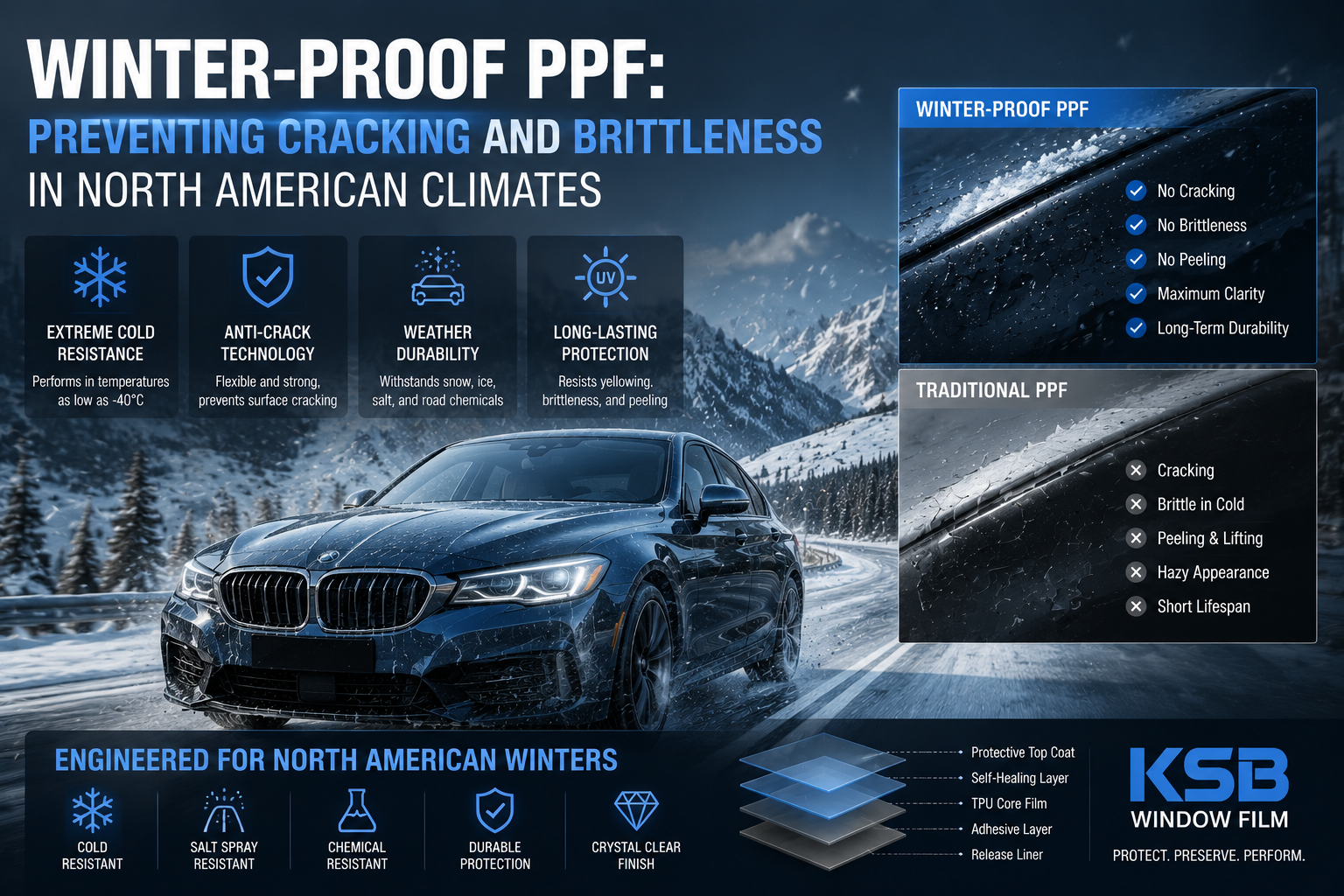
Winter-proof paint protection film engineered for extreme low temperatures, ensuring flexibility, durability, and resistance to cracking in harsh North American climates.
North American winter conditions are a different kind of PPF test. A film that performs excellently in Phoenix or Dubai can crack, delaminate, or become dangerously non-conformant on a vehicle in Edmonton or Minneapolis at -30°C. The physics of polymer behaviour at low temperatures requires specific material engineering that’s distinct from UV stability or heat resistance.
What Happens to PPF in Cold Temperatures
Thermoplastic polyurethane is a viscoelastic polymer — its mechanical properties are strongly temperature-dependent. As temperature decreases below the material’s glass transition temperature (Tg), TPU transitions from rubbery and flexible to glassy and brittle.
The consequences at low temperatures:
Film brittleness: At temperatures well below Tg, TPU loses its elastomeric character. A film that stretches to 400% elongation at room temperature may crack at 50–80% elongation below -20°C. Stone impacts that would elastically deform and recover at +20°C can fracture the film at -20°C.
Ice and freeze-thaw cycling: Water infiltrating at film edges freezes and expands, applying wedge forces that lift the edge adhesive bond. Multiple freeze-thaw cycles progressively enlarge this failure.
Cracking on panel flexion: Vehicle body panels flex during cold starts as the metal contracts and expands with temperature changes. Film that doesn’t accommodate this flexion can crack along panel edges or form visible stress cracking patterns.
Installation in cold conditions: PPF applied below 10°C using inadequate heating shows poor initial adhesive activation and reduced conformability — leading to application bubbles and edge issues that appear days later when the vehicle moves to a heated garage.
How KSB Engineers for Cold Weather Performance
Low-Temperature Glass Transition (Tg)
The base TPU compound specification for cold-climate PPF targets Tg as low as possible while maintaining the mechanical properties needed for impact resistance and self-healing. KSB’s North American specification uses aliphatic TPU compounds with Tg below -40°C — maintaining rubbery, flexible behaviour at the most extreme North American winter temperatures.
Verification test: Cooled film sample at -30°C for 30 minutes, then subjected to 90° mandrel bend. Quality cold-climate PPF shows no cracking. Film not designed for cold climates shows surface micro-cracking or outright fracture.
Elongation at Break at Low Temperature
Elongation at break (ASTM D882) measured at -20°C is the key cold-climate performance metric:
Temperature
Standard PPF
KSB North America spec
+23°C
450%
480%
-10°C
280%
380%
-20°C
140%
260%
-30°C
65%
160%
At -20°C, KSB’s North American specification maintains 260% elongation at break — still highly flexible. Standard PPF at 140% is approaching the threshold where real-world stress events (stone impact, panel flex during cold start) approach the failure point.
Salt and De-icing Chemical Resistance
North American roads use calcium chloride, magnesium chloride, and sodium chloride for winter de-icing. These salts are corrosive to adhesive systems and can degrade some polymer formulations through repeated wet/dry cycling.
KSB’s cold-climate specification includes 1,000-hour salt spray testing (ASTM B117) with no blistering or edge lifting. The top coat is also formulated to resist the chemical contact from these salt solutions, which can be more concentrated at film edges where splash deposits accumulate.
The Freeze-Thaw Edge Challenge
The most common cold-climate PPF failure is edge lifting driven by freeze-thaw cycling. Water at the film edge freezes, expanding approximately 9% in volume. This expansion applies mechanical force to the adhesive bond at the edge. After multiple cycles, the edge progressively lifts.
KSB’s approach:
Adhesive with excellent low-temperature bond strength — maintained above 12 N/25mm at -20°C (vs. 5–8 N/25mm for standard adhesive at this temperature)
Hydrophobic top coat surface that reduces water infiltration at edges
Edge seal recommendation: silicone edge sealant at panel edges during installation helps prevent water infiltration and is standard practice for North American winter climates
Cold-Climate Installation Practice
PPF should not be installed below 10°C ambient without controlled heating. KSB’s North American distributors recommend:
Heated installation environment (minimum 18°C for 24 hours before and during installation)
Pre-warmed film (store rolls at 20°C minimum for 48 hours before installation)
Paint surface temperature verified above 15°C at time of application
Extended cure time (72 hours at 20°C minimum) before winter outdoor exposure
Cold installation without these precautions produces installations that appear acceptable initially but develop edge issues within weeks.
FAQ
My customer had PPF installed and it cracked in the first winter. What happened?
The most likely causes: (1) Film not rated for the temperatures experienced — standard film at -30°C can crack. (2) Installation below the temperature minimum without adequate heating. (3) Pre-existing edge lift due to contaminated paint preparation, allowing moisture infiltration that then froze. (4) Freeze-thaw cycling at inadequately sealed edges. A film properly specified for cold climates, professionally installed in controlled conditions, should not crack through normal North American winters.
KSB Window Film’s North American specification PPF maintains flexibility to -40°C with documented elongation data and salt spray test results. Cold-climate TDS available.