Published: June 29,2026 · 9 min read · Category: PPF Sourcing
About this article: KSB Window Film exports TPU PPF to distributors and importers in over 30 countries. Import process questions are among the most common technical enquiries from first-time buyers — this guide reflects what we know about the real process, not just the theory.
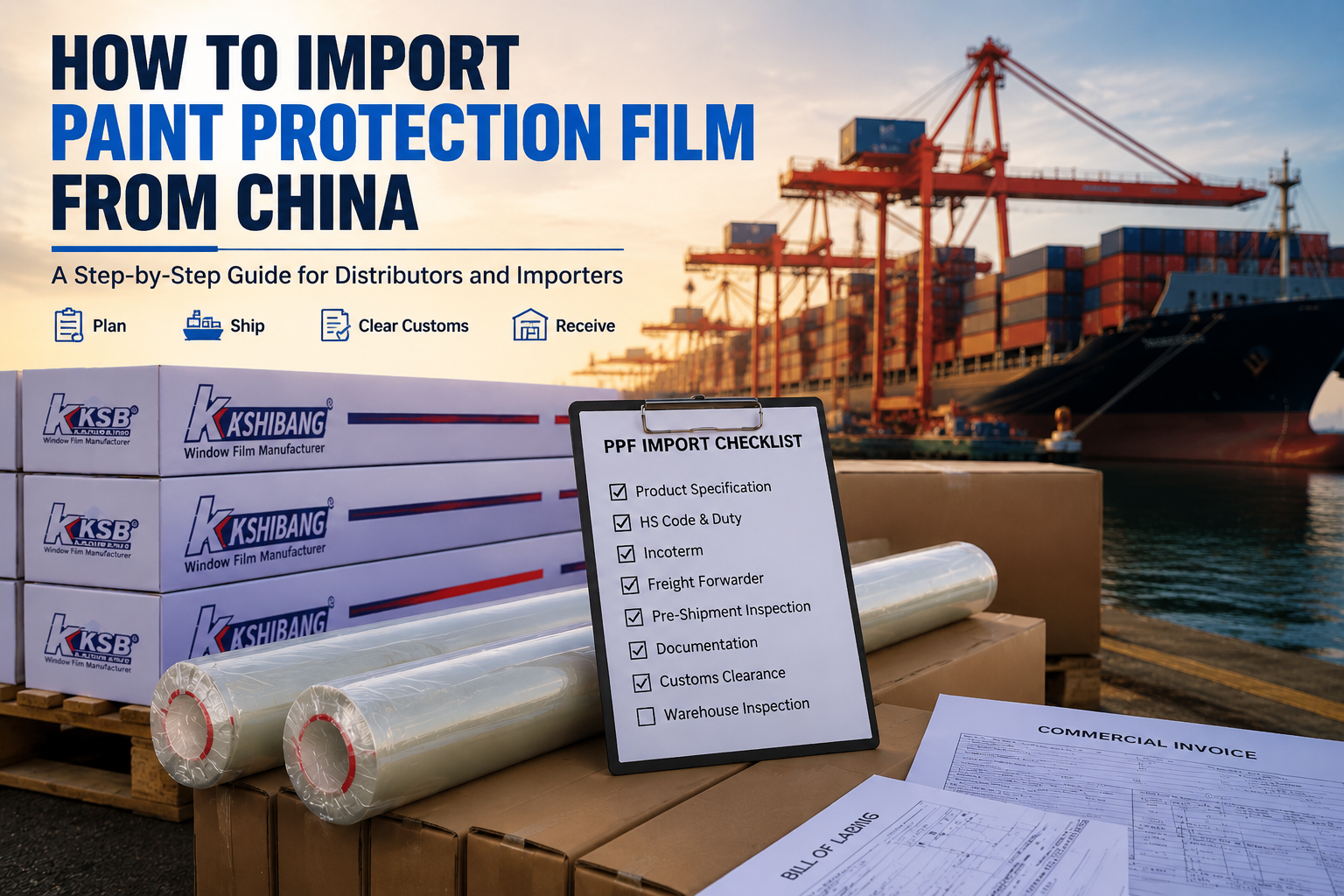
Professional infographic showing the process of importing paint protection film from China, including shipping, customs clearance, logistics, and PPF product delivery.
Importing PPF from China for the first time is achievable without a logistics background — but it requires getting several sequential decisions right. This is a step-by-step walkthrough from supplier selection through to goods in your warehouse.
Step 1: Get Your Product Specification Right Before You Order
Every import problem that starts with “the product isn’t what I expected” traces back to an insufficient specification at the time of ordering. Before placing any order:
Confirm TPU grade and supplier (ask explicitly)
Confirm haze specification (in writing, as a number)
Confirm self-healing standard (temperature and time conditions)
Confirm film thickness (and layer distribution if you can get it)
Confirm VLT and tint appearance (sample physically before ordering)
Confirm finish (gloss vs. matte)
Get these in writing in the purchase order. An email confirmation is a record. A verbal conversation is not.
Step 2: Understand Your HS Code and Import Duty
PPF (thermoplastic polyurethane film) is typically classified under:
HS 3921.90 (other plates, sheets, film, foil of plastics) or
HS 3919.90 (self-adhesive plates, sheets, film of plastics)
The correct classification depends on the specific product construction and the importing country’s tariff schedule. This matters because:
For US buyers: Section 301 tariffs on Chinese goods affect many plastic film products. As of 2026, PPF under relevant HS codes may face tariffs of 7.5–25% on top of standard MFN rates. Verify the current applicable rate with a licensed customs broker before you calculate landed cost.
For EU buyers: EU import duties on plastic film products and the applicable rate depend on your HS classification. Preferential rates may not apply to Chinese-origin goods.
Work with a licensed customs broker in your country to verify the correct HS classification and current duty rate before your first order. The duty calculation is part of your landed cost and part of your pricing model.
Step 3: Choose Your Incoterm
Incoterms define where the seller’s responsibility ends and yours begins.
FOB (Free on Board, named Chinese port): The supplier handles export clearance and loads the goods on the vessel at a named Chinese port. From that point, freight and risk are yours. FOB is the most common term for China imports and gives you control over freight selection and cost.
EXW (Ex Works): The supplier hands you the goods at their factory gate. You handle everything from that point — including export customs clearance from China, which requires a Chinese customs broker. Not recommended for first-time importers.
CIF (Cost, Insurance, Freight): The supplier arranges and pays for freight and insurance to your destination port. Convenient but you lose control of freight selection and the supplier may build a margin into freight costs. Check if their freight quote is competitive.
DDP (Delivered Duty Paid): The supplier handles everything including import duties to your door. Maximum simplicity, maximum cost. Useful for very first trial orders where you want to understand the product before managing the logistics yourself.
Recommendation for most buyers: FOB named Chinese port (Shenzhen, Guangzhou, or Shanghai are the main PPF shipping points). Select your own freight forwarder for cost and service control.
Step 4: Select a Freight Forwarder
A freight forwarder is your logistics partner — booking cargo space, coordinating export documentation from China, and working with your customs broker at destination.
For China-origin goods, use a forwarder with specific China-to-[your country] experience. They know the reliable carriers on your lane, common documentation issues, and port-specific procedures.
Ocean freight vs. air freight:
PPF is relatively dense product. For any commercial quantity (more than a sample order), ocean freight is the only economically viable option — typically $400–$1,200 per 500kg shipment depending on destination, vs. 5–8x that for air freight per kg.
Transit times:
China to US West Coast: 14–18 days
China to US East Coast: 25–32 days
China to UK/EU: 25–30 days
China to Australia: 18–22 days
China to UAE: 12–16 days
One-stop logistics and freight forwarding service for global paint protection film distribution.
Step 5: Arrange Pre-Shipment Inspection (For First Orders)
Before your first order ships, commission a pre-shipment inspection (PSI) from SGS, Intertek, Bureau Veritas, or QIMA. The inspector visits the factory after production is complete, checks the goods against your purchase order specification, and issues a report.
Cost: $250–$450 for a standard PSI. Time: 1–2 business days after booking. This catches problems before the container leaves China — incomparably cheaper than finding them when the goods arrive at your warehouse.
For established supplier relationships, you may reduce PSI frequency to every 3–4 orders rather than every order. For first orders, it’s non-negotiable good practice.
Step 6: Documentation Checklist
Your supplier should provide:
Commercial Invoice: Accurate transaction value, product description, HS code. Must match your purchase order.
Packing List: Itemised breakdown of rolls, dimensions, weights per carton.
Bill of Lading (B/L): The carrier’s receipt and the key document of title.
Certificate of Origin (CO): Used to determine applicable duty rates. May be required by your customs authority.
SGS or product test reports: May be required at customs for plastic film products in some markets. Have them available.
For US buyers: Import declaration (ISF filing) must be submitted to US Customs 24 hours before vessel departure from China. Your customs broker handles this.
For EU buyers: Import declaration and relevant product certification documentation.
Step 7: Customs Clearance at Destination
Use a licensed customs broker in your country for all commercial imports. They:
Submit the import declaration to your customs authority
Calculate and arrange payment of applicable duties and taxes
Handle any customs exam or inspection queries
Release your goods from port custody
Customs broker fee: typically $150–$350 per shipment for standard clearances. Non-negotiable investment — handling customs declarations yourself as a first-time importer creates significant risk of delays, additional exams, and penalties.
Step 8: Incoming Inspection at Your Warehouse
When the shipment arrives, don’t skip incoming inspection to get orders out the door faster.
Visual check for haze or surface defects across multiple rolls
Verify quantities against packing list
Document any discrepancies immediately with photos and notify your supplier within 5–10 business days. Late notification weakens your position in any dispute.
FAQ
Can I import PPF as a personal shipment rather than a commercial import?
For a few sample rolls, yes — personal import or de minimis exemptions apply in most markets for low-value goods. For any commercial volume, commercial import declarations and duty payment are required. Attempting to under-declare commercial goods as personal imports is customs fraud.
How do I find a reliable freight forwarder for China shipments?
Referrals from other importers in your industry are the most reliable path. Alternatively, Flexport, Freightos, and similar platforms provide online freight booking with Chinese-origin capability. For ongoing commercial volumes, building a direct relationship with a forwarder who knows your specific lane is better than platform-based booking.
My supplier offered to handle the full import process. Should I accept?
DDP terms from a supplier you trust can simplify first orders. The risk: you lose visibility into freight cost (the supplier may be adding margin), and you lose control over customs broker selection. For ongoing commercial relationships, managing your own freight and customs provides cost control and transparency that DDP doesn’t.
KSB Handles the Export Side — You Handle the Import
KSB Window Film manages all China-side documentation: accurate commercial invoices, packing lists, certificates of origin, and product test reports. We work with major freight forwarders on all primary export lanes and can advise on typical logistics costs for your market.