Window Film Testing Standards Explained: ASTM, TSER, SHGC, VLT, and Certifications
Published: June 29, 2026 · 10 min read · Category: Window Film Technical
About this article: KSB Window Film tests our products to ASTM, ISO, and EN standards and provides third-party certified results with every product data sheet. This guide is partly a product specification reference and partly a buyer protection guide — understanding these standards helps you evaluate whether a supplier’s performance claims are real.
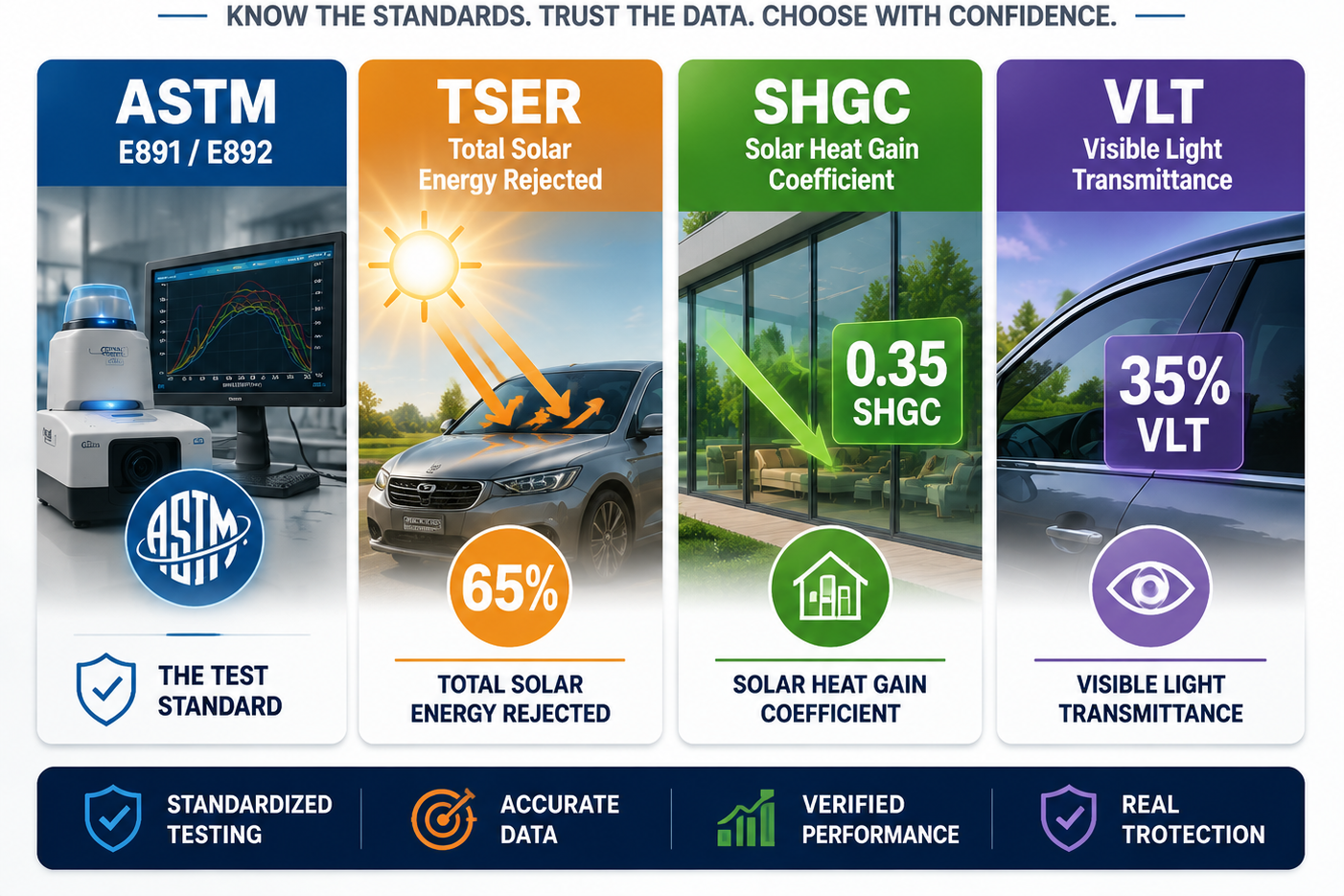
astm-based window film testing metrics: vlt, tser, shgc performance comparison
Here’s an uncomfortable truth about window film performance data: the numbers on a product data sheet are only meaningful if you know how they were measured. “TSER 65%” can mean almost anything, depending on whether it was measured to ISO 9050, ASTM E891, a manufacturer’s internal protocol, or nothing at all. “99% IR rejection” almost always comes with a footnote that should be read carefully.
This guide explains what the key metrics actually measure, what the relevant test standards require, and which numbers to trust when evaluating suppliers.
The Core Metrics
VLT — Visible Light Transmittance
The percentage of visible light (380–780nm wavelength range) that passes through the film plus glass system.
What it measures: How dark or transparent the film appears to the human eye.
Why it matters: VLT determines regulatory compliance (most jurisdictions set minimum VLT for road vehicles), occupant visibility, and daylight entry in architectural applications.
Test standard: ISO 9050 (Glass in building) or ASTM E972 (Standard Test Method for Solar-Weighted Transmittance). Both use spectrophotometric measurement across the visible wavelength range with luminosity weighting (emphasising the wavelengths the human eye is most sensitive to).
The compliance context: VLT measurements for window tinting law compliance are typically measured with a tint meter — a field device that approximates spectrophotometric measurement. Tint meters are calibrated but not laboratory-precise; a film measuring 35% VLT in a lab may read 33–37% on field equipment. Specify a small compliance margin.
What to watch for: VLT should be measured on the film-plus-glass system (installed film, not bare film). A film measured alone will show different VLT from the same film installed on 4mm float glass. Specification-grade VLT data should state what it includes.
TSER — Total Solar Energy Rejected
The percentage of total incident solar energy (covering UV, visible, and infrared) that the film prevents from transmitting into the conditioned space.
What it measures: Comprehensive heat rejection performance. This is the number most directly correlated with how much the film reduces cabin or room temperature.
The formula: TSER = 1 − (Solar direct transmittance + Solar indirect inward heat transfer fraction)
This captures both the radiation transmitted directly through the film and the portion of absorbed solar energy that re-radiates inward from the glass/film system. This is why TSER is a more complete heat metric than simple transmittance.
Test standard: ISO 9050, or EN 410 for European markets, or NFRC 300 for architectural applications in North America. All these standards use spectral irradiance weighting (using the solar spectrum distribution as a weighting function across the measurement wavelength range).
Why TSER is often inflated in marketing: TSER depends on the measurement system (glass type, angle, indoor/outdoor emissivity assumptions). Measuring film alone versus film on glass produces different results. The standard specifies a reference glass, but not all manufacturers follow this. A properly measured TSER reference on 4mm float glass (as per ISO 9050) is lower than the same film measured in isolation.
Request: “TSER measured per ISO 9050 or EN 410 on 4mm float glass” — specify the glass substrate in your test report request.
SHGC — Solar Heat Gain Coefficient
SHGC is the architectural equivalent of TSER expressed as a coefficient (0 to 1) rather than a percentage. SHGC = 1 − (TSER as decimal).
A film with TSER 60% has SHGC 0.40. A film with TSER 80% has SHGC 0.20.
SHGC is the metric used in building energy codes, green building certifications (LEED, BREEAM), and commercial glazing specifications. Architects specify SHGC targets; installers need to match them.
Why SHGC and TSER produce different numbers from different sources: The key variable is the reference glazing system. SHGC as defined by NFRC (National Fenestration Rating Council) in North America uses a different reference system from the SHGC in EN 410. A film specified to “SHGC 0.35 per NFRC” may test to “SHGC 0.38 per EN 410” — not because the film is different but because the test systems use different assumptions.
For commercial architectural specifications: confirm which standard the specified SHGC refers to and ensure your test reports use the same standard.
UV Rejection
The percentage of ultraviolet radiation (280–380nm) rejected by the film.
What it measures: Protection from UV exposure — relevant for occupant skin health, interior fading, and material degradation.
Test standard: ISO 9050 specifies UV transmittance as a weighted integral across 280–380nm. UV rejection = 1 − UV transmittance.
Why 99% UV rejection is claimed by almost every film: UV rejection is achievable at very low cost. Quality UV absorbers are cheap and effective. This means even budget dyed films can legitimately claim 99% UV rejection. It’s not a differentiator — it’s a baseline expectation for any quality product.
What UV rejection doesn’t tell you: Nothing about heat rejection. UV is only 5% of solar energy. A film can block 99% of UV while allowing 70% of total solar energy to pass. Don’t use UV rejection as a proxy for heat performance.
IRR — Infrared Rejection Rate
The percentage of infrared radiation rejected. This is where the specification gets contentious.
The measurement problem: Unlike TSER and VLT, there is no universally standardised definition of “IRR” in the window film industry. Different manufacturers measure it differently:
Option A — Single wavelength: Measure transmittance at one specific wavelength (often 900nm, 950nm, or 1,000nm) and report rejection at that wavelength. This is easy to optimise: ceramic particles often have peak absorption around 950nm, so single-wavelength measurement at that peak produces impressive numbers (95–99%). These numbers are technically valid but wildly non-representative of the film’s actual heat performance across the full infrared spectrum.
Option B — Narrow band average: Measure across a defined narrow band (e.g., 900–1,100nm) and average. Better than single wavelength, but still not representative of the full near-IR spectrum.
Option C — Full solar-weighted NIR: Measure across 780–2,500nm using solar irradiance weighting. This is the meaningful measurement because it covers the full near-IR range weighted by where the sun’s energy actually is. This is the IRR that correlates with actual heat rejection performance.
The fraud opportunity: A budget film with TSER 40% can legitimately claim “95% IR rejection” if the measurement is at a single cherry-picked wavelength. This is the source of the confusing situation where a film can claim 99% IR rejection and only 40% TSER — they’re measuring different things.
Request: “IRR measured across 780–2,500nm wavelength range per ISO 9050 solar weighting.” Compare the result to TSER — they should be directionally consistent.
Key Test Standards
ISO 9050
Glass in building — determination of light transmittance, solar energy transmittance, total solar energy transmittance, and ultraviolet transmittance.
The primary international standard for solar and optical properties of glazing materials. Covers VLT, TSER (as total solar energy transmittance), UV transmittance, and related metrics. Used in architectural film specifications globally.
What it requires: spectrophotometric measurement from 250nm to 2,500nm, calculated using the air mass 2 solar spectrum (ASTM E891) as the weighting function, measured on a defined reference glass.
Test reports citing ISO 9050 from accredited laboratories are the most internationally recognised performance documentation for architectural film.
ASTM E891 / E892
These ASTM standards define the terrestrial solar spectral irradiance at air mass 1.5 (ASTM E892, direct normal) and 2.0 (ASTM E891, hemispherical). They’re used as the weighting function in TSER calculations.
When a test report references “measured per ASTM E891” — it means the spectral data was weighted using the ASTM E891 solar spectrum. You may also see “ASTM G173” (the updated consolidated solar spectrum standard).
The practical implication: a TSER calculated using ASTM E891 weighting and one using an alternative solar spectrum will give slightly different results even on the same product. For comparison across suppliers, ensure all results use the same solar spectrum reference.
NFRC Standards (North America)
The National Fenestration Rating Council provides product certification for fenestration products including window film. Their rating system is used in commercial architectural specifications in North America.
NFRC 100: Rating procedure for the U-factor (thermal conductance), VT (visual transmittance), and SHGC of fenestration products.
NFRC 300: Rating procedure for solar optical properties of window films.
NFRC certification (as opposed to simply testing to NFRC methodology) requires ongoing participation in their certification programme with independent verification. Certified products appear in the NFRC Certified Products Directory — a searchable database that specifiers and building officials use for compliance verification.
For architectural film sold for commercial projects in North America, NFRC certification (not just NFRC methodology test reports) is increasingly expected by architects.
EN 410 and EN 673
European standards for glass optical and thermal properties:
EN 410: Determination of luminous and solar characteristics of glazing. The European equivalent of ISO 9050 for optical and solar performance. Specifies the air mass 1 solar spectrum (closer to high-sun conditions than ISO 9050’s air mass 2) which produces slightly different calculated SHGC/TSER values.
EN 673: Determination of thermal transmittance (U value) by calculation. Relevant for assessing whether window film contributes to meeting U-value requirements in European building energy standards.
For EU architectural sales: test reports to EN 410 are the expected documentation format. ISO 9050 results are generally accepted but EN 410 is preferred by European specifiers.
EN 12600:2002 (Europe): Pendulum impact test for glass in buildings. Film-laminated glass is classified by number of drops (1–4), impactor form (A=soft, B=hard), and breakage mode (1=breaks safely, 2=doesn’t break). A classification of “1B1” indicates the highest safety performance.
ANSI Z97.1 (US): Safety glazing materials standard. Defines impact test procedures and safety classifications for glazing materials including film-treated glass.
LPS 1270 (UK/Insurance industry): Security standard for physical attack resistance. Window film on glass is rated for delay resistance against forced entry attacks.
For safety and security film buyers: specifying the applicable standard and required rating is essential. “Safety film” without a standard reference and test result is an unverifiable claim.
LEED and BREEAM: Green Building Certifications
These certification systems don’t test window film directly, but window film contributes to points under specific credits:
LEED (Leadership in Energy and Environmental Design):EA Credit: Optimize Energy Performance — reduced SHGC through window film contributes to reduced cooling loads, supporting energy model improvements. EQ Credit: Daylight — high-VLT solar control film can maintain daylighting while controlling SHGC, supporting compliance with this credit.
BREEAM (Building Research Establishment Environmental Assessment Method, UK):Energy — reduction in operational energy — solar control film reducing cooling load contributes to this credit.
For architectural film specified in LEED or BREEAM projects: provide the SHGC value and VLT value from NFRC or EN 410 test reports. The project’s energy model then incorporates these values.
Making Sense of a Supplier’s Test Report
A properly prepared product test report should contain:
Required element
What to check
Laboratory name and accreditation
ISO 17025 accredited lab (e.g., SGS, Intertek, TÜV)
Test standard reference
ISO 9050 / EN 410 / NFRC 300 — whichever is applicable
Product identification
Named product, not “automotive film”
Reference glass specification
e.g., “4mm clear float glass, ASTM C1036”
Wavelength range measured
Must cover full solar spectrum (250–2,500nm minimum)
Individual metric results
VLT, TSER/SHGC, UV rejection, each separately stated
Test date
Within 12–18 months for current product validation
A report missing any of these elements has a gap worth questioning.
FAQ
My supplier provides test reports from a Chinese laboratory I’ve never heard of. Are they valid?
Only if the laboratory is ISO 17025 accredited. Accreditation is granted by national accreditation bodies (CNAS in China, UKAS in the UK, NVLAP in the US, DAkkS in Germany) after independent assessment of the lab’s technical competence. Check the laboratory’s accreditation status directly on the CNAS registry (cnas.org.cn) before treating their reports as verified. SGS China, Intertek China, and Bureau Veritas China are major accredited labs widely accepted internationally.
A supplier’s TSER is 68%, but a competitor claims 72% for what looks like the same product. What’s going on?
Either the products genuinely differ, or the tests used different conditions. The most common sources of difference: different reference glass (film measured alone vs film on glass); different solar spectrum reference; manufacturer’s internal test vs accredited laboratory test. Request both test reports with full methodology and compare conditions, not just numbers.
KSB Window Film provides current third-party test reports from SGS/Intertek accredited laboratories with every product data sheet — ISO 9050, EN 410 where applicable, and NFRC-method measurements for North American architectural specifications.