Published: June 26, 2026 · 7 min read · Category: PPF Guide
About this article: KSB Window Film manufactures TPU PPF across multiple product tiers. This guide explains the material and manufacturing cost drivers behind price variation — based on our direct production experience.
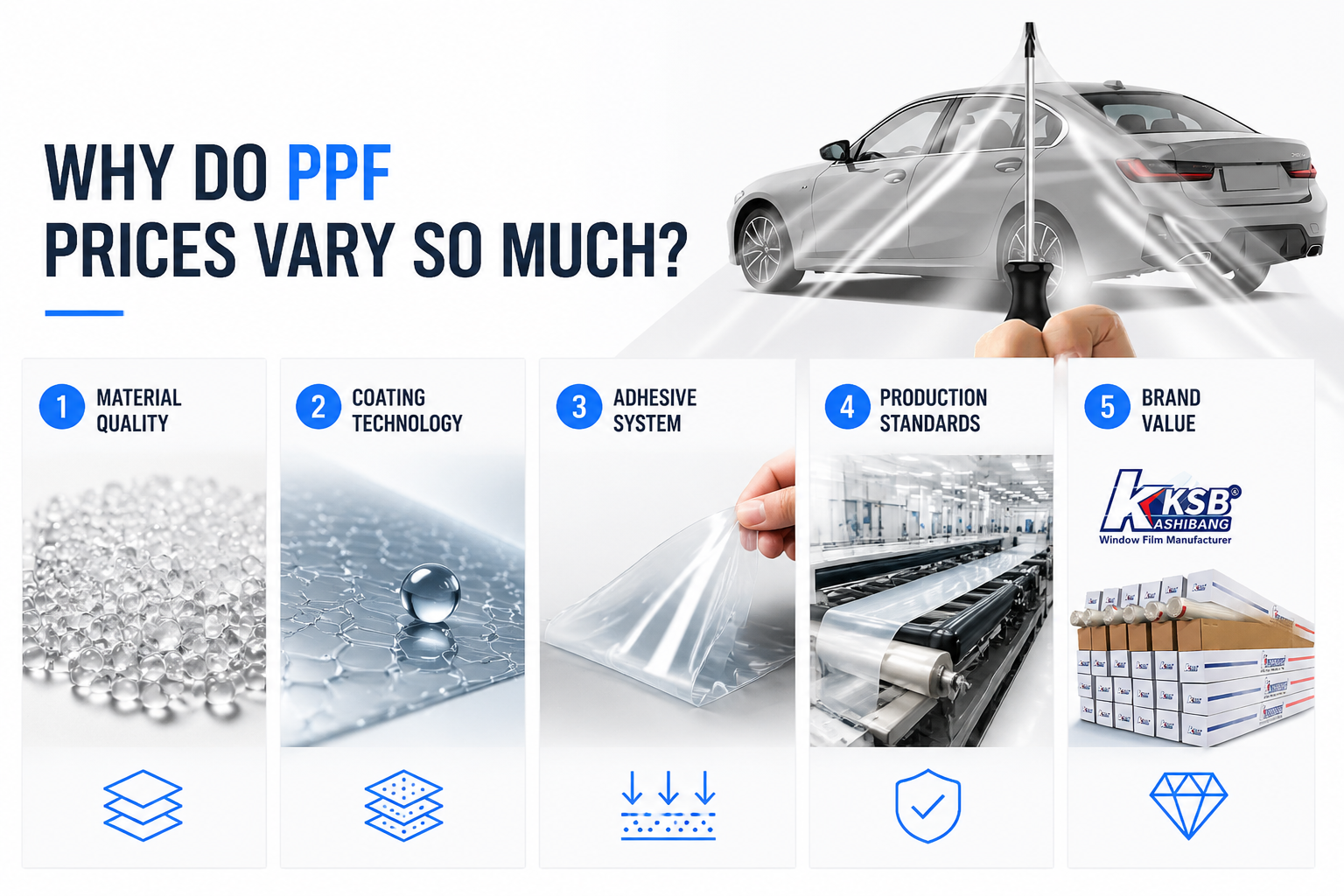
Infographic showing the main factors that affect paint protection film pricing, including TPU quality, coating technology, adhesive systems, manufacturing standards, and brand value.
A buyer who requests PPF quotes from three Chinese manufacturers for what looks like the same product — 7.5 mil TPU, gloss finish, self-healing — can receive prices ranging from $30 to $90 per roll. The 3:1 variation isn’t negotiating tactic or profit margin difference. It reflects genuine differences in what’s inside the roll.
Driver 1: TPU Compound Quality (The Biggest Variable)
The base TPU is the largest single cost and quality driver in PPF manufacturing. The difference between commodity-grade domestic TPU and premium compounds from Covestro, Huntsman, or Lubrizol:
Elongation at break: Premium TPU stretches 450–600% before tearing. Budget TPU: 200–350%. More elongation = better conformability on complex curves = better installation results.
UV stability: Premium TPU compounds include UV stabilizers and antioxidants in the polymer structure. Budget TPU yellows faster.
Optical clarity: Premium TPU has consistent optical properties with minimal haze. Budget TPU introduces baseline haze that makes achieving 1% haze in the finished film impossible regardless of top coat quality.
The cost difference between premium and commodity TPU compound at the raw material level: 40–80%. This flows directly through to finished film pricing.
Driver 2: Top Coat Formulation
The top coat is what the installer and vehicle owner interact with daily — self-healing performance, scratch resistance, optical clarity, and hydrophobic behavior. Top coat formulations range from basic hard coats (minimal self-healing, adequate scratch resistance) to sophisticated elastomeric systems with HALS UV stabilizers.
The difference in material cost between a basic and premium top coat: 25–60%. More importantly, the premium top coat requires:
More precise UV curing control (energy, line speed, atmosphere)
More careful quality monitoring (each batch must achieve consistent crosslink density)
More development investment to get the hardness/healing tradeoff right
Manufacturers with basic top coats have lower overhead in coating operations. Manufacturers with premium top coats have higher process complexity and tighter specifications — which costs more to maintain.
Driver 3: Adhesive System
PSA (pressure-sensitive adhesive) quality is often invisible until it fails — edge lifting two winters after installation, adhesive residue when the film is eventually removed, or installation behavior that makes clean positioning difficult.
Premium PPF adhesive:
Engineered for the specific TPU and top coat stack it’s paired with
Rated for temperature extremes (-20°C to +100°C operating range)
Clean removability after 7–10 years of service
Consistent initial tack that allows positioning without immediate bonding
The cost difference between a quality adhesive system and a budget alternative at the roll level: $3–$8/roll depending on thickness. Small in absolute terms, large in performance implications.
Driver 4: Manufacturing Precision and QC
A manufacturer running tight process controls — inline optical inspection, consistent UV cure energy monitoring, adhesive weight controls, slitting precision — has higher operational overhead than one running with minimal monitoring and reactive QC.
The overhead difference doesn’t appear as a labeled line item in a quote. It appears as:
Consistent haze below 1.5% across batches
Self-healing performance that matches spec on the 50th order as well as the first
Edge quality that installers can work with reliably
Budget manufacturers produce film that’s indistinguishable from premium film on a sunny day in the showroom. The difference appears at the edges, in challenging installation conditions, and over time.
Driver 5: Brand Premium
Some price variation has nothing to do with the film. Established brands — XPEL, Llumar, 3M PPF lines — carry a brand premium that reflects their distribution infrastructure, installer training programs, warranty claims processes, and the marketing investment that built name recognition.
This premium is real in consumer-facing markets where vehicle owners research brands before booking an installer. It’s less relevant in OEM or private label sourcing where you’re building your own brand.
The practical implication: for distribution buyers, the question is whether the brand premium you’re paying for an established name is less or more than the cost of building your own brand on quality Chinese film. For most buyers at meaningful volume, the answer points toward own-brand sourcing.
What Price Premium Is Justified
A premium price is justified when the product genuinely delivers:
Measured lower haze (verified by tint meter or haze meter, not claimed)
Faster, more consistent self-healing (testable with a sample and a heat gun)
Better edge adhesion after thermal cycling (observable over 6 months of real-world use)
Clean removability at the end of service life (verifiable on aged samples)
It’s not justified when:
The premium is primarily brand marketing
The test data doesn’t back the performance claims
The “premium” tier from a given manufacturer uses identical materials to the “standard” tier with different packaging
Test before you pay the premium. A $300 investment in sample rolls and a basic performance evaluation pays back on every purchasing decision you make afterward.
FAQ
How do I know if I’m paying for quality or just for brand name?
Test the film. A haze meter, a self-healing test with a heat gun, and a comparison against a verified benchmark product gives you objective performance data to put against the price. If the premium-priced film doesn’t perform measurably better on those tests, you’re paying for brand.
If two films have the same thickness (e.g., 7.5 mil), are they the same quality?
No. Total thickness is the sum of all layers. A 7.5 mil film with 5 mil of premium TPU and 1.5 mil of quality adhesive is a different product from a 7.5 mil film with 4 mil of budget TPU and 2.5 mil of adhesive. Thickness is one specification among several — always ask for the layer breakdown.
Yes. The best Chinese TPU PPF manufacturers use equivalent material inputs to the best Western brands and achieve comparable or superior performance on objective metrics. The cost advantage comes from manufacturing labor and overhead, not material shortcuts.
KSB Window Film provides haze data, self-healing specifications, and TPU compound documentation with every sample order — so you can evaluate quality against price rather than guessing.