Published: June 10, 2026 · 8 min read · Category: PPF Guide
The lifespan question comes up in almost every PPF sales conversation, and the answer people usually get — “around 5 to 10 years” — is technically accurate and practically useless.
A better answer requires knowing which film, in which climate, on which vehicle, maintained how, installed by whom. The gap between a well-executed PPF installation that lasts 10 years and a poorly chosen or poorly installed product that’s being peeled off at year three isn’t random variation. It’s specific, explainable, and largely predictable if you know what to look for.
This guide breaks down the real determinants of PPF lifespan — and what manufacturers, installers, and buyers can do to push toward the longer end of the range.
The Honest Answer on Lifespan
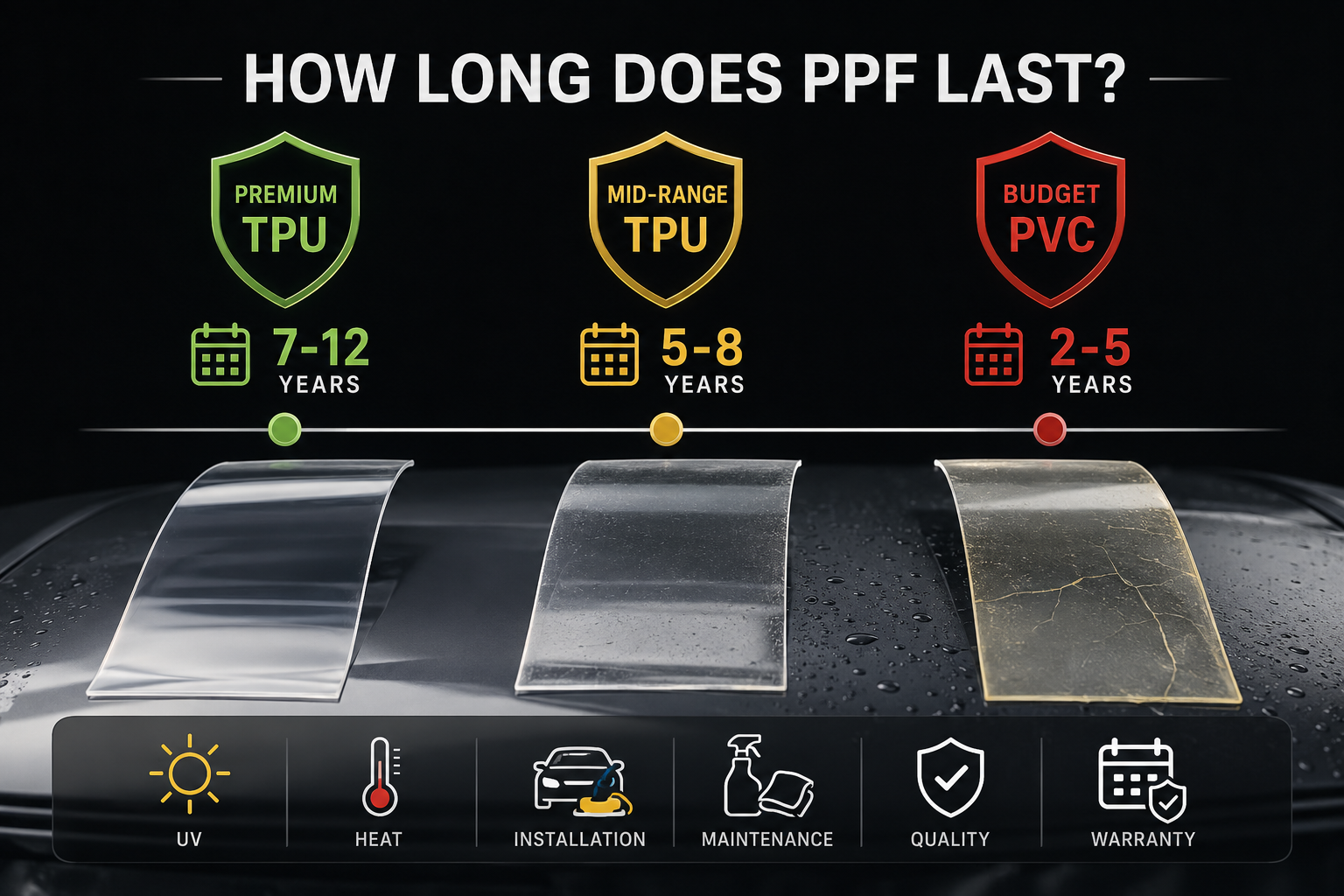
Premium TPU paint protection film, properly installed by a skilled installer on a well-prepared paint surface, and maintained correctly: 7–12 years is a realistic lifespan in most climates. Top-tier products with strong warranties are rated to 10 years.
Mid-range TPU products: 5–8 years depending on conditions and maintenance.
Budget or PVC-based products: 2–5 years before yellowing, edge lifting, or surface degradation makes replacement the better option — regardless of what the warranty says.
These are real-world figures, not manufacturer claims under ideal laboratory conditions.
Factor 1: Film Material and Quality
The most important variable in PPF longevity is the product itself — specifically the quality of the TPU, the top coat formulation, and the UV stabilizer package built into the film.
TPU vs. PVC: PVC film yellows. Full stop. The plasticizers in PVC migrate out of the polymer over time, the UV degradation is well-documented, and no amount of UV stabilizer additive fully compensates for PVC’s fundamental limitations under sustained solar exposure. Premium results require TPU.
For the complete materials comparison, see TPU vs PVC PPF: Which Paint Protection Film Is Better?
Top coat UV stability: The top coat is the film’s first line of defense against UV exposure. Premium top coats incorporate UV absorbers and HALS (Hindered Amine Light Stabilizers) that intercept UV energy before it reaches the TPU substrate or the paint underneath. The quality and concentration of these stabilizers directly affects how long the film maintains its clarity and flexibility.
Base TPU density and grade: Not all TPU is equal. Industrial-grade TPU from major polymer suppliers (Covestro, BASF, Huntsman) has different long-term mechanical properties than generic alternatives. Higher-grade TPU maintains flexibility over temperature cycles without embrittlement, resists chemical attack better, and holds its optical properties longer.
Factor 2: UV Exposure and Climate
UV radiation is the primary aging mechanism for PPF — it degrades polymer chains, causes yellowing, reduces elasticity, and eventually leads to cracking and delamination.
Climate zones: Vehicles in high-UV environments — Middle East, Southeast Asia, Australia, Southern US states, high-altitude regions — age PPF film faster than vehicles in lower-UV climates. A film rated for 10 years under typical Northern European conditions may show meaningful degradation in 6–7 years on a vehicle parked outdoors in Dubai or Queensland.
This isn’t a reason to avoid PPF in high-UV climates — it’s a reason to select products with strong UV stabilizer packages and to account for shorter replacement cycles in your customer or distribution planning.
Parking habits: A vehicle garaged overnight and parked in shade during the day accumulates significantly less UV exposure than a vehicle that lives outdoors. Over a 10-year period, the difference in total UV dose can be substantial — and it shows in film aging.
Factor 3: Heat Cycling
Every day a vehicle goes through a temperature cycle — cool at night, warm through the day, potentially very hot in direct summer sun where panel surface temperatures can exceed 80°C (176°F). Over years, these cycles stress the film-to-paint adhesive bond, the film’s internal structure, and the interface between the top coat and the TPU base.
Quality PPF products are tested against temperature cycling — ASTM thermal aging protocols and accelerated UV testing are standard for premium manufacturers. Budget products may not be.
The practical manifestation of heat cycling failure: edge lifting that starts at corners and panel boundaries, bubbling where the adhesive bond has locally failed, or cracking in the top coat on the most severely stressed areas (leading edges of the bonnet where temperatures peak).
Factor 4: Installation Quality
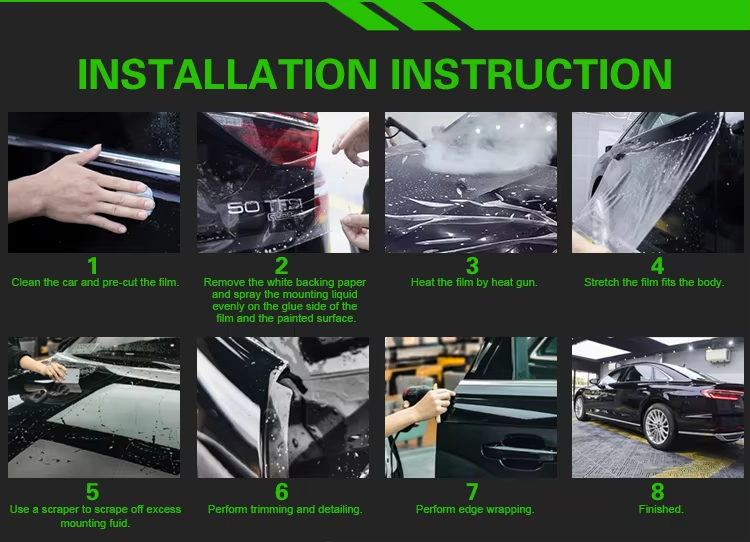
A technically excellent film can be rendered short-lived by a poor installation. Conversely, a mid-range film installed perfectly by a skilled installer will outlast a premium film with a substandard installation.
Surface preparation: PPF applied over contamination — silicone residue, wax, water spots, or paint that hasn’t been properly decontaminated — will fail at the adhesive interface. The film appears bonded initially but lifts progressively as the contamination layer weakens under temperature cycling.
Stretch and residual tension: Sections of film that were aggressively stretched to conform to complex curves hold residual tension that works against the adhesive bond over time. This is especially common around bumper corners, mirror housings, and door handle recesses. Film lifted off these areas at 18 months was often placed under too much tension during installation.
Edge finishing: How the film edges are finished — whether tucked around panel edges or cut on the surface — affects both appearance and longevity. Edges that terminate on the paint surface rather than wrapping around to a clean edge are more vulnerable to lifting and more visible as the film weathers differently from the surrounding paint.
Curing time: Fresh PPF installations need time for the adhesive to fully cure. Aggressive washing, high-pressure water on film edges, and harsh cleaning chemicals applied before the adhesive has fully set can initiate lifting that progresses over the following months.
Factor 5: Maintenance
PPF is easier to maintain than bare paint — but it’s not maintenance-free, and the wrong products shorten its life.
What accelerates aging:
- High-pH (alkaline) cleaning products that attack the top coat chemistry — common in automated car washes
- Petroleum-based cleaners and solvents that can swell or soften the film surface
- Abrasive compounds applied directly to PPF
- High-pressure washing directly at film edges (can initiate or accelerate lifting)
What extends life:
- pH-neutral car shampoos for regular washing
- PPF-compatible ceramic coating or sealant applied over the film — this adds a sacrificial layer and improves hydrophobicity, making the film easier to clean and protecting the top coat from chemical attack
- Prompt removal of bird droppings and insect debris — even though PPF resists the acids in these, sustained contact can eventually affect the top coat
- Annual inspection by the installer — identifying edge lifting or surface changes early allows for targeted repair before a section needs full replacement
Factor 6: The Warranty Question
PPF warranties range from 2 years (budget products) to 10 years (premium products). But warranties need context.
What PPF warranties typically cover:
- Yellowing beyond a defined threshold
- Bubbling and delamination not caused by mechanical damage or improper installation
- Cracking and hazing under normal use conditions
What they typically don’t cover:
- Damage from impacts, scratches, or abrasion
- Failure caused by improper installation (the warranty is with the manufacturer, not the installer)
- Failure caused by incompatible maintenance products
- Film that was installed improperly and then delaminated
The warranty’s value depends entirely on the manufacturer’s claims process and their willingness to honor it. A 10-year warranty from an established manufacturer with a documented claims history is worth something. A 10-year warranty from a budget supplier with no international distribution infrastructure is a marketing claim with limited practical enforceability.
Ask your installer: which manufacturer’s warranty covers this product? What’s the claims process if there’s a problem in year 4? Can they show you a case where the manufacturer honored a warranty claim?
Signs Your PPF Is Reaching End of Life
Knowing when to replace film is as important as knowing how long it should last.
Visual signs:
- Yellowing — the most obvious and most common, especially on PVC products
- Cloudiness or hazing that doesn’t respond to cleaning
- Cracking in the top coat, typically at leading edges or areas of high heat exposure
- Visible lifting at edges, corners, or around panel features
- Peeling sections where the adhesive bond has failed
Performance signs:
- Self-healing capability diminishing noticeably — scratches that would have healed in sunlight previously now don’t
- Water no longer beading on the surface (hydrophobic properties degrading)
- Adhesive residue becoming visible through the film in localized areas
At first signs of significant yellowing or cracking, the conversation with the customer is straightforward: the film has done its job and needs to be replaced. On a properly installed film, removal at this stage should be clean — the paint underneath should be in significantly better condition than it would have been without protection.
What to Tell Your Customers
For installers building customer relationships, the lifespan conversation is an opportunity to set honest expectations and build long-term trust.
The right framing: premium PPF is a consumable that protects the investment underneath it. A 7–10 year service life on a film that prevents one respray (which it almost certainly will) has paid for itself. At end of life, replacement is a routine maintenance item — not a product failure.
Customers who understand this upfront are less likely to feel misled when the film needs replacing at year 8, and more likely to return for the replacement installation.
FAQ
1. How long does premium TPU PPF last?
Premium TPU paint protection film typically lasts 7–12 years with proper installation and maintenance.
2. Does PVC PPF last as long as TPU PPF?
No. PVC PPF usually lasts 2–5 years and is more likely to yellow, crack, or lift over time.
3. What shortens the lifespan of PPF?
Strong UV exposure, poor installation, harsh chemicals, automatic car washes, and improper maintenance can reduce PPF lifespan.
4. Can ceramic coating extend PPF life?
Yes. A PPF-compatible ceramic coating helps protect the top coat, improves hydrophobicity, and makes cleaning easier.
5. How do I know when PPF needs replacement?
Common signs include yellowing, hazing, edge lifting, cracking, peeling, and reduced self-healing performance.
Evaluating PPF suppliers and want to verify longevity claims against actual test data? Contact us — we help buyers assess manufacturer credentials and connect with suppliers whose products perform to their warranty specifications.
Further Reading
On this site:
- What Is Paint Protection Film (PPF)? Complete Guide for Beginners — Full overview including what PPF does and doesn’t protect against
- TPU vs PVC PPF: Which Paint Protection Film Is Better? — Why material choice is the single biggest lifespan determinant
- 6.5mil vs 7.5mil vs 8.5mil PPF: What’s the Difference? — How thickness fits into the overall product decision
- Gloss PPF vs Matte PPF: Which Finish Should You Choose? — Maintenance differences between finish types
- How to Start Your Own Window Film Brand — Brand building guidance that applies equally to PPF product lines
External:
- ASTM Weathering and UV Testing Standards — Industry test protocols for accelerated aging in protective films
- Atlas Weathering Services — Third-party accelerated weathering testing used by PPF manufacturers to validate lifespan claims
- SEMA Vehicle Appearance Resources — Industry body guidance on automotive appearance product standards
- International Carwash Association — Relevant context on car wash chemical compatibility with PPF products
Get a Free Sample or Quote
Looking for a reliable window film supplier? Contact us today for fast response and professional support.