Published: June 6, 2026 · 8 min read · Category: PPF Guide
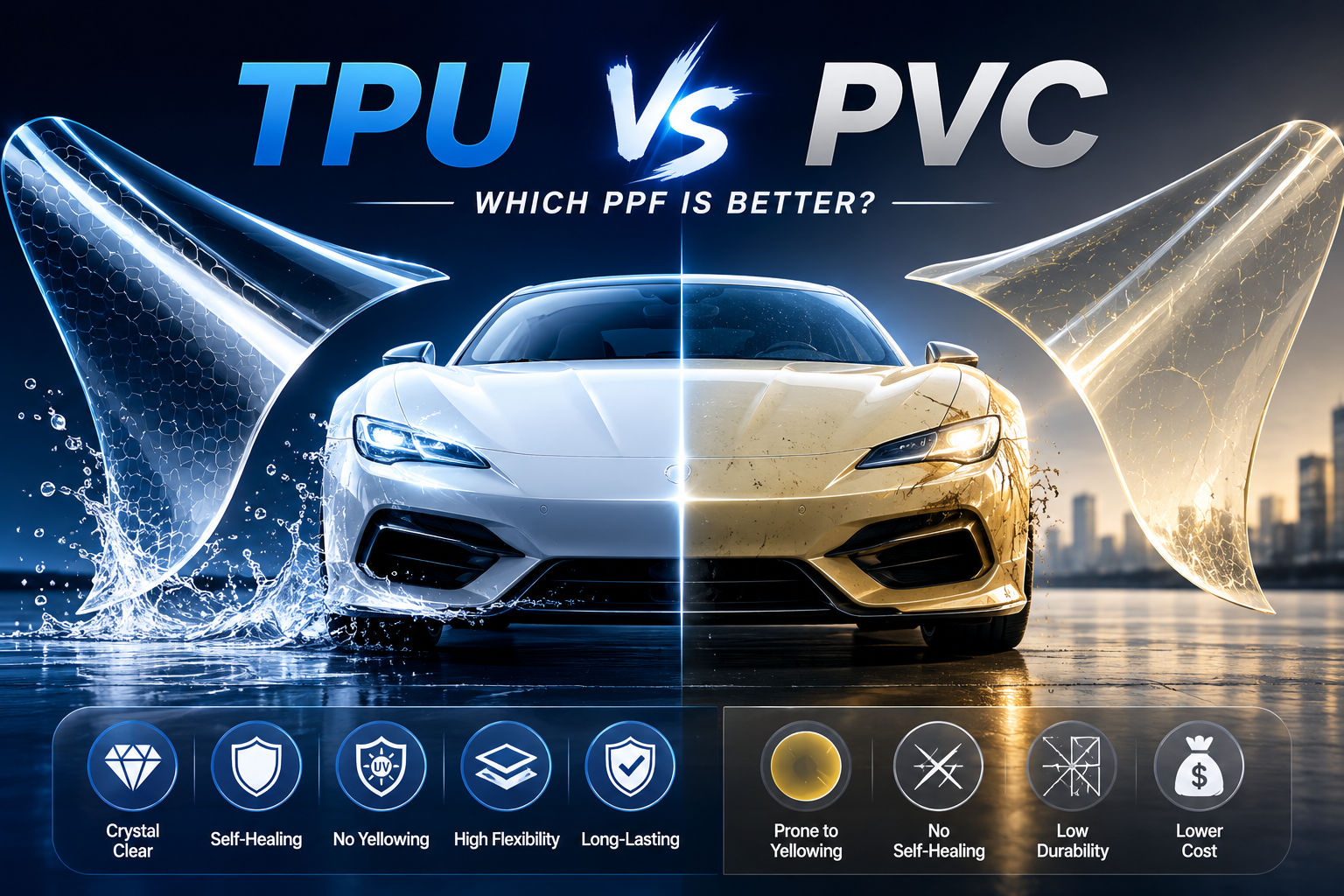
If you’ve been shopping for paint protection film — or sourcing it as a distributor — you’ve likely encountered both TPU and PVC products, sometimes side by side, sometimes without the material type being clearly disclosed.
The price difference between them can be significant. So can the performance difference. But the marketing language on both sides doesn’t always make it easy to understand what you’re actually comparing.
This article breaks down what TPU and PVC actually are, how they perform differently in real-world applications, and which one belongs in your product lineup or on your vehicle.
The Materials: A Quick Grounding
PVC (Polyvinyl Chloride) is one of the most widely used plastics in the world — it’s in pipes, cables, flooring, packaging, and a thousand other applications. It’s inexpensive to produce, relatively easy to process, and reasonably durable in low-stress environments.
In the context of paint protection film, PVC was the dominant material in early products — particularly in the 1990s and early 2000s. It’s still used in budget PPF products today.
TPU (Thermoplastic Polyurethane) is a more sophisticated polymer — physically more elastic, optically clearer, and significantly more resistant to temperature extremes and UV degradation than PVC. It’s used in applications where flexibility, durability, and performance under stress matter: medical devices, industrial hoses, automotive interior components, and — since it became economically accessible for film manufacturing — high-performance paint protection film.
The shift from PVC to TPU in quality PPF products wasn’t a marketing decision. It happened because TPU performs better on vehicles in almost every dimension that matters for paint protection.
Clarity: The Most Visible Difference
Put a sample of quality TPU film and a sample of PVC film on the same painted surface and look at them carefully. The TPU film is, in most cases, optically closer to invisible. The PVC film may have a slight plastic sheen or a subtle coloring that’s more noticeable on darker paint colors and in certain lighting conditions.
This matters for two reasons.
First, aesthetically: one of the primary requirements of paint protection film is that it doesn’t significantly change the appearance of the protected surface. Film that reads as “plastic” on the paint undermines that requirement.
Second, as a quality indicator: the optical clarity of a PPF product reflects the quality of the base material and the manufacturing process. Haze, cloudiness, or slight discoloration at the edges of a film section are signs of lower material quality or inconsistent coating — and they tend to worsen over time rather than improve.
Yellowing: The Long-Term PVC Problem
This is the most significant practical difference between the two material types, and the one that creates the most customer complaints in the PPF category.
PVC yellows. It’s a well-documented phenomenon caused by UV exposure degrading the polymer structure and the plasticizers used in PVC formulation. On a vehicle, this means a film that’s acceptably clear at installation starts to develop a yellow or brownish tint over time — typically becoming noticeable at 2–4 years on a vehicle with regular sun exposure.
On white or light-colored vehicles, yellowing PPF is particularly obvious. On a white hood, a yellowed film section looks like the paint has stained. On darker colors, the contrast is less stark but still visible up close.
TPU, by contrast, has substantially better UV stability. Premium TPU-based PPF from established manufacturers is formulated with UV inhibitors in the base material and the top coat that dramatically slow the yellowing process. Quality TPU products can maintain optical clarity for 7–10 years on vehicles with typical outdoor exposure.
For professional installers, this distinction is existential: a customer who paid for paint protection film and calls two years later because it’s turned yellow is not a satisfied customer. The product recommendation that led to that outcome damages the installer’s reputation regardless of whose film it was.
Self-Healing: TPU’s Inherent Advantage
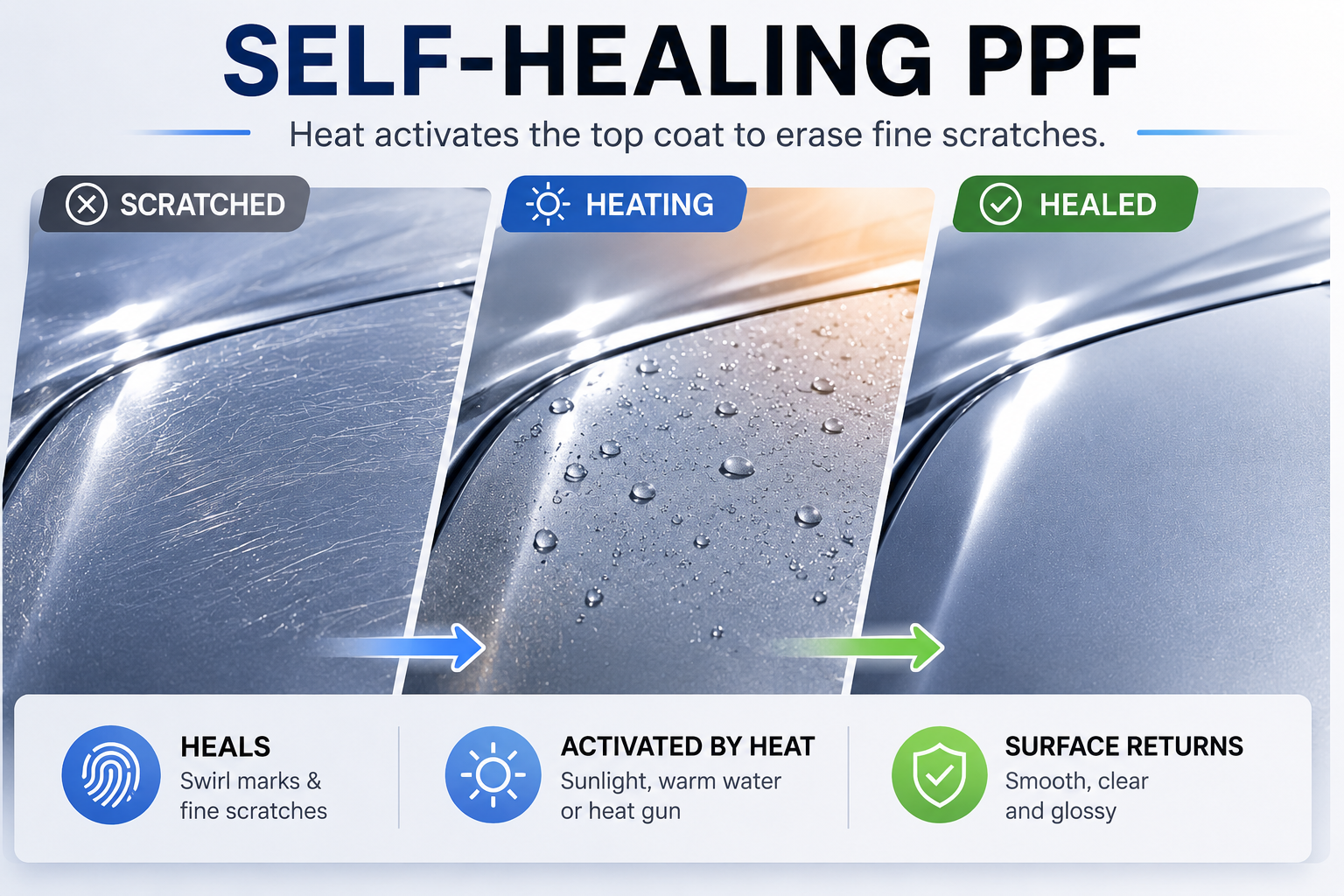
Modern PPF’s self-healing capability — where light surface scratches disappear when the film is exposed to heat — is fundamentally a property of TPU chemistry.
The elastic memory that allows the film’s top coat to return to its original state after deformation is a characteristic of polyurethane polymer chains. PVC doesn’t have this property in any meaningful way. PVC-based PPF films can incorporate self-healing top coats, but the underlying material doesn’t support the same performance level as a TPU substrate.
In practice: self-healing PPF is almost exclusively TPU. Budget PVC products are not marketed as self-healing because they aren’t, or because the performance claim is so marginal as to be meaningless.
Conformability: Wrapping Complex Curves
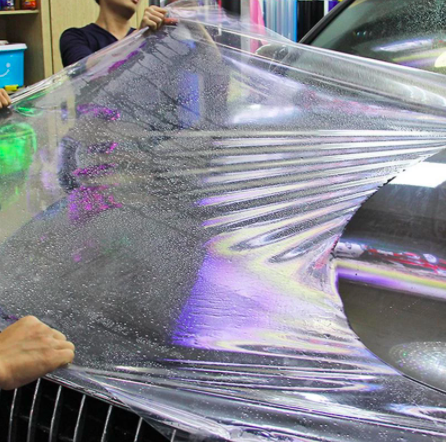
Applying PPF to a modern vehicle involves dealing with complex compound curves, tight radii, and panel shapes designed for aerodynamics rather than easy film application. The film needs to stretch, conform to the surface, and lie flat without lifting, bubbling, or developing stress wrinkles.
TPU is significantly more elastic and conformable than PVC. It stretches further before tearing, conforms to tighter curves, and recovers better if a section needs to be repositioned during installation.
This matters both to the installer — TPU is easier to work with, especially on complex panels — and to the longevity of the installation. Film that was stressed during installation holds residual tension that can cause edge lifting over time. Conformable film reaches its final position with lower residual stress and better long-term adhesion.
Temperature Performance
Vehicles experience temperature extremes — from winter storage in subfreezing conditions to summer parking in direct sunlight where panel surface temperatures can exceed 80°C (176°F). The film needs to maintain adhesion and dimensional stability across this entire range.
PVC becomes brittle at low temperatures and soft at high temperatures — the plasticizers that make it flexible at room temperature migrate out of the polymer over time, causing the film to become stiffer and more prone to cracking, particularly at edges and in low-temperature conditions.
TPU maintains its mechanical properties across a much wider temperature range. It flexes rather than cracks in the cold, and it doesn’t soften to the point of deformation in high heat. For vehicles in climates with significant seasonal temperature variation, this is a meaningful durability difference.
Chemical Resistance
Paint protection film is exposed to fuel splash, insect acids, bird droppings, road tar, and cleaning chemicals. How the film responds to these exposures affects both the surface appearance and the integrity of the film over time.
TPU generally has better chemical resistance than PVC, particularly to acidic substances. Bird dropping and insect damage — one of the primary protection use cases for PPF — is less likely to etch through TPU and reach the paint underneath.
PVC is susceptible to certain solvents and cleaning chemicals that are commonly used in car care — including some of the products installers use during the installation process. A PVC film that encounters an incompatible chemical can cloud, lift at edges, or delaminate.
Installation: A Note for Professionals
For installers who’ve worked with both material types: the installation experience is notably different.
TPU films are stretchier and more forgiving during application. They can be repositioned more readily, conform to curves with less heat application, and recover better if pulled. The learning curve on complex installations is shallower with a conformable TPU film.
PVC films are stiffer and less forgiving. Mistakes during application are harder to correct. Edge finishing on tight radii is more difficult. For newer installers, the margin for error on a PVC film installation is narrower.
This isn’t irrelevant to buyers — the installation quality you get from a given installer reflects both their skill and the material they’re working with.
Cost: The PVC Advantage (and Its Limits)
PVC PPF is cheaper. That’s the honest answer to why it still exists in the market.
For price-sensitive applications — a used vehicle where the owner wants some protection without a premium investment, a fleet operator protecting panel edges on commercial vehicles, or market segments where the value proposition of premium film doesn’t translate to the buyer — PVC products can be a legitimate, lower-cost option.
The practical ceiling: a yellowing film is a product failure from the customer’s perspective, regardless of what the installer paid for it. The cost saving of PVC over TPU per job is typically measured in tens of dollars. The cost of an unhappy customer — refund demands, reputation damage, replacing the film — is measured in hundreds. For most professional installers, this math points clearly toward TPU.
The Verdict
For any installation where optical clarity, longevity, and professional quality matter — which is most installations on vehicles the owner cares about — TPU is the correct choice. The price premium is modest at the roll level and justified several times over by the performance difference.
PVC has a place in low-cost, short-term, or non-critical applications. It doesn’t have a place in professional paint protection work done to a standard the installer is willing to put their name on.
For Distributors and Sourcing Buyers
If you’re building a PPF product line, the TPU vs. PVC decision is also a brand positioning decision. Stocking PVC products in a line that’s positioned as professional-grade creates a credibility gap that will surface in installer feedback eventually.
For guidance on sourcing and manufacturer selection in the PPF category, the principles in our Window Film Factory Audit Checklist apply directly to PPF manufacturer evaluation — the verification questions are nearly identical.
FAQ
1. What is the main difference between TPU and PVC PPF?
TPU PPF offers better durability, self-healing, flexibility, and yellowing resistance, while PVC PPF is more affordable but lower in long-term performance.
2. Does TPU PPF yellow over time?
High-quality TPU PPF has strong UV resistance and can maintain clarity for many years with proper care.
3. Why is PVC PPF cheaper than TPU PPF?
PVC uses lower-cost materials and a simpler manufacturing process, making it more budget-friendly.
4. Which PPF has better self-healing performance?
TPU paint protection film provides significantly better self-healing capability than PVC film.
5. Is TPU PPF easier to install?
Yes. TPU film is more flexible and conformable, making installation easier on curved vehicle surfaces.
Looking to source TPU PPF for distribution or OEM branding? Contact us — we work with verified TPU film manufacturers and can help match product specs to your market requirements.
Further Reading
On this site:
- What Is Paint Protection Film (PPF)? Complete Guide for Beginners — Foundation overview before the material comparison
- Gloss PPF vs Matte PPF: Which Finish Should You Choose? — Finish options for TPU-based products
- 6.5mil vs 7.5mil vs 8.5mil PPF: What’s the Difference? — Thickness as the other major product variable
- How Long Does Paint Protection Film Last? — How material type affects longevity
- What Certifications Should a Window Film Manufacturer Have? — Certification framework applicable to PPF manufacturers
External:
- TPU Technical Properties — Covestro — Technical reference on TPU material properties from a major polymer manufacturer
- SEMA Automotive Film Resources — Industry standards context for automotive protective films
- Intertek Automotive Testing — Third-party testing for PPF performance verification
Get a Free Sample or Quote
Looking for a reliable window film supplier? Contact us today for fast response and professional support.