The Future of Nano Coating Technology in Window Films
Published: July 24 , 2026 · 8 min read · Category: Industry Insights
About this article: KSB Window Film’s technical team actively tracks nano coating R&D through supplier relationships, industry conferences, and material science publications. The product developments discussed in this article reflect what we’re seeing at the manufacturing level — not academic forecasts.
Advanced nano coating technologies in window films including CTO and multi-layer nanocomposite structures
Nano coating technology in window films has already delivered one major commercial breakthrough — the nano ceramic category that now dominates the professional installer market. What’s coming next builds on the same foundation of precision nanoscale material engineering, and several developments are close enough to commercial reality that buyers and distributors should be paying attention.
This article covers the nano coating developments that are most likely to matter for window film products in the next five years — not science fiction, but real material science that’s transitioning from research labs toward manufacturing scale.
What Nano Coatings Currently Do in Window Films
Current nano coating technology in window film focuses primarily on two functions: thermal management (ceramic nanoparticles absorbing and reflecting infrared radiation) and optical control (nano-scale particle sizing maintaining clarity while filtering specific wavelengths).
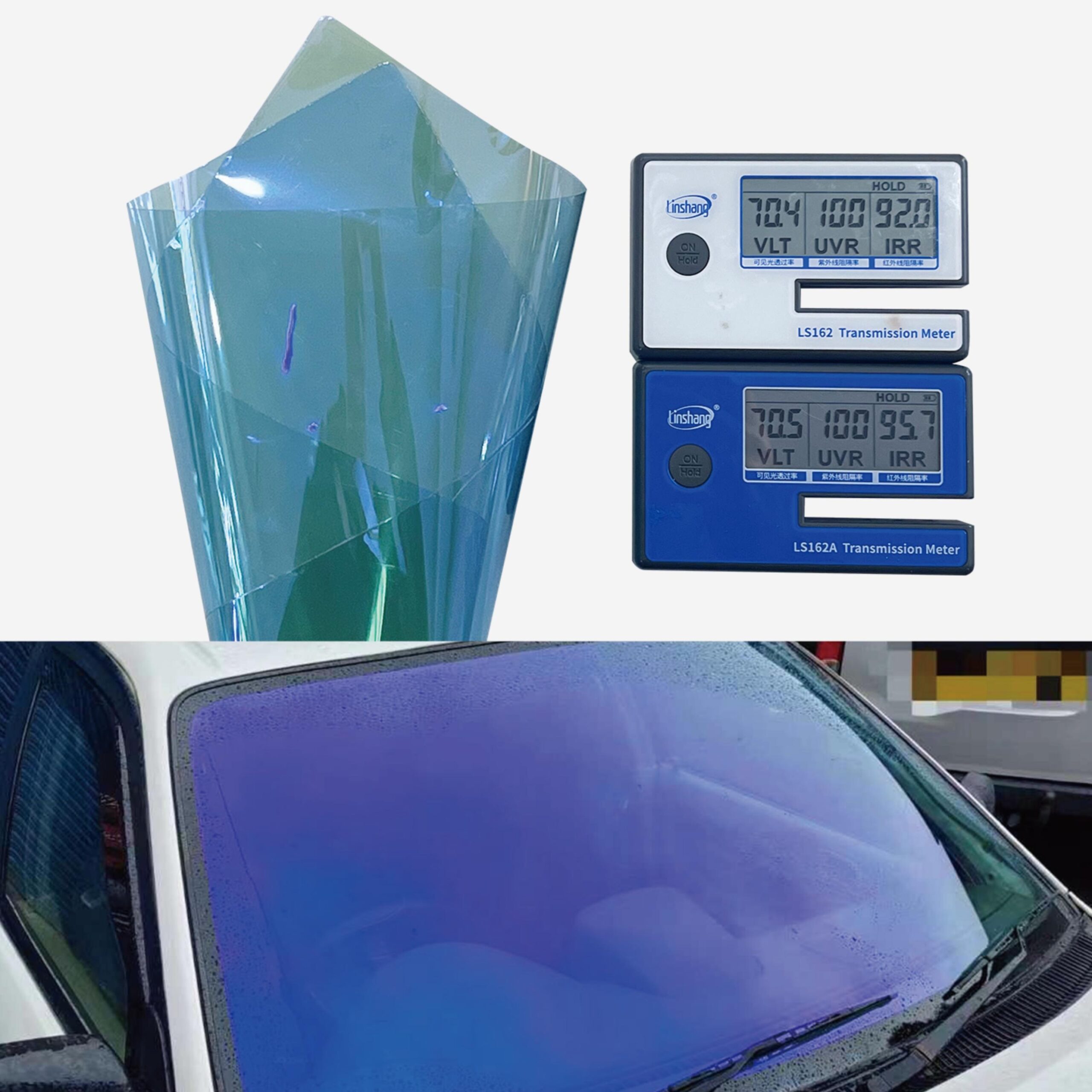
The state of the art in 2026 for production ceramic film: TSER above 70% at visible light transmittance of 35–50%, with haze below 2%. These are genuine achievements that would have been difficult to manufacture consistently five years ago.
What current technology doesn’t do well: the IR rejection is good but not perfect (significant IR still transmits), the transition between UV/IR blocking and visible light transmission isn’t perfectly selective, and the coatings are passive — they can’t adapt to changing conditions.
The next generation addresses each of these limitations.
Cesium Tungsten Oxide: The Near-Term High-Performance Material
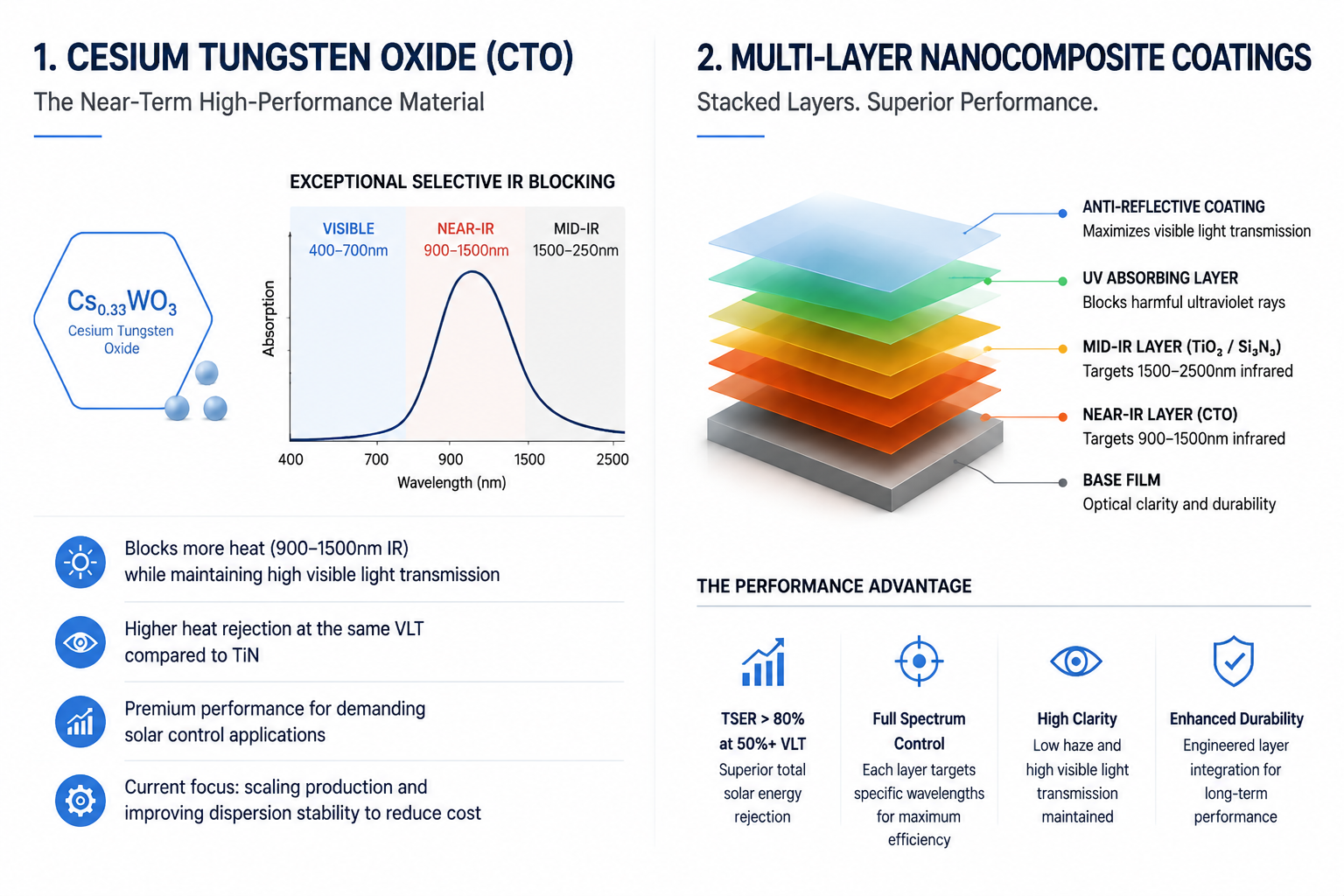
Cesium tungsten oxide (Cs₀.₃₃WO₃) has emerged as one of the most promising materials for next-generation selective IR blocking in window films. Its key property: extremely strong absorption in the near-infrared range (900–1,500nm) with minimal absorption in the visible spectrum (400–700nm).
This selectivity — blocking heat without blocking light — is what every window film engineer is trying to maximize. CTO achieves it more efficiently than titanium nitride for certain application profiles, particularly where visible light transmission is a priority.
Commercial CTO-based window films exist today at the premium end of the market. The near-term development is scaling production to reduce cost and improving the dispersion stability of CTO nanoparticles in coating formulations — the challenge with CTO is that it’s more prone to agglomeration than TiN, requiring more sophisticated dispersion chemistry.
Manufacturers who’ve solved the CTO dispersion problem consistently produce film with meaningfully better heat rejection at equivalent VLT than TiN-based alternatives. This is real product differentiation that shows up in third-party test data.
Multi-Layer Nanocomposite Coatings
Current ceramic window film typically uses one or two functional coating layers. Advanced research and early commercial products are demonstrating what multi-layer nanocomposite coatings can achieve: stacked functional layers, each targeting a specific portion of the solar spectrum, combined to achieve solar control performance that no single-layer coating can match.
A multi-layer architecture might include:
A CTO layer targeting near-IR (900–1,500nm)
A titanium oxide or silicon nitride layer targeting mid-IR (1,500–2,500nm)
UV-absorbing organic or inorganic layer
Anti-reflective optical coating to maximize visible light transmission
The combined performance of these layers can push TSER above 80% at 50%+ VLT — numbers that current single-layer ceramic products can’t achieve. Several manufacturers are in late-stage development of multi-layer nanocomposite automotive and architectural films.
The manufacturing challenge: each additional layer requires precise deposition, and the interaction effects between layers need to be engineered carefully. This is where firms with sophisticated sputtering infrastructure and coating R&D capability have a significant advantage over simpler converters.
Phase-Change Nano Materials for Thermal Regulation
Perhaps the most technically interesting near-term development: nanoparticle coatings that change their optical properties in response to temperature, without any electrical input.
Vanadium dioxide (VO₂) undergoes a reversible metal-insulator phase transition at approximately 68°C — below that temperature, it’s transparent to IR; above it, it reflects IR. Researchers have been working to lower this transition temperature to the range of glass surface temperatures on a sunny day (40–60°C) through nanostructuring and doping.
The commercial implication: a window coating that automatically becomes more reflective when the glass gets hot (when solar control is most needed) and transparent when cool. No power supply. No controller. No user action required. The coating manages itself based on temperature.
Several Chinese and European research groups have achieved VO₂ transition temperatures in the 35–45°C range — the relevant range for automotive glass in hot climates. Lab-scale samples show good performance. The challenge: VO₂ coatings at these transition temperatures currently have modest visible transmittance (the phase transition affects visible light as well as IR to some degree) and haven’t yet demonstrated the cycle durability required for 10-year window film service life.
Commercial thermochromic window film products are likely 3–5 years from mainstream availability. When they arrive, they’ll be marketed primarily at automotive applications in hot climates and at commercial building facade applications where automated solar management is valued.
Anti-Fouling and Self-Cleaning Nano Coatings
TiO₂ (titanium dioxide) nanoparticles have photocatalytic properties — when exposed to UV light, they catalyze the decomposition of organic surface contamination. This “self-cleaning” mechanism has been applied to exterior glass for years, and is being integrated into window film products.
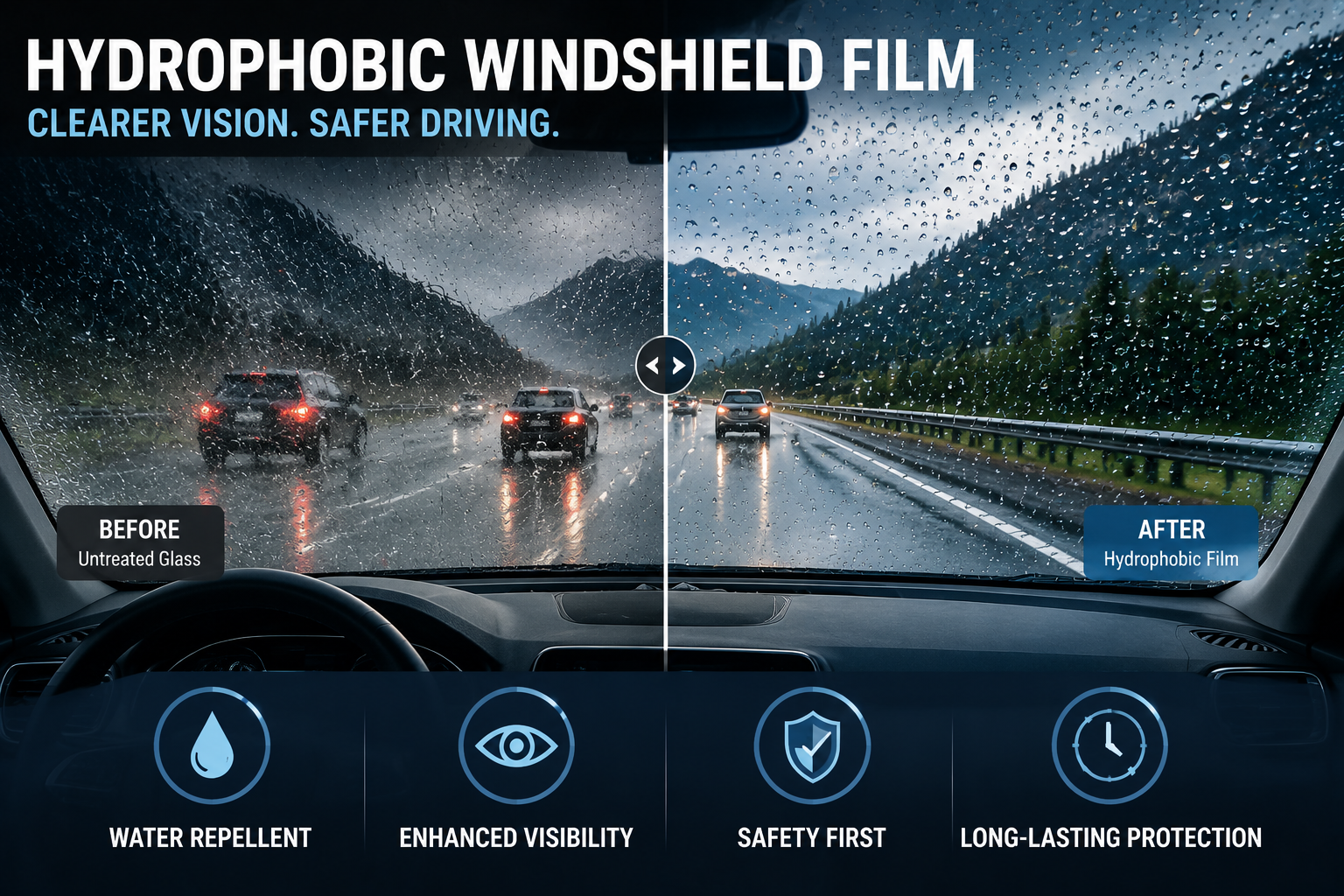
The application: a window film with a TiO₂ photocatalytic top coat that breaks down surface organic contamination (bird droppings, insect residue, pollen, atmospheric particulate) when exposed to UV. Combined with hydrophilic or hydrophobic properties, this produces a film that requires significantly less manual cleaning to maintain optical clarity.
Commercial products combining solar control with photocatalytic self-cleaning surface properties are available at the premium end of the architectural film market. The challenge for photocatalytic films is that the same reactive oxygen species that breaks down contamination can also attack the polymer top coat if the chemistry isn’t carefully balanced — durability testing is critical.
Anti-Microbial Nano Coatings
Silver nanoparticles and other nano-scale anti-microbial agents embedded in or applied to film surfaces create surfaces with documented pathogen-reduction properties. For healthcare and public space applications — glass partitions in hospitals, glass surfaces in schools and transit systems — this has genuine functional value.
The technical challenge: anti-microbial efficacy needs to be maintained over years of cleaning and environmental exposure. Some silver-ion release mechanisms deplete over time. Newer formulations using more durable nano-scale silver structures show better longevity — but durability data over realistic service lifetimes is still accumulating.
What This Means for Buyers
In the next 1–2 years: Multi-layer nanocomposite films and CTO-optimized ceramics will deliver measurably better performance than current single-layer ceramic. If you’re building a premium product range, these are the products to evaluate as they come to market.
In 3–5 years: Thermochromic passive smart coatings will enter the market. When they do, they’ll create a new performance category above current static ceramic film for automotive and building applications. Distributors who’ve built ceramic film expertise will be positioned to adopt the next tier.
Now: The performance claims on current ceramic products are worth verifying more carefully than before. As multi-layer and CTO products enter the market, single-layer TiN products that were competitive two years ago may be technically outclassed by new entries. Third-party test data with full-spectrum IR measurement is the only reliable way to track the performance frontier.
FAQ
How do I know if a ceramic film uses CTO vs TiN?
Ask the manufacturer directly. They should be able to name their ceramic compound. CTO-based films typically show very high near-IR rejection with good visible light transmission — the selective absorption profile shows up in spectrophotometer data as a distinct absorption peak in the 900–1,500nm range. A spectrometric comparison of a CTO-based film against a TiN-based film will show measurably different spectral profiles.
Is multi-layer film more prone to delamination?
It depends on the adhesion between layers and the quality of the lamination process. Well-engineered multi-layer films from manufacturers with rigorous lamination processes have delamination rates comparable to single-layer products. Poorly laminated multi-layer films can have adhesion failures at layer interfaces that single-layer products don’t have. Ask specifically about delamination testing data when evaluating multi-layer products.
Will thermochromic film replace ceramic film?
No — the two products serve different functions. Thermochromic film modulates solar transmission based on temperature (passive, automatic solar control). Ceramic film provides fixed solar control regardless of temperature. Thermochromic is better at optimizing for varying conditions; ceramic is better for applications where a consistent level of solar rejection is required. Both will have market roles.
Are nano coatings safe?
Engineered nanoparticles in consumer products have received significant regulatory scrutiny, particularly in the EU under REACH. The nanoparticles in window film are embedded in polymer matrices — they’re not free particles in the way that some nanoparticle concerns (inhalation of airborne nanomaterials) relate to. REACH compliance testing on nano-containing products covers this. Products from manufacturers with current REACH documentation have been assessed for nanoparticle concerns.
Stay Current With KSB’s Ceramic Film Development
KSB Window Film is actively evaluating CTO-enhanced and multi-layer nanocomposite formulations for upcoming product releases. Distributors who want early access to next-generation ceramic products as they reach commercial availability are welcome to join our product development preview program.
In the meantime, our current premium ceramic series is fully third-party tested and available for immediate sampling.