Published: June 30, 2026 · 8 min read · Category: PPF Sourcing
About this article: KSB Window Film supplies wholesale TPU PPF to distributors and installer networks globally. This guide addresses the wholesale buying decisions we help buyers work through most frequently.
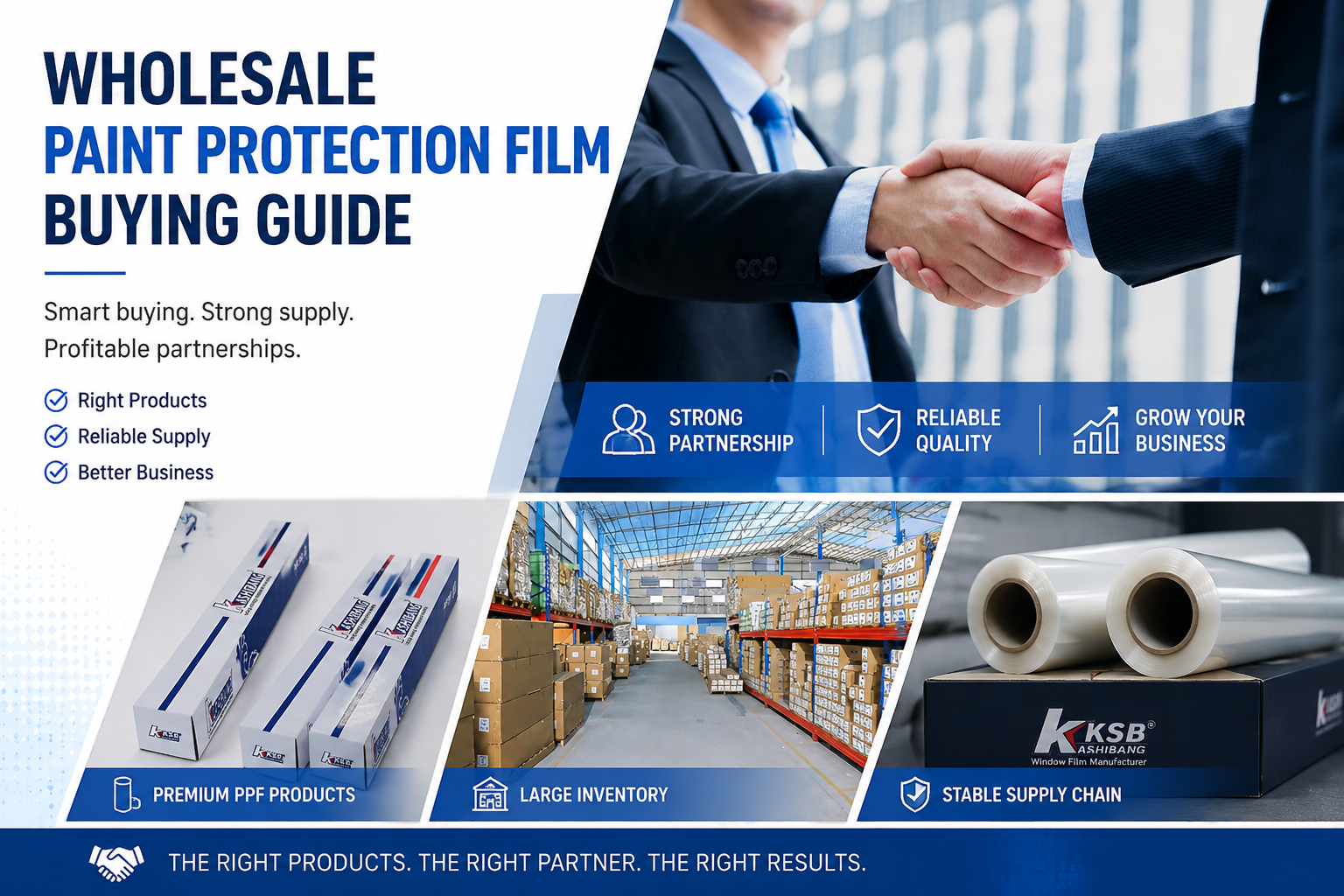
Wholesale PPF buying is a distinct activity from evaluating a single product or placing one order. It’s a supply chain management function — balancing product range, inventory commitment, price tiers, supplier relationships, and the install-ready requirements of your installer accounts.
This guide covers wholesale PPF buying as a business operation.
Building Your Product Range
The SKU Decision
Too many SKUs create inventory complexity and fragment your buying volume across products. Too few SKUs leave gaps that push your installer accounts to other distributors.
Most successful PPF distributors operate on the 80/20 principle: 2–3 SKUs generate the majority of revenue, and 3–5 tail SKUs fill coverage gaps.
Core SKUs every distributor needs:
- Mid-range gloss (7.5 mil): Your volume product. Positioned as the professional standard. Strong self-healing, good optical clarity, competitive pricing. This is what most jobs get specified with.
- Premium gloss (8–8.5 mil): Your upsell. Used for high-value vehicles, luxury and exotic applications, clients who want the best. Higher margin, lower volume.
High-value additions:
- Matte/satin finish: Growing demand, premium pricing tolerance, natural upsell alongside gloss. Can’t be substituted by gloss in any application.
- Pre-cut kits support: While kits themselves are software + cutting equipment, stocking the bulk film your installers cut from is essential if they run pre-cut kit programs.
What to Avoid
Stocking 8+ SKUs at launch dilutes your buying volume, increases warehouse complexity, and creates cash flow management challenges. The tendency to stock everything “just in case” results in multiple slow-moving lines that sit in your warehouse for months. Start narrow, go deep on core SKUs, and add based on demonstrated installer demand.
Supplier Structure: Don’t Rely on a Single Source
Single-source supply chains are operationally simple and strategically fragile. A production delay, quality issue, or capacity problem at one factory affects your entire product range. Experienced wholesale buyers maintain:
Primary supplier (70–80% of volume): Your main factory relationship. Best pricing through volume concentration. Deep product knowledge. OEM development if volume justifies.
Secondary supplier (15–25% of volume): Backup supply for core SKUs. Different factory — same product spec. Activated when primary has a production issue or your volume exceeds primary capacity.
Spot supplier: Optional. A trading company or secondary factory for occasional tail SKU needs that don’t justify direct factory volume.
This structure costs more to set up and manage than single-source supply. It costs far less than a stock-out situation when your primary factory has a two-week production shutdown.
Price Tier Management
PPF wholesale pricing is volume-sensitive in ways that create real competitive advantages at scale.
Typical factory pricing structure (per roll, indicative):
| Monthly Volume (rolls) | Price Index |
|---|---|
| 50–150 | 100% (base) |
| 150–400 | 88–92% |
| 400–800 | 80–86% |
| 800+ | 72–78% |
The jump from 150 to 400 rolls/month is often where meaningful margin improvement happens. If your volume is consistently approaching a tier threshold, consolidating SKUs or timing orders to cross the threshold is worth the working capital analysis.
Inventory Management for PPF
Lead Time Reality
Ocean freight from China: 14–32 days depending on destination. Production lead time (reorder): 3–5 weeks for stock products. Total replenishment cycle: 6–10 weeks from reorder to goods available.
Implication: Reorder points must be set based on 8–10 weeks of forward demand, not current stock levels. The distributor who reorders when inventory is low is the one who stocks out.
Shelf Life
PPF has a shelf life. Adhesive chemistry changes over time, PET base yellows (in PVC products), and top coat elastomeric properties degrade with age. Quality TPU film from reputable manufacturers: 3–5 years from production date if stored correctly (climate controlled, horizontal on racks, away from UV exposure).
Operate first-in, first-out (FIFO) rotation. Selling aged stock generates installation problems and warranty claims that cost more than the inventory was worth.
Seasonal Demand Patterns
PPF installation demand follows vehicle purchase cycles and seasonal driving patterns. Peaks typically in spring (new vehicle season) and late summer/early autumn (pre-winter preparation). Plan inventory 6–8 weeks before your expected peak — not during it.
Pricing Your Wholesale Range to Installer Accounts
Margin Principles
Your pricing to installers needs to:
- Leave enough margin for the installer to make money on each job
- Leave enough margin for you to run a profitable distribution business
- Stay competitive versus other distributors in your market
Typical installer margin on film product (their purchase cost vs. their retail charge to customers): 50–100% markup. If your mid-range gloss costs the installer $85/roll and they install a bonnet job using 1.5 rolls, their material cost is $128 and they charge the customer $300–$400 for the bonnet. That math needs to work.
Private Label Premium
If you’re distributing under your own brand, you have pricing flexibility that stock-brand distributors don’t. Installers who’ve committed to your brand and trained on your products are less likely to price-shop you against alternative distributors of the same product. This loyalty enables premium pricing that improves your margins while keeping the overall economics attractive for your installer accounts.
FAQ
How many installer accounts do I need to justify a direct factory relationship?
At the point where your monthly volume from a factory exceeds 200 rolls consistently — direct factory pricing, payment terms, and OEM development access justify the relationship management overhead. Below 200 rolls, a trading company or domestic distributor may be more appropriate.
Should I carry both gloss and matte from the same manufacturer?
Generally yes. Film appearance consistency (colour, optical quality) between gloss and matte matters when installers combine both on one vehicle. Same manufacturer = same base TPU = more consistent appearance match.
What’s the risk of a distributor exclusivity agreement with a factory?
Exclusivity agreements give you territorial protection on products but may also create minimum volume commitments that are challenging if your market softens. Negotiate exclusivity with realistic volume minimums — achievable in normal trading conditions, not dependent on exceptional growth.
Further Reading
On this site:
- How Much Does Paint Protection Film Cost? — Cost structure from manufacturing through to installation
- How to Import Paint Protection Film from China — Import process for wholesale buyers
- How Long Does Paint Protection Film Last? — Key factors affecting PPF lifespan and long-term durability
- PPF Factory Audit Checklist for Importers and Distributors — Key factory evaluation points for quality, capacity, and compliance
External:
- SEMA Automotive Distribution Resources — Industry context for automotive aftermarket distribution
Build Your Wholesale Programme With KSB
KSB Window Film operates distributor wholesale programs with tiered pricing, private label capability, and OEM development for accounts building their own brands. Our export team works with new and established distributors across multiple markets.
→ Request KSB’s wholesale distributor program overview — we respond within one business day.
Get a Free Sample or Quote
Looking for a reliable window film supplier? Contact us today for fast response and professional support.