XPEL vs TPU Paint Protection Film: What’s the Difference?
Published: July 28, 2026 · 8 min read · Category: PPF Guide
About this article: KSB Window Film manufactures and distributes TPU PPF alongside our window film range, supplying OEM and private label programs to distributors in multiple markets. This comparison reflects our direct product experience across the PPF category.
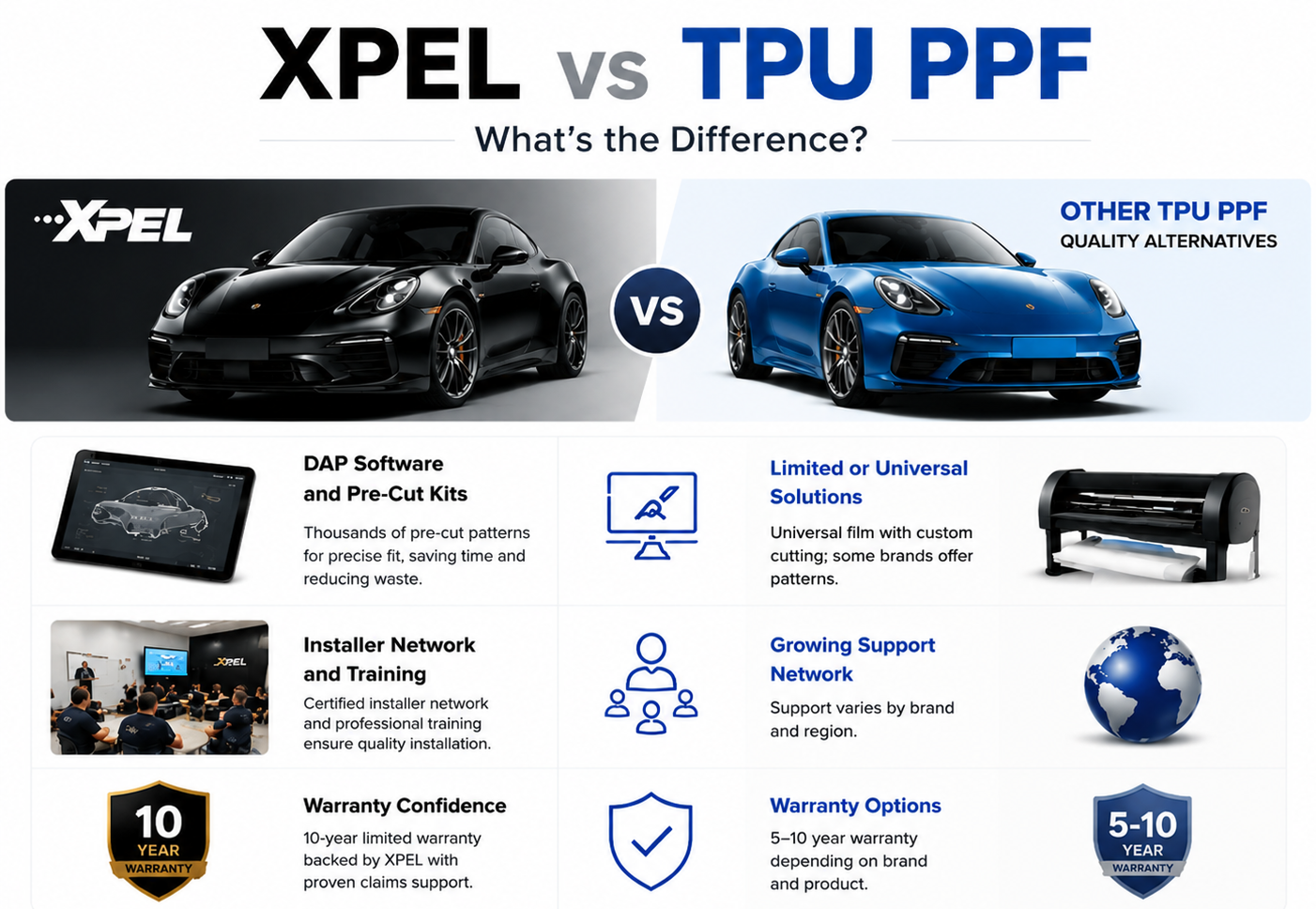
Simplified comparison of XPEL and TPU PPF highlighting software access, installer network training, and warranty support differences
The comparison that comes up most often in PPF conversations is XPEL vs. “the alternatives.” XPEL has achieved brand recognition in paint protection film comparable to what 3M has in window film — the name is the reference point, and buyers want to know how other options measure up.
The comparison is slightly complicated because “XPEL vs TPU PPF” frames it as brand vs. material, which mixes two different categories. XPEL’s products ARE TPU-based PPF. The real comparison is XPEL vs. other TPU PPF options — which is a more useful question.
This article clarifies the comparison, covers what XPEL actually offers, and explains where competing products are genuinely equivalent and where the brand premium reflects something real.
What XPEL Is
XPEL is a San Antonio-based company that produces and distributes paint protection film, window tint (under the XPEL Prime brand), and ceramic coating products. Their flagship PPF products — XPEL Ultimate Plus and XPEL Stealth — are among the most widely recognized brands in professional PPF installation globally.
XPEL’s products are TPU-based. They use premium thermoplastic polyurethane film with proprietary self-healing top coat chemistry. The film is manufactured in partnership with Avery Dennison and other industrial partners, not in XPEL’s own factories — XPEL is primarily a product development, software, and distribution business.
XPEL’s competitive advantage has two components: product performance (genuine, documented, consistently good) and the DAP (Design Access Program) software that provides pre-cut kit patterns for thousands of vehicle models. The software has been a significant installer-side differentiator — the availability of precise, vehicle-specific pre-cut patterns reduces installation time and material waste substantially.
TPU PPF in General: What You’re Actually Comparing
When buyers or installers compare “XPEL vs TPU PPF,” they’re often really asking: “Is XPEL worth paying a premium over other TPU products?”
The honest answer requires separating the product from the brand:
Product performance: XPEL Ultimate Plus tests well on the metrics that matter — optical clarity (haze below 1%), self-healing speed, adhesion strength, and UV stability. These are properties of the TPU compound and top coat formulation. Other TPU PPF products from quality manufacturers achieve comparable metrics.
Brand infrastructure: XPEL’s dealer training and certification program, its software access for pre-cut patterns, its warranty claims process, and its brand recognition with end consumers are genuinely valuable components. These are things you’re partly paying for when you pay the XPEL premium.
Where Competing TPU Products Are Genuinely Equivalent
Raw Material Quality
Premium TPU PPF from competitive manufacturers — Stek, Llumar, 3M Pro Series, SunTek, and several premium Chinese manufacturers — uses equivalent-grade TPU base materials. The polymer chemistry behind self-healing, optical clarity, and mechanical protection is well-understood and available to any manufacturer sourcing from major TPU suppliers.
A film using Covestro or Huntsman TPU at an appropriate grade will have the physical properties required for competitive performance regardless of whether it’s branded XPEL or anything else.
Self-Healing Performance
Several competing products match XPEL’s self-healing speed and scratch recovery. Stek DYNOshield, SunTek Ultra, and premium products from Chinese manufacturers (Sino Performance Films, others) achieve comparable fine-scratch recovery times in equivalent temperature conditions. The elastomeric top coat technology is not XPEL-exclusive.
Impact Resistance
At equivalent thickness (7.5 mil or 8.5 mil are the common standards), TPU PPF from quality manufacturers delivers comparable rock chip protection. The TPU’s mechanical properties — elongation at break, tensile strength, impact absorption — are determined by the polymer grade and film construction, not the brand.
Where XPEL Has Genuine Advantages
DAP Software and Pre-Cut Kits
This is XPEL’s most significant practical advantage for installers. The Design Access Program provides installer access to a massive library of pre-cut kit patterns for specific vehicle makes, models, and years. The patterns are refined based on installer feedback over years of real-world installation. Precision pre-cut kits reduce installation time and produce cleaner edge finishes than bulk-roll installations cut on-site.
Competing software systems exist — Suntek has its own pattern library, SolarGard/Tint Tek have pattern software — but XPEL’s DAP library is the broadest and most refined. For installers who do high-volume PPF work across many vehicle models, access to XPEL’s pattern library has real commercial value.
Installer Network and Training
XPEL’s certified installer program provides training that ensures a baseline installation quality across their dealer network. For consumers buying XPEL through an authorized dealer, the certification provides some quality assurance beyond the product itself.
Warranty Confidence
XPEL’s product warranty is well-known in the industry — their warranty claims process has a track record, and consumers can verify warranty terms clearly. “Backed by XPEL warranty” communicates something to end consumers that a warranty from an unknown brand doesn’t.
The Price Gap: What You’re Paying For
XPEL film costs more than most competing TPU products — typically 30–60% more per roll or per square foot than equivalent mid-range TPU PPF, and 15–25% more than other premium brands.
Breaking down what that premium buys:
Brand trust with end consumers (real commercial value in consumer-facing markets)
DAP software access for installers (genuine installation efficiency advantage)
Warranty infrastructure (real confidence in claims process)
Product consistency (real, though competitors are closing the gap)
For an installer building a consumer-facing business where brand recognition drives purchase decisions, the XPEL premium has commercial justification. For a fleet operator or a distributor building their own brand using third-party TPU film, the same premium is harder to justify against competing products with verified performance data.
Chinese TPU PPF: Closing the Performance Gap
Premium Chinese TPU PPF manufacturers have been the most aggressive in closing the performance gap with XPEL and equivalent Western brands. Products from Sino Performance Films, Shenzhen Uppf Technology, KSB Window Film, and others at the premium tier achieve XPEL-comparable haze values, self-healing performance, and adhesion strength at 40–60% lower material cost.
KSB’s TPU PPF program is specifically designed for distributors and OEM brand builders — offering current SGS test documentation, geographic exclusivity agreements, and custom packaging development alongside the film supply itself.
What they don’t have: XPEL’s brand recognition, DAP software access, or equivalent installer network reach in Western markets. For distributors in markets where brand recognition matters less and performance documentation matters more, these products represent significant value.
For building a private label PPF brand — using Chinese TPU film with your own branding, documentation, and warranty infrastructure — the underlying product quality is sufficient to compete in the professional installer market. The brand building work is the harder part, not the product.
FAQ
Is XPEL actually manufactured by XPEL?
XPEL is primarily a product development, software, and distribution company. The physical film is manufactured in partnership with industrial film manufacturers including Avery Dennison. This is not unusual in the specialty film industry and doesn’t reflect on product quality — the formulation, QC standards, and performance specifications are XPEL-driven.
Can a Chinese TPU PPF genuinely match XPEL performance?
On objective measured metrics (haze, self-healing speed, adhesion, UV stability), the best Chinese TPU products are competitive. The gap exists in brand recognition, installer software support, and warranty infrastructure — not in the fundamental film performance. Request third-party test data and compare against XPEL’s published specifications.
Is XPEL’s warranty actually enforceable?
XPEL’s warranty has been honoured in practice — their claims process works, which is more than can be said for all warranty claims. The warranty covers yellowing, cracking, and delamination under normal use. It doesn’t cover physical damage, improper installation, or improper maintenance. Read the specific terms before representing warranty coverage to end customers.
What thickness does XPEL recommend?
XPEL Ultimate Plus is available at 8 mil. Their partial coverage kits use the same film. For high-impact protection on bonnets and bumpers, 8 mil is appropriate. For full vehicle applications where conformability matters, some installers prefer 7.5 mil alternatives on complex panels. The thickness tradeoffs apply to XPEL just as to any TPU film.
Should I use XPEL or build my own brand?
Depends on your business model. Reselling XPEL as an authorized dealer: thin margins but strong consumer pull. Building your own brand on quality Chinese TPU: better margins, requires more brand-building effort, less pre-existing consumer recognition. Both are viable strategies; the right choice depends on your market and investment appetite.
Build Your PPF Brand on KSB Verified TPU Film
KSB Window Film offers a structured OEM and private label program for TPU PPF — current third-party test documentation, geographic exclusivity options, and custom packaging. If you’re comparing options against XPEL and want to see independent test data, we’ll provide it with samples.