Published: June 12, 2026 · 8 min read · Category: Manufacturing
“Nano ceramic” has become one of the most overused terms in the window film industry. Walk through any trade show, browse any manufacturer catalog, and you’ll find it attached to products at wildly different price points with wildly different performance levels.
Some of what’s being sold as nano ceramic genuinely deserves the label. A meaningful amount of it doesn’t — or at least doesn’t deliver what the name implies. Understanding how real nano ceramic film is actually made helps you tell the difference, ask better questions of suppliers, and explain the technology to your customers in a way that builds confidence rather than confusion.
What “Nano Ceramic” Actually Means
The term breaks into two parts.
Nano refers to scale — specifically, particles measured in nanometers. One nanometer is one billionth of a meter. For context, a red blood cell is roughly 7,000 nanometers in diameter. The ceramic particles in a high-quality nano ceramic window film are typically in the range of 5–100 nanometers.
Why does size matter? Because when particles get small enough — below the wavelength of visible light — they stop scattering light and become effectively invisible to the human eye. This is what allows nano ceramic film to block infrared heat and UV radiation while remaining optically clear. A film that used the same ceramic materials but in larger particle sizes would appear hazy or frosted.
Ceramic refers to the material class — inorganic, non-metallic compounds that are stable at high temperatures, chemically inert, and in this application, specifically chosen for their infrared-absorbing or reflecting properties.
The most commonly used ceramic materials in window film production include:
- Titanium nitride (TiN): A gold-colored ceramic compound with excellent IR absorption properties and high thermal stability
- Antimony tin oxide (ATO): Used in some formulations for IR reflection
- Cesium tungsten oxide (CTO): Highly selective IR blocking with minimal visible light absorption — used in some premium formulations
- Indium tin oxide (ITO): Electrically conductive ceramic, used in some multi-functional film products
The specific material and formulation used is proprietary to each manufacturer and represents a genuine competitive differentiator between products. When a supplier can’t or won’t tell you which ceramic material their film uses, that’s worth noting.
The Two Main Production Routes
There isn’t a single way to make nano ceramic window film. Two distinct production approaches exist in the industry, with meaningfully different implications for performance and consistency.
Route 1: Ceramic Sputtering (Physical Vapor Deposition)
This is the same magnetron sputtering technology used to apply metallic coatings, adapted for ceramic target materials.
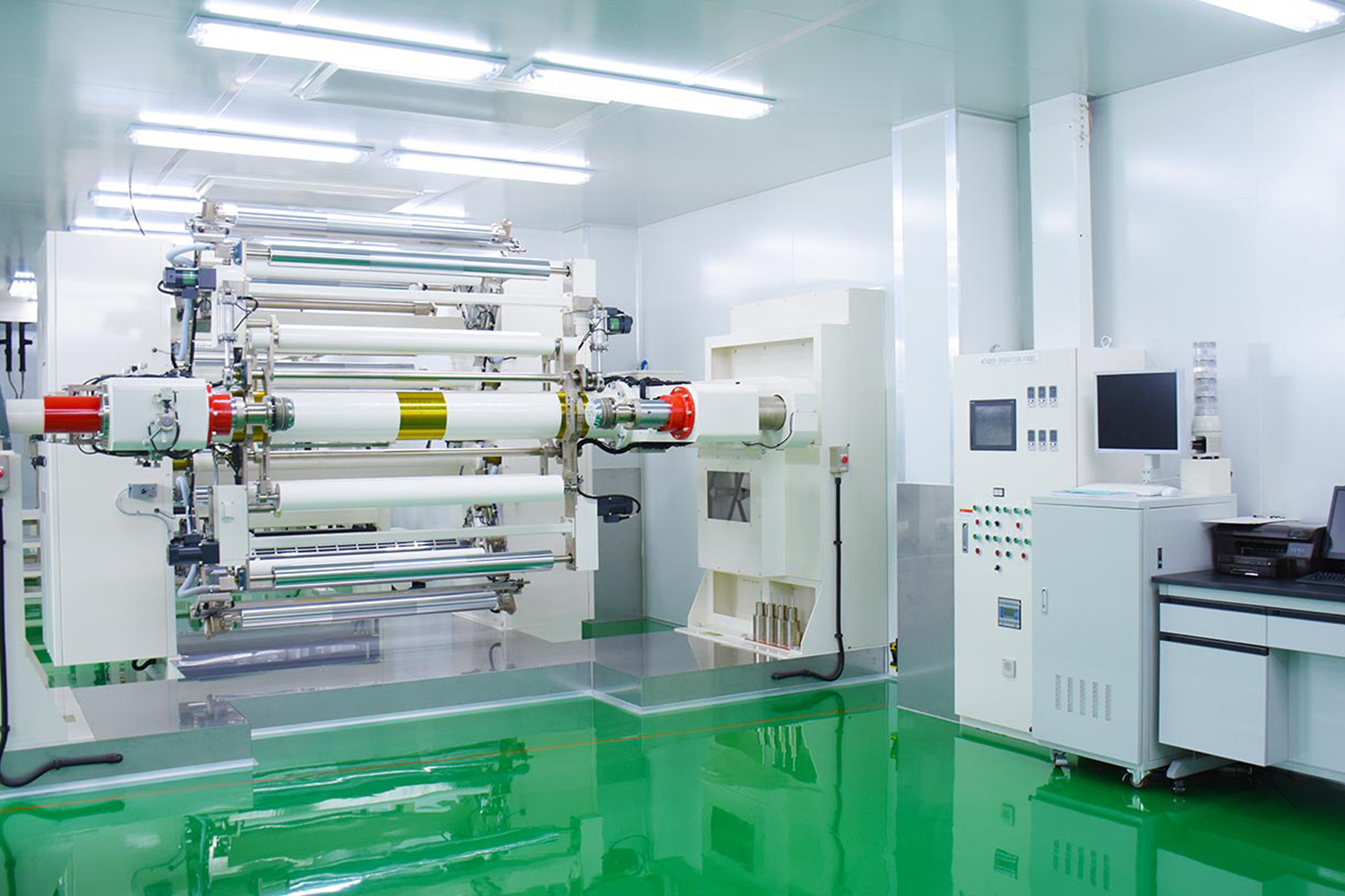
In a sputtering process, the target material (in this case, a ceramic compound like titanium nitride) is placed inside a vacuum chamber. High-energy ions bombard the target, ejecting individual atoms or small clusters of atoms from its surface. These ejected particles travel through the vacuum and deposit on the PET base film passing through the chamber, building up an ultra-thin ceramic coating layer by layer.
Why ceramic sputtering produces high-performance film: The deposition happens at the atomic level. The resulting coating is extremely uniform, chemically bonded to the film surface, and precisely controllable in thickness. By adjusting sputtering parameters — power, pressure, target composition, deposition time — manufacturers can fine-tune the optical and thermal properties of the coating.
Sputtered ceramic coatings are also extremely durable. The ceramic layer is physically bonded to the PET, not just sitting on the surface, which contributes to the long-term performance stability that distinguishes premium nano ceramic products from cheaper alternatives.
The limitation: Ceramic sputtering is technically demanding. The sputtering equipment itself is expensive. Ceramic targets are more challenging to work with than metallic targets — they can crack under uneven thermal stress and require careful process control to maintain deposition consistency. Not every factory with a sputtering line has successfully adapted it for ceramic materials.
Route 2: Nano Particle Dispersion Coating (Wet Process)
An alternative approach involves dispersing nano-scale ceramic particles into a liquid carrier — typically a resin or coating solution — and applying that liquid to the PET film surface using conventional wet coating techniques (slot-die, gravure, or similar).
The key technical challenge with this approach is achieving a uniform, stable dispersion of nanoparticles in the coating solution. Nanoparticles have high surface area and strong tendency to agglomerate (clump together) — clusters of particles are larger than individual particles, and if they exceed a critical size, they start to scatter visible light, creating haze.
Manufacturers using wet process ceramic coating invest heavily in dispersion chemistry — surfactants, stabilizers, and mixing processes that keep particles individually separated in the coating solution. The quality of dispersion chemistry is a major differentiator in this production route.
Why it matters to you as a buyer: Wet process nano ceramic can produce excellent film when the dispersion chemistry is right. It can also produce film with marginal haze, uneven particle distribution (visible as slight cloudiness or optical non-uniformity), and inferior durability compared to sputtered coatings — when the chemistry isn’t controlled tightly.
Asking a supplier which production route they use — and following up with questions about their specific process controls — will tell you a lot about how seriously they’ve invested in the technology.
The Multi-Layer Stack
A finished nano ceramic window film isn’t just a ceramic coating on PET. It’s a multi-layer structure where each layer contributes something to the overall performance profile.
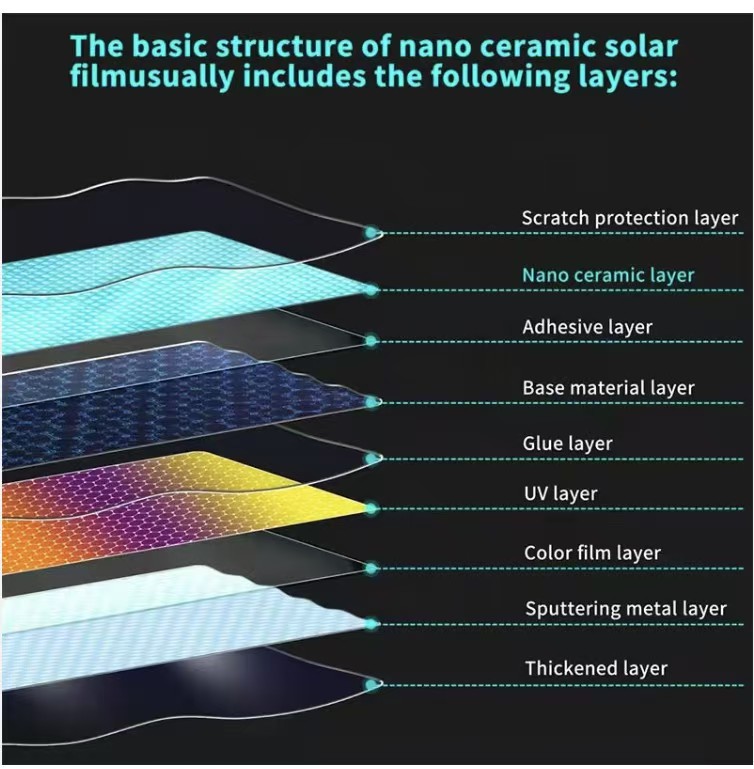
A typical premium nano ceramic film might look like this from outside surface to glass:
- Scratch-resistant hard coat — Protects the exterior surface from cleaning abrasion. Usually a UV-cured polyurethane or acrylic formulation, 1–3 microns thick.
- PET base film (layer 1) — Primary structural layer, 50–75 microns. Provides mechanical integrity and dimensional stability.
- Ceramic functional coating — The nano ceramic layer(s), typically less than 1 micron total thickness but doing most of the thermal work.
- PET base film (layer 2) — In dual-layer constructions, a second PET film bonded to the first. Improves safety performance (the laminated structure holds glass fragments together on impact) and adds dimensional stability.
- Pressure-sensitive adhesive (PSA) — Typically 25–35 microns. The adhesive chemistry — acrylic-based in most premium products — determines installation behavior, edge adhesion, long-term clarity, and temperature resistance.
- Release liner — Silicone-coated paper or PET, protecting the adhesive until installation.
The total finished thickness is usually in the range of 100–150 microns for a standard single-layer product, 180–250 microns for dual-layer safety constructions.
Why Performance Varies So Much Across Nano Ceramic Products
If nano ceramic technology is well-understood, why does performance vary so dramatically between products claiming the same technology?
Several reasons:
Ceramic material selection. Titanium nitride, cesium tungsten oxide, and antimony tin oxide all have different spectral properties — some absorb IR more efficiently, some reflect it, some are more selective across the solar spectrum. A manufacturer using a lower-cost ceramic compound will achieve lower IR rejection than one using an optimized material, even with equivalent coating quality.
Coating thickness and uniformity. IR rejection scales with ceramic layer thickness up to a point. A thinner coating — whether by design to reduce cost or by inconsistent process control — will perform below what the material is theoretically capable of. Non-uniform thickness (varying across the width or length of the roll) creates performance variation across a single installation.
IR measurement methodology. This point cannot be overstated. A film can honestly claim “95% IR rejection” if it’s measuring at a specific favorable wavelength (around 950–1,000nm, where most ceramic materials perform well) and deliver only 50–60% rejection across the full solar IR spectrum. Both claims are technically accurate; only the second reflects real-world thermal performance.
When comparing nano ceramic products from different suppliers, insist on test reports that specify the measurement methodology — ideally testing to NFRC standards or the equivalent, which measures across the full solar spectrum. See What Certifications Should a Window Film Manufacturer Have? for how to evaluate what the test reports actually show.
Adhesive and base film quality. A nano ceramic coating on a low-grade PET base with mediocre adhesive still costs less than the same coating on premium PET with a high-performance adhesive — and the performance difference shows up not in IR rejection numbers but in installation quality, optical clarity, and long-term durability.
What to Ask Suppliers About Their Nano Ceramic Production
Whether you’re evaluating a new supplier or revisiting an existing one, these questions cut through marketing language to the substance of the product:
- Is your ceramic coating applied by sputtering or wet process? Either can be excellent; the answer tells you what process controls to ask about next.
- What ceramic material does your film use? Titanium nitride, CTO, ATO — or a vague answer? Vague answers usually mean the supplier doesn’t know, which means they’re not manufacturing it themselves.
- Can you provide IR test reports that specify the measurement wavelength range? A single-wavelength measurement at 950nm is not the same as full-spectrum solar IR measurement.
- What is your hard coat composition and scratch resistance rating? Pencil hardness of 3H or above is typical for quality products.
- What’s the ceramic coating thickness? A manufacturer running their own production process can answer this. One sourcing film from elsewhere usually can’t.
A supplier who can answer these questions specifically and confidently is almost certainly manufacturing what they claim. One who deflects, gets vague, or promises to “check with the technical team” and never follows up is probably not.
The Nano Ceramic Market: Where Things Stand in 2026
Nano ceramic has moved from a premium niche to a mainstream product category in most developed markets. North American and European professional installers increasingly default to ceramic for performance jobs, and consumer awareness — driven partly by manufacturer marketing, partly by genuine performance differences — has made “is this ceramic?” a common question in automotive and home installation contexts.
The manufacturing quality gap has also widened. The best nano ceramic products from leading Chinese manufacturers now compete credibly with premium Western brands on objective performance metrics. The worst products carrying “nano ceramic” labels on the box are, to put it plainly, dyed film with a label upgrade.
Third-party testing is the only reliable way to know which side of that divide a specific product sits on. Samples, independent testing, and current SGS or Intertek reports aren’t optional for a buyer putting their brand’s reputation behind a product — they’re the baseline.
For a detailed guide to finding and evaluating ceramic film suppliers specifically, see Ceramic Window Film Supplier: What to Look for Before You Order.
FAQ
Q1: What is nano ceramic window film made of?
Nano ceramic window film is made with nano-sized ceramic particles embedded into multi-layer PET film structures for heat and UV protection.
Q2: How does nano ceramic film block heat?
The ceramic particles absorb and reject infrared heat while maintaining high visibility and clear optical performance.
Q3: What manufacturing process is used for nano ceramic film?
Manufacturers typically use precision coating systems and magnetron sputtering technology to apply ceramic layers evenly onto PET film.
Q4: Why is nano ceramic film better than dyed film?
Nano ceramic film offers better heat rejection, longer durability, color stability, and no signal interference compared to dyed film.
Q5: Does nano ceramic window film affect GPS or mobile signals?
No. Nano ceramic film is non-metallic, so it does not interfere with GPS, radio, or mobile phone signals.
Sourcing nano ceramic window film and want to verify whether a supplier’s product is the real thing? Contact us — we help buyers evaluate specific products against claimed specifications and connect with manufacturers with verified ceramic production capability.
Further Reading
On this site:
- How Window Film Is Manufactured: From Raw Materials to Finished Rolls — The full production context that nano ceramic fits within
- Window Film Quality Control Process: How Manufacturers Ensure Consistency — How to verify the coating process produces consistent results
- Ceramic Window Film Supplier: What to Look for Before You Order — Evaluating specific ceramic film products and suppliers
- What Certifications Should a Window Film Manufacturer Have? — How to read IR rejection test reports correctly
- Top 7 Window Film Manufacturers in China (2026 Verified List) — Manufacturers with genuine nano ceramic capability
External:
- Society of Vacuum Coaters (SVC) — Technical reference for sputtering and PVD coating technology
- NFRC Solar Heat Gain Standards — Standards for measuring solar performance, including full-spectrum IR methodology
- American Ceramic Society — Background on ceramic materials science, including titanium nitride and related compounds
Get a Free Sample or Quote
Looking for a reliable window film supplier? Contact us today for fast response and professional support.