Published: July 17, 2026 · 8 min read · Category: Sourcing Guide
The gap between what nano ceramic window film is supposed to do and what a specific product actually does is where a lot of distributor and installer problems start. A supplier sends a sample, it looks good, it installs well, and you move forward. Then six months in, you’re fielding complaints from installers whose customers say the film “doesn’t block heat like it should.”
Testing would have caught it. Most buyers don’t test beyond a visual inspection and a quick tint meter check — not because they’re careless, but because they don’t know what tests are worth running and how to interpret the results.
This guide covers every testing method available to buyers, from basic tools anyone can use to professional-grade equipment worth investing in if you’re distributing at scale.
What You’re Actually Testing For
Before running any test, be clear on what matters:
VLT accuracy: Does the film’s measured Visible Light Transmittance match the labeled spec? A 35% VLT film that measures 28% or 42% means either the spec is wrong or QC is inconsistent.
IR rejection performance: Is the heat rejection delivering what the test report claims? This is the primary spec for ceramic film and the one most worth verifying independently.
TSER (Total Solar Energy Rejected): The integrated performance across the full solar spectrum. Harder to measure without lab equipment, but derivable from a solar spectrum analyzer.
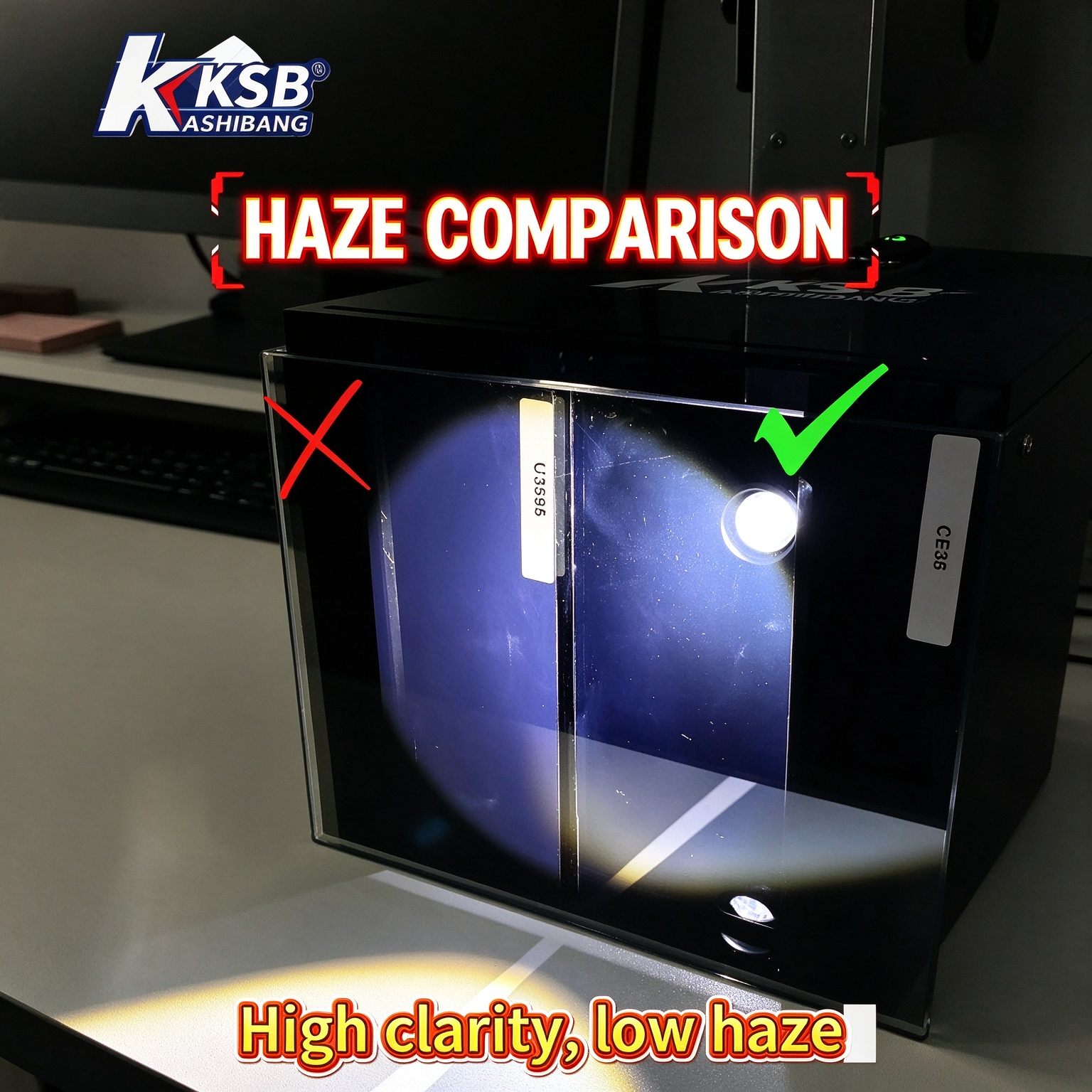
Optical clarity: Haze in the transparent state. Premium ceramic should be below 2% haze.
Color consistency: Uniform tint across the roll, no variation from edge to center.
Adhesive performance: How it installs, whether it holds long-term, whether it removes cleanly.
Level 1: Basic Tests Any Buyer Can Run
Tint Meter (VLT Measurement)
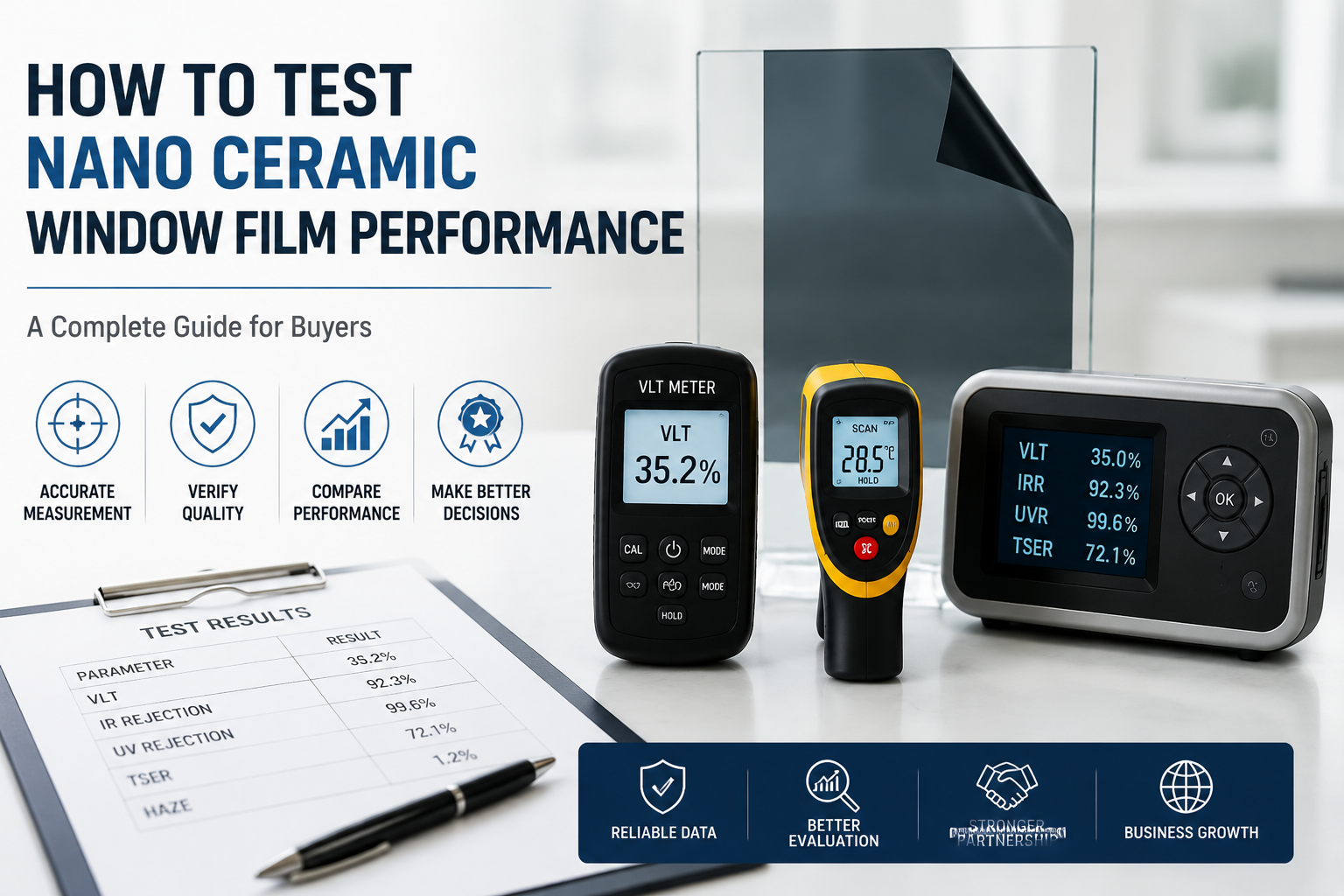
A tint meter is the most fundamental window film testing tool. It measures Visible Light Transmittance by shining a light source through the film and measuring what comes through. Decent entry-level tint meters cost $80–$150; professional-grade models run $300–$600.
How to use it: Apply the film sample to a piece of clean flat glass. Clamp the tint meter across the glass-film combination. Read the VLT percentage.
What to check: Does the result match the labeled VLT within ±3%? A 35% film measuring 32–38% is within reasonable tolerance. One measuring 27% is significantly off-spec.
Limitation: Tint meters measure visible light only. They tell you nothing about IR rejection.
Visual Optical Quality Check
Before any instrument testing, assess the film visually:
- Install a 30cm × 30cm sample on clean flat glass
- View text through the film at arm’s length: legible without blur?
- Tilt the glass and look at an oblique angle in good lighting: any visible haze, cloudiness, or mottling?
- Hold the film up to a window and look across its surface in raking light: any inclusions, surface defects, or coating irregularities?
Premium ceramic film in the transparent state should be optically clean. Any noticeable haze, uneven tint, or visible surface defects are quality indicators worth investigating further.
IR Heat Lamp Test (Qualitative)
This is the simplest way to experience the IR rejection difference before investing in instruments.
Setup: An IR heat lamp (available at hardware stores, typically sold as a bathroom heat lamp). Position the lamp at a fixed distance (30cm is typical). Hold your hand behind an unfilmed piece of glass — feel the warmth. Then place a film sample on the glass and repeat.
What you’re testing: The subjective difference in radiant heat transmission. A quality nano ceramic film should produce a noticeably cooler sensation at equivalent distance. A film claiming ceramic performance that produces the same heat sensation as unfilmed glass is not performing as labeled.
Limitation: Qualitative, not quantitative. The test tells you whether IR rejection is meaningful, not how much.
Level 2: Intermediate Testing
IR Thermometer Measurement
Upgrade the heat lamp test to a quantitative measurement by adding an IR thermometer.
Setup: Fix the heat lamp at a constant distance from a vertical glass surface. Apply an IR thermometer to measure surface temperature on the interior side of the glass (the side away from the lamp).
Method:
- Measure baseline: unfilmed glass, lamp at 30cm, record interior surface temperature after 2 minutes
- Apply film to glass
- With same lamp distance and same duration, record interior surface temperature again
- Calculate the temperature difference
What to expect: A quality nano ceramic film should reduce the interior surface temperature by 15–25% relative to unfilmed glass in this test setup. A film delivering only 5–8% reduction is not delivering ceramic-tier performance.
Calibration note: For meaningful comparison between suppliers, keep the lamp distance, lamp wattage, and measurement duration identical across tests.
Side-by-Side Comparison
The most practical distributor test: run two supplier samples simultaneously on separate pieces of identical glass, under the same light source, and compare IR thermometer readings. This directly answers the question “which product blocks more heat?” without requiring absolute calibration.
Level 3: Professional Grade Testing
Solar Spectrum Analyzer (Tint Meter With IR)
Professional solar spectrum analyzers — instruments from manufacturers like Solartech, Raytek, or Edtm — measure transmittance across the solar spectrum, including visible light, near-IR, and UV. They provide TSER and full-spectrum IR rejection data directly.
Entry-level professional solar meters cost $600–$1,500. They’re the bridge between basic tint meters and lab equipment, and for any serious distributor evaluating multiple suppliers, the investment pays back quickly.
How to use: Install film on glass, apply the meter across the film-glass combination, read the display. Depending on the instrument, outputs include VLT, IR rejection (full spectrum or defined range), UV rejection, and TSER or total solar transmittance.
Limitation: Consumer-grade solar meters measure a defined IR band, not the full 780–2,500nm range. They’re more indicative than laboratory-grade but significantly more useful than qualitative tests. Professional laboratory meters cover the full solar spectrum.
UV Transmittance Measurement
A UV radiometer or spectrophotometer with UV range can measure UV transmittance directly. Most quality window films claim 99%+ UV rejection — this is straightforward to verify with appropriate equipment. A film allowing more than 1–2% UV transmittance is not performing to spec.
Level 4: Third-Party Lab Testing
For importers, brand builders, or distributors making large volume commitments, sending samples to a certified testing laboratory is the most definitive evaluation available.
Who to use:
- SGS: Major global lab with strong window film testing capability and industry recognition. www.sgs.com
- Intertek: Equivalent capability, particularly strong in Asia-Pacific markets. www.intertek.com
- Bureau Veritas: Strong European market presence. www.bureauveritas.com
- NFRC-approved simulation labs (for products targeting US commercial market)
What to specify: When submitting samples, request:
- VLT measurement
- Full-spectrum solar transmittance and TSER (specify ISO 9050 or NFRC methodology)
- UV transmittance
- IR transmittance across 780–2,500nm
- Haze measurement (ASTM D1003)
- Adhesion/peel strength (if evaluating adhesive performance)
Cost: A comprehensive window film test package from SGS or Intertek typically runs $400–$900 per sample, depending on the parameter set and turnaround time.
When it’s worth it: Before a major OEM commitment. Before building a branded product range. When a supplier’s existing test reports are old, generic, or use non-standard methodology. When you’re considering switching primary suppliers.
What to Do With Test Results
If the tested VLT is significantly off-spec: Flag immediately with the supplier. Ask for an explanation and a current production sample for retest. Consistent VLT deviation indicates QC problems.
If IR rejection is below claimed spec: The product is either mislabeled or the claimed spec was measured using a non-representative methodology. Either way, it’s not delivering what was sold. Raise it with the supplier — the response tells you whether this is a product issue or a communication issue.
If the sample performs well but production batches vary: Request batch records and QC documentation. Ask what process controls ensure consistency. Production variation that’s visible in testing suggests inadequate in-process monitoring.
If a supplier’s product outperforms another at equivalent VLT: That’s a meaningful buying signal. Comparative data from consistent test methodology is the most useful output of a structured evaluation process.
FAQ
Can I test nano ceramic window film without buying any equipment?
The basic visual and qualitative heat lamp tests require no special equipment beyond a heat lamp you can find at a hardware store. They won’t give you numbers, but they’ll tell you whether a film is performing at all. For anything beyond that, a tint meter is the minimum investment worth making.
How much should I spend on testing equipment?
For an occasional sample evaluation: a basic tint meter ($100–$150) and an IR heat lamp test setup ($30–$50 for the lamp). For regular supplier evaluation: a professional solar meter ($800–$1,500) is worth the investment if you’re sourcing at meaningful volumes. For definitive certification-quality data: use a third-party lab ($400–$900 per test).
Can I trust a supplier’s own test reports without independent verification?
For initial evaluation, yes — a current, specific SGS or Intertek report is credible evidence of performance. For large volume commitments, OEM programs, or branded product lines, independent verification of at least one sample per supplier relationship provides additional confidence. Reports from non-accredited labs or “in-house” testing without third-party verification carry lower evidential weight.
How often should I test incoming shipments from an established supplier?
For new suppliers: test the first three orders to establish a performance baseline. For established suppliers: annual batch testing (one sample per year from a production run) catches drift before it becomes a customer problem. For any order where you receive more complaints than usual: test immediately and compare against the baseline.
What does elevated haze indicate?
Haze in the transparent state (above 3–5%) most often indicates either poor nano-particle dispersion in the ceramic coating (wet-process products) or ITO layer non-uniformity (sputtered products). It’s a quality signal worth investigating — film that’s noticeably hazy in the clear state is not delivering the optical quality that premium ceramic film should provide.
Further Reading
On this site:
- IR Rejection Explained: What Does It Really Mean? — Understanding the spec you’re testing for
- What Certifications Should a Window Film Manufacturer Have? — How third-party testing fits into the broader certification picture
- How to Compare Window Film Quotes from Different Suppliers — Using test data in a supplier comparison framework
- Window Film Quality Control Process — What the manufacturer’s own QC should look like
- How Nano Ceramic Window Film Blocks Heat — The physics behind what you’re measuring
External:
- NFRC Testing Methodology — Standard solar film performance measurement framework
- ASTM D1003 Haze Standard — Standard test method for haze and luminous transmittance of transparent plastics
- SGS Window Film Testing Services — Third-party testing for definitive performance data
- EDTM Solar Film Meters — Professional tint meters and solar spectrum measurement tools
Get a Free Sample or Quote
Looking for a reliable window film supplier? Contact us today for fast response and professional support.