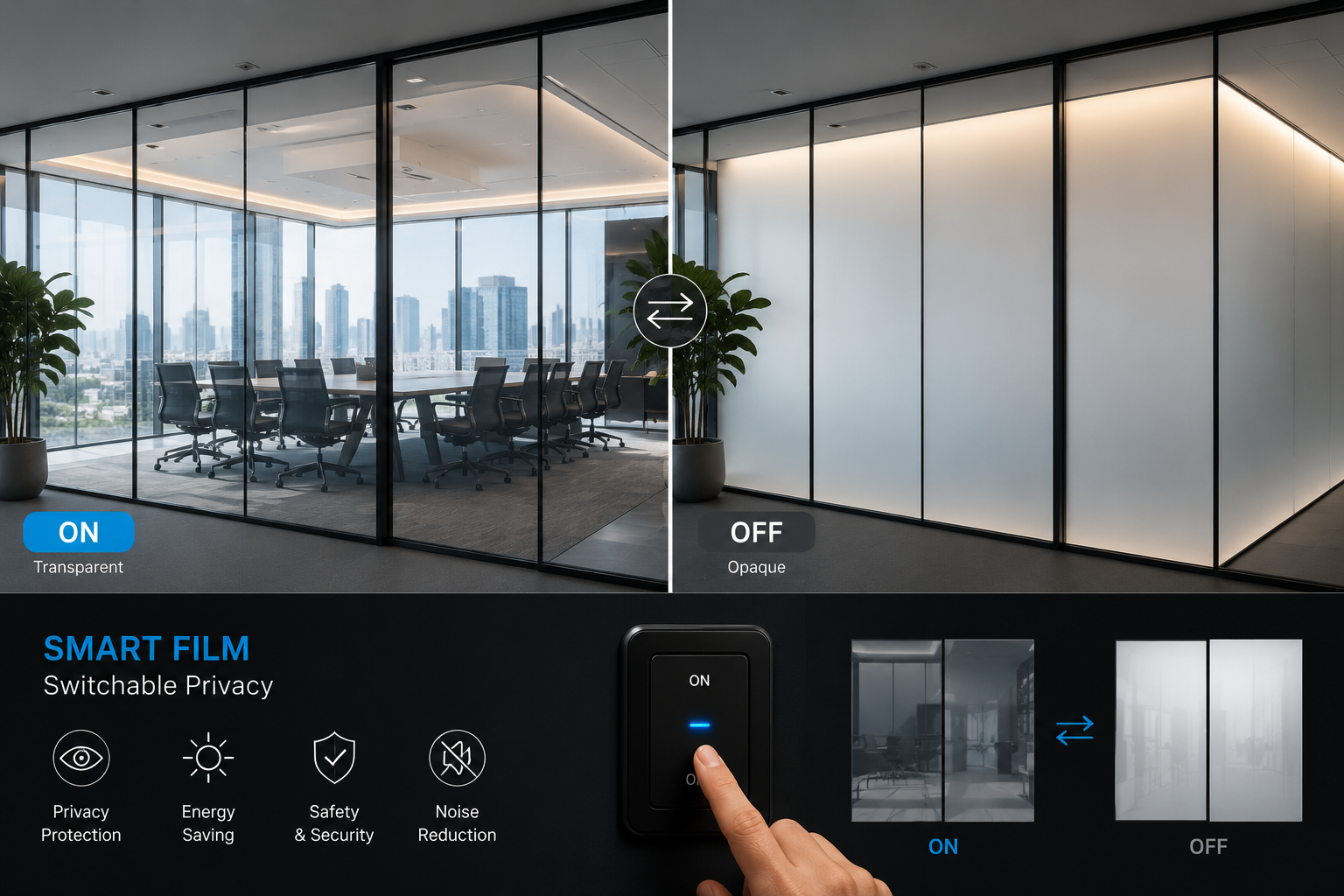
The Future of Smart Glass and Smart Film Technology
Published: July 20, 2026 · 9 min read · Category: Industry Insights
About this article: KSB Window Film has been manufacturing and exporting smart film, nano ceramic, and specialty window film from Dongguan, China since 2010 — serving distributors and project buyers in over 40 countries. The trends covered here reflect active buyer demand, supplier R&D we’re tracking, and commercial specifications we’re supporting across North America, Europe, the Middle East, and Southeast Asia.
Overview of next generation smart glass and smart film technologies including PDLC, electrochromic, and AI controlled smart glazing systems
Switchable glass has been “the future” for about twenty years. The problem with futures that take that long to arrive is that by the time they do, the conversation has already moved to the next thing.
The honest assessment in 2026: smart glass and smart film have crossed into mainstream commercial use, and the genuinely interesting developments are no longer about whether the technology works — it does — but about where it’s going next. The next wave of smart glazing technology is heading toward integration, intelligence, and multifunctionality in ways that go substantially beyond the on/off privacy switch that most buyers know today.
This article covers what’s actually developing, what timelines look like for commercial availability, and what buyers and distributors should be paying attention to.
Where the Technology Stands Today
Current commercial smart film is primarily PDLC-based — Polymer Dispersed Liquid Crystal — delivering an on/off or dimmed privacy function with response times under a second. It works reliably, it’s retrofittable to existing glass, and it’s dropped in price to the point where mid-market commercial projects can include it without special budget justification.
Smart glass (factory-integrated versions using PDLC, electrochromic, or SPD technology) is well established in premium construction. Boeing’s 787 electrochromic windows have been in service since 2011. Several luxury car manufacturers offer SPD sunroofs. High-specification commercial buildings routinely specify electrochromic facades.
What these existing products don’t do: they don’t respond to environmental conditions autonomously, they don’t generate energy, they don’t integrate seamlessly with AI-driven building systems, and they don’t offer the kind of nuanced, application-specific performance that the next generation of products is designed to achieve.
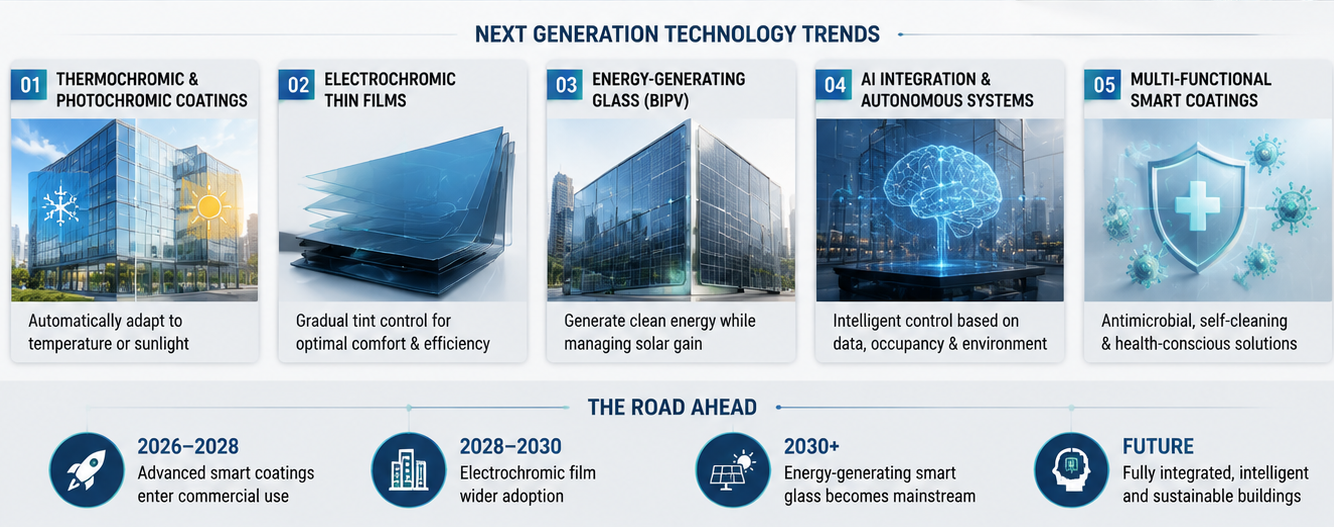
Trend 1: Thermochromic and Photochromic Smart Coatings
The most practically significant near-term development is smart film that responds to temperature or light intensity without requiring electrical switching at all.
Thermochromic glazing changes its solar transmission properties in response to temperature — becoming more reflective when the glass gets hot (when solar heat management is most needed) and more transparent when cool. This eliminates the need for sensors, controllers, and user intervention. The glass manages itself.
Vanadium dioxide (VO₂) is the most researched thermochromic material for this application — it undergoes a reversible phase transition at around 68°C in its pure form, which researchers have been working to lower to room-temperature-relevant ranges through doping and nanostructuring. Products using VO₂-based coatings are approaching commercial viability, with several Chinese and European manufacturers actively developing coating processes.
Photochromic glazing darkens in response to UV intensity — similar to photochromic eyeglass lenses. The darker-when-sunny, clearer-when-overcast behavior addresses solar control automatically. Commercial versions are less mature than thermochromic products but are in advanced development.
For the smart film market specifically: applying thermochromic or photochromic functional layers within a film laminate structure is technically achievable and several manufacturers are in development stages. The commercial challenge is achieving the response speed and contrast ratio that makes the product genuinely useful rather than a novelty.
Trend 2: Electrochromic Thin Films
Electrochromic materials change color/tint in response to low-voltage DC current — unlike PDLC, which is AC-driven and switches between clear and opaque, electrochromic glazing transitions gradually through tint levels, allowing precise solar transmission control.
Current commercial electrochromic glass (Sage Glass, View Inc.) is factory-integrated and expensive. The push in research and development is toward electrochromic thin films that can be applied to existing glass as a retrofit product — the same installation flexibility that made PDLC smart film commercially accessible.
Progress is real. Electrochromic film products have been in development at multiple research institutions and startups. The technical challenges — cycle stability, switching speed (electrochromic is inherently slower than PDLC, measured in minutes rather than seconds), and manufacturing at commercial scale with consistent performance — have slowed commercialization, but several companies are at or approaching market-ready product stages.
When electrochromic film reaches commercial scale, it will offer building owners something PDLC doesn’t: continuous solar modulation that optimizes for comfort and energy efficiency throughout the day, rather than a binary privacy switch.
Trend 3: Building-Integrated Photovoltaics (BIPV) and Energy-Generating Glass
The idea of windows that generate electricity while also managing solar gain has been pursued for decades. The convergence of improved transparent photovoltaic cell technology and advanced coating processes is finally making this commercially interesting.
Transparent or semi-transparent solar cells can be integrated into window glass or film, generating electricity from the UV and near-infrared portions of solar radiation while passing visible light. Current transparent solar cells achieve 5–10% energy conversion efficiency — lower than conventional solar panels, but the value proposition is generating electricity from building surfaces that would otherwise do nothing.
The connection to smart film: integrated smart-photovoltaic laminate films are being developed that combine solar control, switchable privacy, and electricity generation in a single glazing film. The technical complexity is significant, but prototype products exist and the commercial potential in energy-conscious markets is substantial.
This won’t be a mainstream window film product in 2026. It will be by 2030.
Trend 4: AI Integration and Autonomous Building Systems
Current smart film and glass installations are typically controlled by wall switches, timers, or basic building management system integration. The next layer is AI-driven autonomous control.
Intelligent building systems that learn occupancy patterns, optimise glass transmission based on time of day, season, cloud cover, and occupant preferences — and do so without requiring manual input — are already available at the building management level. The integration with smart glazing is following.
In practice, this means conference rooms where glass opacity responds to meeting scheduling automatically, facades where solar transmission adjusts throughout the day to maintain target interior temperatures without HVAC intervention, and residential smart glass that adapts to occupant schedules and preferences without requiring any switching.
The technology exists at the building management level. The standardization of interface between building management systems and smart glass/film products is the remaining friction — and it’s being reduced through protocols like KNX, DALI, and emerging IoT frameworks specifically designed for building envelope integration.
Trend 5: Anti-Microbial and Multi-Functional Smart Coatings
Post-COVID institutional awareness of surface hygiene has sustained commercial interest in functional coatings that go beyond optical properties. Smart film combining PDLC privacy switching with anti-microbial silver-ion or copper-ion surface coatings is in commercial development for healthcare and public space applications.
The value proposition in a hospital patient room: privacy switching eliminates the hygiene concerns of curtains, and anti-microbial coating reduces surface pathogen load on the glass surface. Combined with easy-clean hydrophobic properties, this addresses multiple infection control requirements in a single product.
What This Means for Buyers and Distributors in 2026
For buyers making decisions today, the practical implications:
Current PDLC smart film is mature and commercially proven. If you’re specifying or distributing smart film now, you’re working with technology that’s reliable and well-supported. The products available today don’t need to wait for future developments to justify use.
Electrochromic film will change the architectural glazing market when it arrives. Distributors who’ve built smart film expertise will be positioned to adopt the next generation when it becomes commercially accessible. Those who haven’t will be starting from scratch against established players.
Integration capability is becoming a differentiator. Smart film suppliers who can demonstrate BMS integration, smart home compatibility, and automation system support are winning commercial specification projects over those who only offer basic switching. Building this capability into your product offering is worth the investment now.
Energy performance documentation is increasingly required. As smart film becomes part of energy efficiency compliance pathways, buyers need NFRC certification, SHGC data, and energy modelling support from their suppliers. Manufacturers who’ve invested in this infrastructure are capturing specification projects that product-only suppliers are missing.
FAQ
When will thermochromic smart film be commercially available?
Commercial products are at late-stage development from several manufacturers as of 2026. First commercial launches in specialty applications (commercial building facades, automotive) are likely within 2–4 years. Mainstream retrofit smart film availability is probably 5+ years out at the quality and price point required for broad adoption.
Will AI-controlled smart glass require expensive hardware upgrades?
Not necessarily. Most AI integration happens at the building management or smart home hub level — the smart film or glass itself doesn’t change. Existing smart film installations with compatible controllers can often be connected to AI-enabled BMS platforms without replacing the film or the transformer. The controller interface is the upgrade point.
Is the shift to electrochromic going to make PDLC smart film obsolete?
No — the two technologies serve different needs. PDLC switches fast (under a second) between clear and fully frosted — ideal for privacy applications. Electrochromic transitions slowly (minutes) through tint levels — ideal for solar control optimization. They’re complementary, not competing. PDLC will remain the right choice for privacy applications regardless of electrochromic development.
How does the move toward energy-generating glass affect smart film manufacturers?
It creates product complexity and new R&D requirements. Manufacturers who’ve built genuine coating technology capability — particularly those with sputtering and multi-layer laminate experience — are better positioned to develop energy-generating coating applications than those who have been primarily assembly operations.
Should I wait for the next generation before investing in smart film?
No. Projects that need privacy switching today should specify today’s PDLC products, which are reliable, well-documented, and commercially competitive. Waiting for future technology means forgoing the benefits of smart film for years, with no guarantee that timeline predictions for new technology are accurate.
Ready to Source Smart Film or Discuss Upcoming Product Development?
KSB Window Film manufactures PDLC smart film and nano ceramic window film, exported to distributors, glazing contractors, and project buyers across the US, EU, Australia, and the Middle East.
Whether you’re specifying smart film for a commercial project today or planning for the next generation of electrochromic products, our technical team can advise on what’s commercially available now and what’s realistically coming.