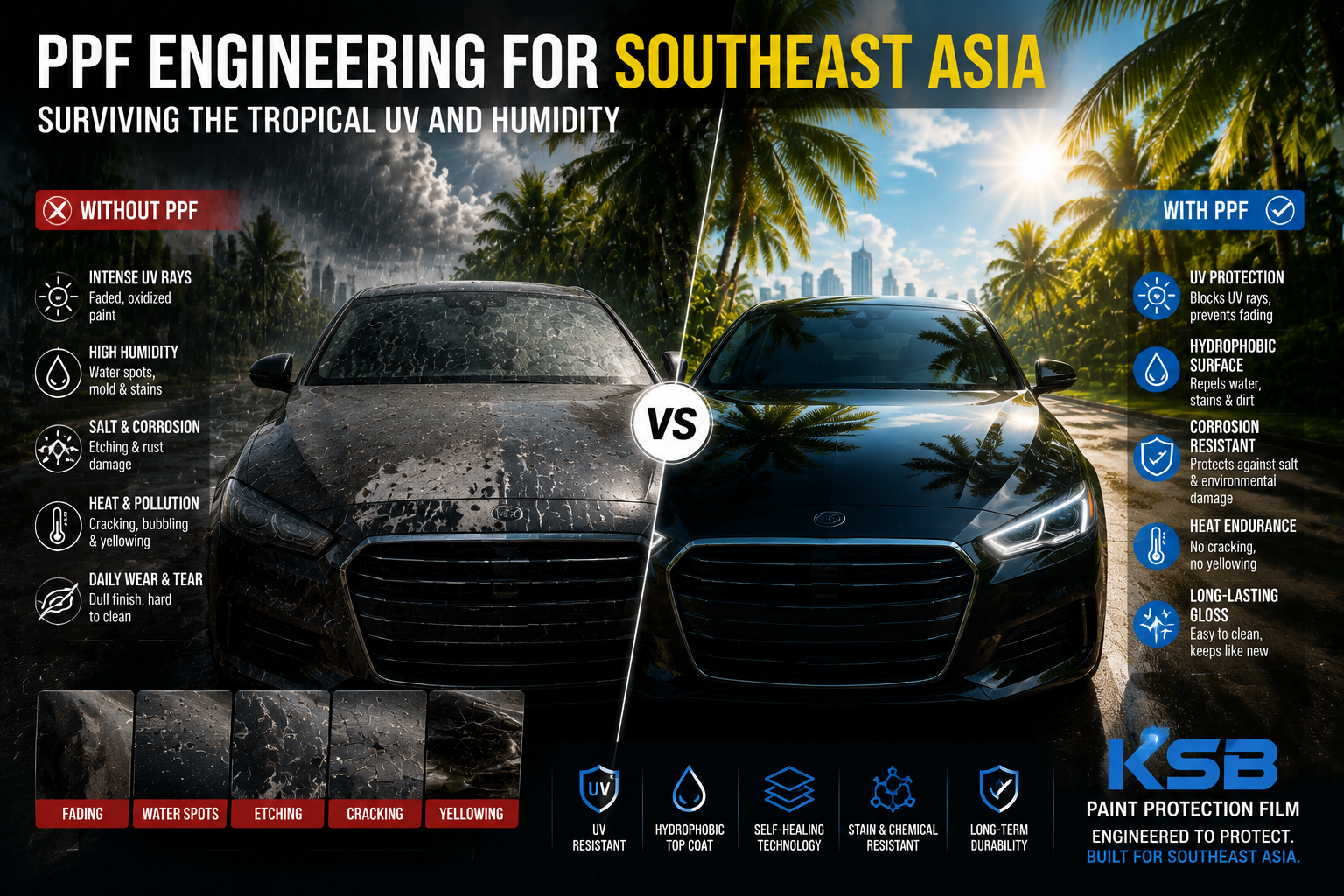
Surviving the Tropical UV and Humidity: PPF Engineering for Southeast Asia
Published: July 28 , 2026 · 7 min read · Category: PPF Regional
About this article: KSB Window Film has supplied PPF to distributors in the Philippines, Malaysia, Thailand, Indonesia, Singapore, and Vietnam for over a decade. The specific challenges of tropical PPF are different from Middle Eastern challenges — and require different formulation responses.
Hydrophobic PPF protects car paint from UV, humidity, acid rain and water spots in Southeast Asia tropical environments.
Southeast Asia’s climate is deceptively demanding for paint protection film. The challenges are less dramatic than a Gulf sandstorm — but the combination of 85–95% year-round humidity, intense UV, frequent acid rain events, and year-round high ambient temperature creates a degradation environment that is uniquely challenging for film, adhesive, and top coat chemistry.
The Four Tropical Climate Challenges for PPF
Challenge 1: Mould and Fungal Growth at Film Edges
High relative humidity sustained over months creates conditions for microbial growth in the organic adhesive layer — particularly at film edges where moisture can penetrate under the film. Mould and mildew growing under PPF edges appear as dark discolouration at the film perimeter. Once established, they’re very difficult to remove without lifting the film.
KSB response: Our Southeast Asia adhesive specification incorporates antimicrobial additives. The adhesive’s water absorption is also minimised through hydrophobic polymer chemistry — reducing moisture penetration at edges and reducing the water activity available for microbial growth.
Challenge 2: Water Spotting and Acid Rain Etching
Southeast Asian cities — particularly in industrial areas — experience acid rain events (pH 4.0–5.0) that deposit acidic mineral compounds on vehicle surfaces. When water evaporates, these compounds concentrate and can etch into top coat surfaces that aren’t resistant to dilute acid attack.
Water spots from hard water (high mineral content, common in many SE Asian cities) similarly leave mineral deposits that can penetrate and stain insufficiently hydrophobic top coats.
KSB response: Our tropical specification top coat has enhanced hydrophobicity (water contact angle >110°) and acid resistance (no surface change after 24-hour exposure to pH 4.0 solution). The hydrophobic surface reduces the time that water droplets sit on the film surface — less dwell time means less mineral deposition and less acid etching time.
Challenge 3: UV-Accelerated Ageing at Tropical Angles
At low latitudes (1°–15°N for most SE Asian markets), solar UV irradiance is higher than at mid-latitudes, and the sun angle produces more direct UV incidence on vehicle horizontal surfaces (bonnets, roofs). Combined with the year-round UV exposure (no winter UV reduction), tropical UV dose is 20–40% higher than comparable European markets.
KSB response: Aliphatic TPU base with HALS loading adjusted upward for tropical UV exposure, plus UVA absorbers in the top coat. The tropical formulation is similar in UV stabilisation intensity to our Middle East specification but without the high-temperature adhesive adaptation (temperatures are high but not as extreme as Gulf conditions).
Challenge 4: Hydrolysis from Sustained Humidity
High sustained humidity in tropical conditions — 90%+ RH for months at a time — accelerates polyurethane hydrolysis. Hydrolysis breaks urethane linkages and reduces the molecular weight of the polymer network, degrading mechanical properties (tensile strength, elongation).
KSB response: Aliphatic TPU with hydrolysis-resistant chemistry (as discussed in the data in Why Aliphatic TPU is the Gold Standard). The 1,000-hour hydrolysis test at 70°C / 95% RH showing >90% tensile strength retention is particularly relevant for tropical markets.
The Water-Spotting Challenge: A Closer Look
Water spotting is the most common complaint from Southeast Asian PPF installers. It’s not a failure of the PPF — it’s often a misunderstanding of what the film can and cannot do.
What happens: Hard water from rain or washing evaporates on the film surface, leaving mineral deposits (primarily calcium and magnesium carbonates). On a standard hydrophilic surface, these deposits adhere strongly and can etch into the coating. On a hydrophobic surface, water beads and rolls off more readily before depositing minerals.
The hydrophobicity specification: Water contact angle (WCA) measures how repellent a surface is to water:
Standard top coat: WCA 80–90°
Hydrophobic top coat: WCA 100–110°
Super-hydrophobic (lotus effect): WCA > 120°
KSB’s tropical specification achieves WCA >110° — enough to reduce water dwell time significantly and minimise mineral deposition. Regular washing (weekly) of PPF-protected vehicles in SE Asia is still recommended; the hydrophobic coating reduces damage, not the need for maintenance.
What Makes Tropical PPF Different to Source
When sourcing PPF for Southeast Asian distribution, verify:
Hydrolysis resistance: Request 1,000-hour hydrolysis test data (ISO 2440 or equivalent). Results should show >85% tensile strength retention.
Antimicrobial adhesive: Ask whether the adhesive incorporates antimicrobial protection. This is not standard in all PPF; it’s a specific tropical market adaptation.
Water contact angle specification: Request WCA measurement. Standard coating vs. tropical hydrophobic coating has a measurable difference.
Acid resistance: Request pH 4.0 immersion test data (24 hours) showing no visible surface change.
FAQ
Does PPF in tropical climates need more maintenance than in other climates?
More frequent washing is recommended — weekly rather than bi-weekly — because the combination of high dust, pollen, bird activity, and acid rain creates more frequent contamination events. Hydrophobic top coats make each washing easier but don’t eliminate the need for it.
Can standard global-specification PPF survive in SE Asia?
Yes, with reduced service life compared to tropical-specification film. Standard PPF in tropical conditions typically shows accelerated top coat haze development (from water spotting without adequate hydrophobicity) and possible edge issues in very high-humidity microenvironments (underground car parks, coastal areas). Tropical specification film provides more reliable long-term performance.