OEM Customization and Private Label Window Film: A Guide for Brand Builders
Published: June 30, 2026 · 11 min read · Category: OEM & Private Label
About this article: KSB Window Film runs private label programmes for distributors across 60+ countries. Some of these have become genuine brands that their regional markets recognise. This guide is based on what we’ve seen work — and the mistakes that repeatedly sink otherwise promising programmes.
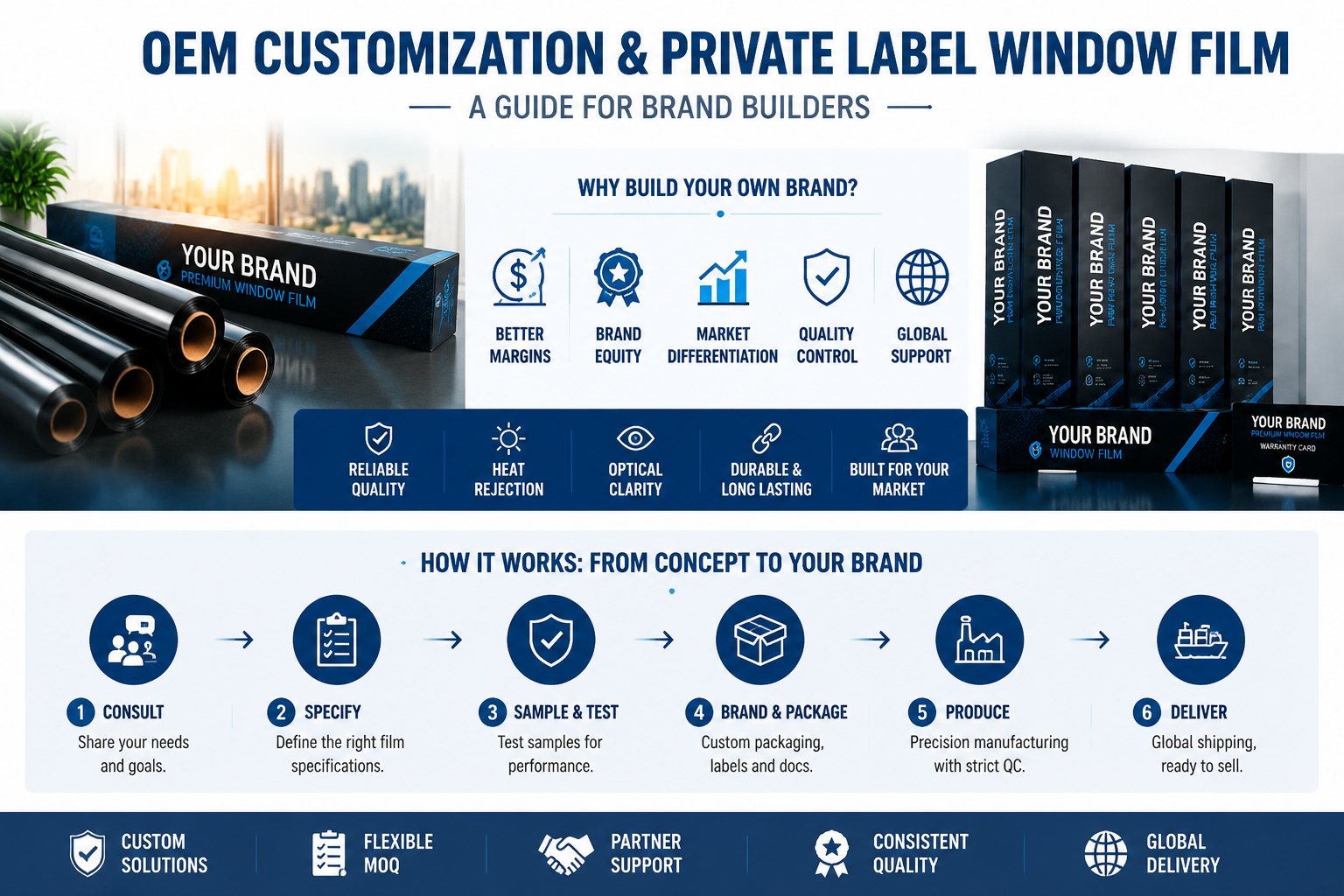
OEM and private label window film packaging solutions showing branded cartons and rolls designed for distributor brand building and global market customization.
There’s a moment in the growth of every successful window film distributor when they start wondering whether they should have their own brand. The economics look compelling: better margins, customer loyalty, something proprietary to defend. The question is whether you can actually build something worth having, or whether you’re just adding a logo to somebody else’s product and calling it a brand.
The honest answer is: both outcomes happen regularly. The difference usually comes down to a handful of decisions made before the first roll is ordered.
Why Private Label, and Why Now
The structural argument for private label window film is stronger in 2026 than it’s ever been:
The major established brands (3M, Llumar, SunTek, XPEL) have invested decades building installer networks and consumer awareness. Competing with them on brand recognition in their home markets is expensive and slow. But their pricing power rests on that brand equity — they can charge a premium that direct-from-manufacturer alternatives can’t match. Distributors who build a credible private label brand can occupy the position between “budget unknown brand” and “premium brand” at margins that neither extreme can achieve.
Consumer sophistication about window film has also increased. In 2010, many consumers deferred entirely to their installer’s recommendation. Today they research online, compare specifications, and sometimes arrive knowing more about TSER and VLT than the person installing their film. A private label brand that provides credible technical documentation and honest performance claims can stand on that foundation rather than relying on brand heritage.
And practically: the manufacturing quality available from top-tier Chinese manufacturers like KSB now matches or exceeds what major brands were producing a decade ago. The product quality gap that once justified paying a significant premium for branded film has largely closed for most application categories.
The Decision: Private Label vs OEM vs Simply Reselling
These three models differ in how much you own and how much you control:
Reselling an established brand means you’re a distributor in their network. You have access to their products, their warranties, their marketing. The downside is margin compression, supply dependency, and the fact that any installer in your territory can access the same product through competing distributors. You don’t own anything that’s hard to replace.
Private label means the manufacturer produces to their specification, packages it under your brand, and you control the pricing, positioning, and customer relationship. The product quality depends on which manufacturer you use — you own the brand, not the formula.
OEM (custom formulation) means you develop a specification with the manufacturer — specific optical properties, specific formulation for your market’s climate, specific performance targets. The manufacturer makes something that is genuinely yours technically, not just cosmetically. You own the brand and the spec.
Most programmes start as private label and evolve toward OEM once there’s enough volume to justify the development investment. Starting with OEM when you’re not sure about volume is putting the cart before the horse.
What You Actually Need Before Your First Conversation With a Manufacturer
The most common mistake in private label programmes is starting with “how much does it cost?” before defining what you need. This gets you a price quote for a product you may not want, and a relationship that starts with the manufacturer assuming they know better than you what you should sell.
Before approaching manufacturers, answer these questions:
What market are you serving? “Australian automotive installers” is a market. “Window film buyers” is not. Your market determines the regulatory environment (VLT compliance for Australian road laws), the climate requirements (UV intensity, temperature extremes), and the typical price sensitivity of buyers.
What performance specification do you need? Don’t just say “ceramic.” Specify the VLT range your market needs, the minimum TSER you want to claim, whether you need signal transparency (for panoramic roofs, for GPS-sensitive customers), and what the self-healing/top coat requirement is. A manufacturer who receives a detailed brief produces a more useful response than one who receives “send me your best ceramic film.”
How much volume are you realistically projecting? Be honest with yourself. A distributor buying 50 rolls per month doesn’t have the leverage of one buying 500, and a manufacturer will price and prioritise accordingly. Know your realistic number before the conversation, not your aspirational number.
What does your brand need to communicate? Before you design the packaging, decide what you want the brand to mean. Premium and technical? Accessible and practical? Regional identity? This shapes everything from the product name to the label design to which performance specs you lead with.
The Manufacturer Relationship: What Matters Most
Finding a manufacturer who can produce good film is table stakes. What differentiates a programme that builds long-term value is the manufacturer relationship — specifically, whether they can be a partner rather than just a supplier.
Documentation capability is the first real test. You need to provide your installer network with product data sheets, performance test reports, installation guides, and warranty documentation — all under your brand. A manufacturer who can supply the underlying test data, help you adapt it to your brand format, and update it when products are tested again is far more valuable than one who hands you a generic data sheet in Chinese.
Communication quality across time zones. This sounds obvious, but it’s consistently the thing that determines whether programmes succeed or founder. If you’re in the US or Europe and your manufacturer is in Guangdong, you need a contact who responds to commercial questions in English within 24 hours, not someone who translates enquiries and replies three days later. Test this during the evaluation process — not just how fast they respond to your initial enquiry, but how fast and how usefully they respond to your second and third questions.
Flexibility on first orders. Most manufacturers have MOQ requirements that make sense for their production economics. The ones worth working with will offer first-order flexibility (smaller quantities, wider product mix) to let you test the market before committing to standard production volumes. A manufacturer who demands full MOQ on the first order without understanding your market situation is telling you something about how they’ll behave when you have a problem later.
Building the Product Range
The instinct is to launch a full product range. Resist it.
The most successful private label programmes typically launch with two to three products: one premium ceramic, one mid-range carbon or entry ceramic, and sometimes one safety or specialty product if there’s clear market demand. Everything else gets added as sales data accumulates. A focus on fewer products means you can invest more in the installation support, documentation, and marketing that makes each product successful.
The temptation to match every SKU your competitors offer leads to inventory that doesn’t move, MOQ commitments that tie up capital, and a portfolio too wide to explain clearly to installers.
One question worth asking early: what is your one-line reason why a professional installer should specify your film over the alternatives available to them? If the answer is “it’s cheaper,” you’re in a race you probably don’t want to run. If the answer is “it’s the only ceramic film in our market with documented 3,000-hour QUV data at a credible price point,” that’s something you can build on.
Packaging: More Important Than It Looks
Window film is a professional trade product. Installers unwrap a roll in front of their customers; a poorly designed label or a flimsy core creates an impression that the film itself might reinforce or undermine.
The decisions that matter:
Core material. Cardboard cores are standard. Double-wall cores at 5mm+ wall thickness resist the compression that ruins rolls in transit and storage. A roll with a deformed core creates installation problems regardless of film quality.
Label information. The label is where your brand lives, but it’s also functional: product name, thickness, roll dimensions, VLT (if applicable), recommended applications, QR code to technical data sheet, and batch number. The batch number is for quality management — when an installer has a problem with a specific roll, you need to be able to trace it.
What not to do. Don’t print performance numbers on the label unless they’re verified by third-party testing. An installer who sells a customer on “TSER 65%” and then gets challenged to prove it needs documentation, not a label claim. The label creates expectations; the documentation delivers credibility.
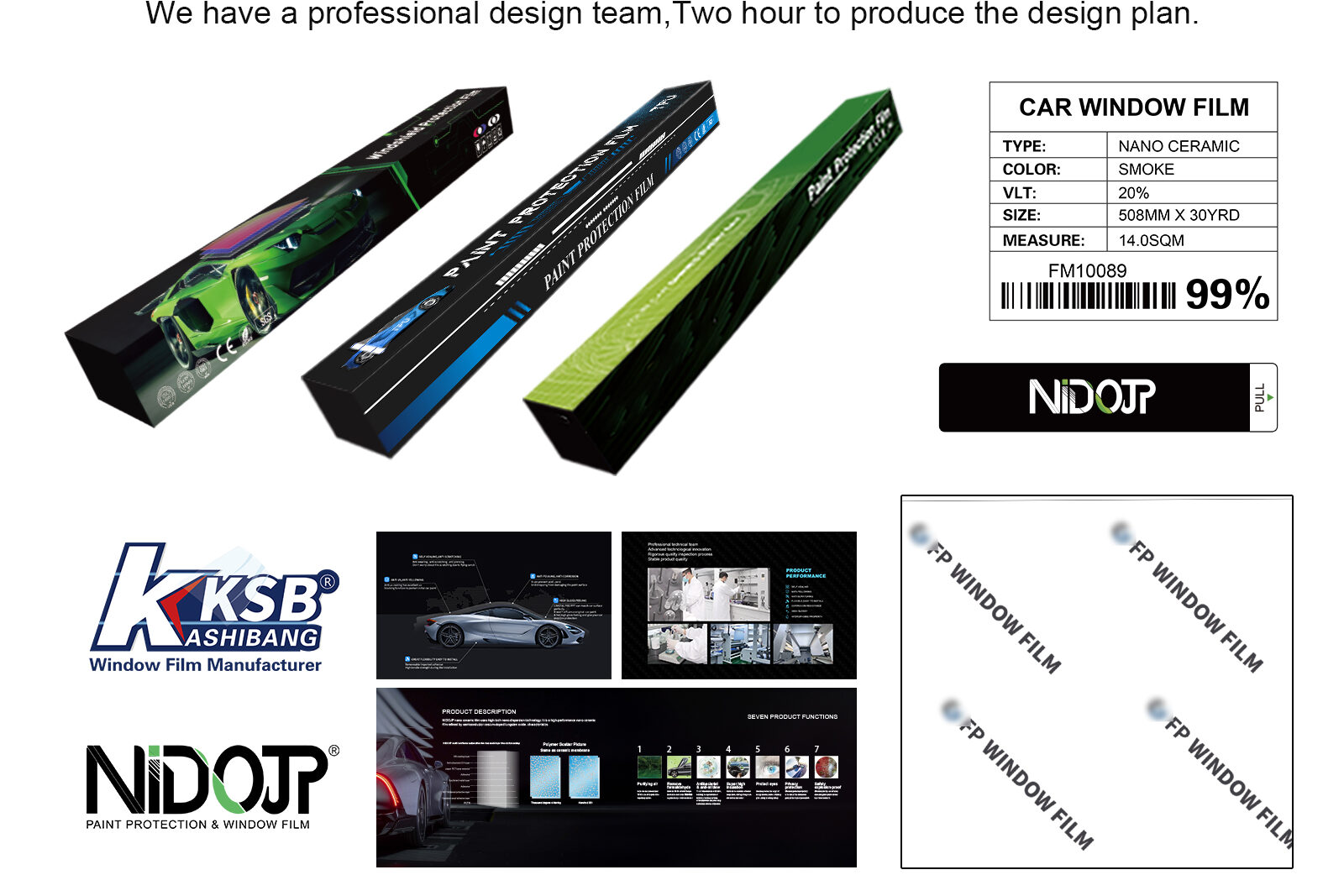
Custom branded packaging solution for window film OEM and private label projects, including logo printing and export carton design.
The Economics: Running the Numbers Honestly
For a distributor buying directly from a manufacturer like KSB and building their own brand:
A mid-range ceramic automotive film at 1.52m × 20m rolls costs roughly $10–$18 ex-works depending on specification and volume. Add shipping, customs, and last-mile logistics and you’re at roughly $14–$25 landed cost per roll in Western markets. With private label packaging, add $1–$3 per roll.
Trade price to professional installers: typically $45–$80 per roll for mid-range ceramic. Installer gross margin from this pricing: $25–$60 per roll, allowing them to price competitively to their customers.
The distributor’s margin between landed cost and trade price: 50–60% gross margin is achievable for a properly positioned brand. Compare this to the 20–30% typical gross margin for a distributor reselling a major established brand.
The caveat: the marketing investment to establish a private label brand — product documentation, installer training materials, sample programmes, website content — isn’t trivial. Budget $15,000–$40,000 for a proper brand launch, and expect 18–24 months before the brand has enough market presence to sell on reputation rather than price.
Common Mistakes in Private Label Programmes
Choosing the manufacturer with the lowest price. This gets said a lot, but the mechanism is worth understanding. Low-price manufacturers typically cut costs in: raw material quality (aromatic TPU instead of aliphatic, non-name-brand adhesive), quality control (no clean room, no QUV testing), and documentation (generic test reports, no batch traceability). When your private label programme generates its first warranty claim — and it will — you’ll discover whether your manufacturer has the systems to investigate and resolve it, or whether they’ll blame the installer.
Launching with a warranty you can’t honour. A 10-year warranty sounds better than a 7-year warranty, which sounds better than a 5-year warranty. But a warranty is only as good as the product backing it and the manufacturer’s willingness to support claims. If your film can genuinely be warranted to 10 years based on QUV data, offer 10 years. If the data supports 7 years, offer 7 years honestly. The installation businesses that recommend your brand have their reputations on the line when your warranty fails.
Ignoring the installer experience. The end consumer doesn’t buy window film; an installer installs it. The installer’s daily experience with your product — how it handles during installation, whether it conforms without webbing, whether the adhesive working window is appropriate — determines whether they recommend it or don’t. Pricing and brand positioning affect the sale; product experience affects repeat specification.
FAQ
How long does it take to go from “I want my own brand” to “I have product in my warehouse”?
For private label on an existing specification: 12–18 weeks typically. The breakdown: 3–4 weeks for manufacturer evaluation and product selection, 3–5 weeks for packaging artwork development and approval, 3–5 weeks for production and packaging, 4–6 weeks for sea freight. Parallel-pathing the artwork development with the production scheduling can compress this.
For custom (OEM) formulation development, add 8–14 weeks for the development cycle before you get to production.
Should I tell my customers the film is made in China?
Transparency is generally better than obscurity. “Manufactured to our specification in Dongguan, China” is accurate and honest. The more important statement is about the manufacturer’s quality credentials: “manufactured in an ISO 9001 facility with ISO 7 clean room coating and third-party QUV testing.” That’s the substance behind the geography.
Panjiva — Verify any manufacturer’s actual export history before signing anything
Build Something That’s Actually Yours
KSB Window Film has run private label programmes for distributors from single-country operations to multi-market brands. We know what the economics look like at different volume levels, and we won’t sell you a programme that doesn’t make sense for your scale.