Published: June 4 , 2026 · 14 min read · Category: Sourcing Guide
Importing window film from China for the first time is one of those things that sounds manageable until you’re three weeks in and suddenly fielding questions about HS codes, fumigation certificates, and whether your shipment needs a customs broker or if you can handle it yourself.
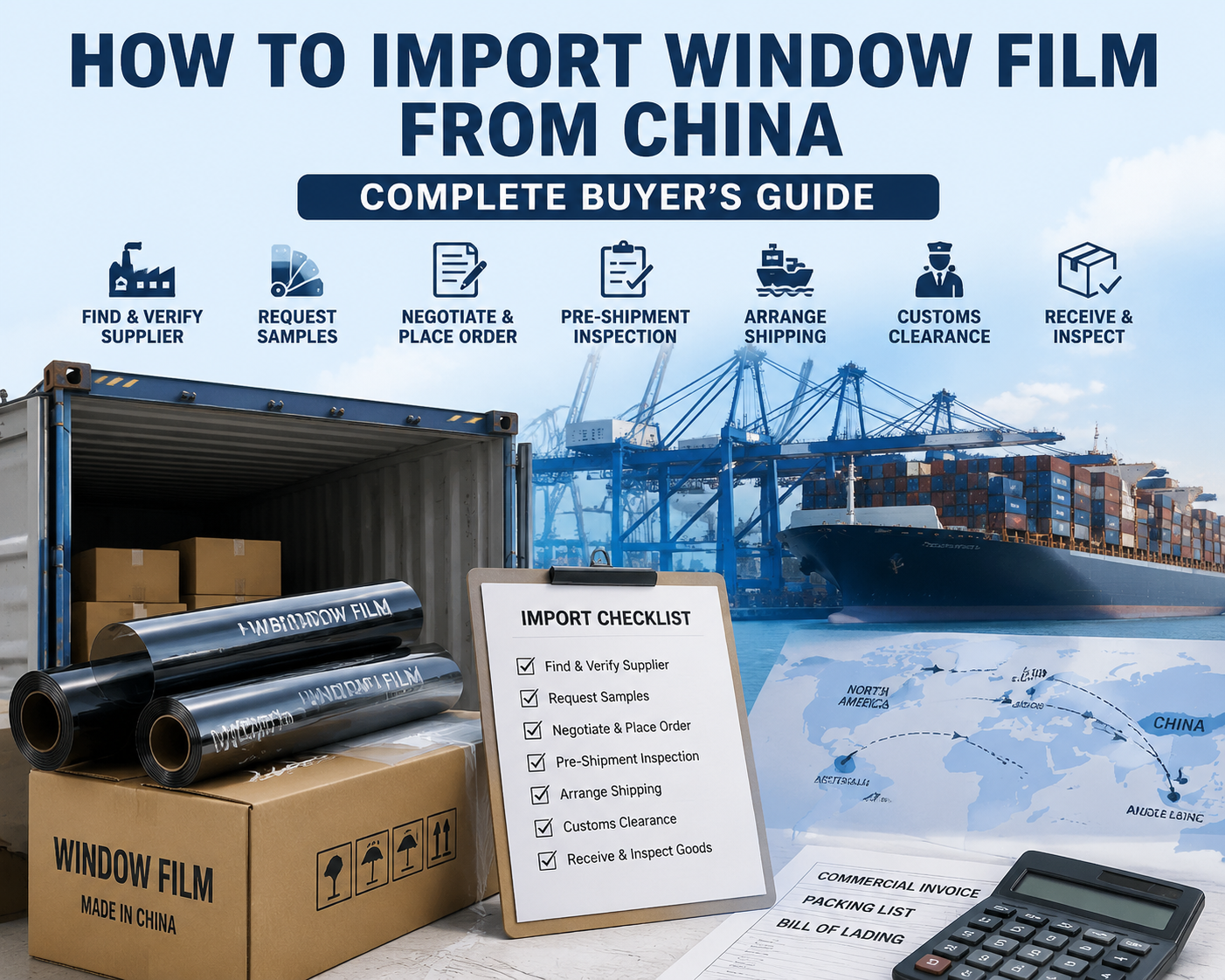
This guide covers the full process — from finding the right supplier to getting product through customs and into your warehouse. It’s written for first-time importers, but there’s enough detail here to be useful even if you’ve done a few orders and run into problems you couldn’t explain.
We’ve structured it as a step-by-step process because that’s how importing actually works: sequentially, with each stage depending on what came before it.
Step 1: Get Clear on What You’re Importing
Before you contact a single supplier, you need to know exactly what you’re looking for. “Window film” is a product category, not a specification — and Chinese manufacturers produce dozens of distinct product types with different raw materials, performance characteristics, price points, and applicable regulations.
The main categories:
By application:
- Automotive window tint film
- Architectural / building window film (solar control, safety, decorative)
- Marine window film
- Privacy and one-way vision film
By technology:
- Dyed film (entry-level, least expensive)
- Metalized film (better heat rejection, some signal interference)
- Carbon film (stable color, no signal interference)
- Nano-ceramic film (premium heat rejection, no metallic content)
- Ceramic-carbon hybrid
By function:
- Solar control / heat rejection
- UV blocking
- Safety and security (anti-shatter)
- Decorative / frosted / printed
Each category has different performance standards, different applicable certifications, and — importantly — different HS codes that determine what you pay in import duties.
If you’re not sure what your market actually wants, start with our Window Film Wholesale: A Practical Buyer’s Guide for Distributors before going further. Getting the product selection right before you place a supplier order saves a lot of expensive course-correcting later.
Step 2: Find and Verify Your Supplier
The single most consequential decision in this entire process is who you buy from. Everything downstream — quality, lead times, documentation accuracy, post-shipment support — flows from this choice.
Where to Find Suppliers
Alibaba and Made-in-China are the obvious starting points and genuinely useful for initial discovery. Search “window film manufacturer” or specific product types. Filter for Gold Suppliers and Trade Assurance status as a baseline screen — these aren’t quality guarantees, but they do reduce the chance of outright fraud.
Canton Fair (held twice annually in Guangzhou) remains the best place to evaluate multiple suppliers face-to-face. If you’re planning to import seriously, attending at least once is worth the trip.
Industry referrals are underrated. If you’re in the window tinting industry, other distributors — even in non-competing markets — often have supplier relationships they’re willing to share. The best factories frequently don’t have strong Alibaba presences because they don’t need them.
Factory vs. Trading Company
This decision deserves its own treatment. The short version: factories offer better pricing at scale and full OEM capability; trading companies offer lower MOQs, broader product ranges, and more responsive service. We’ve covered this in detail in Window Film Factory vs Trading Company: What’s the Difference?
How to Verify a Supplier
Don’t skip this step. Supplier verification is where most first-time importer mistakes originate.
Request and verify the business license. Chinese companies are required to have a 营业执照 (Yíngyè Zhízhào). The business scope will tell you whether the company is registered as a manufacturer or trading entity. Request the original document — not a screenshot.
Cross-reference the address. The address on the business license should correspond to actual manufacturing or warehousing space, not a commercial office building. Google Maps and Baidu Maps satellite view will both show you what’s there.
Ask for a factory video walkthrough or audit. Legitimate manufacturers have nothing to hide. A good factory video should show production equipment, not a showroom. Better still, hire a third-party inspection company to conduct a physical audit before your first order.
Check their export records. Panjiva and ImportGenius track US customs records by exporter. Search the company name or shipping address — you can see actual shipment history, which markets they export to, and roughly what volumes they move. A “manufacturer” with zero export records from their listed address is a red flag.
Use our Window Film Factory Audit Checklist as a structured starting point — 12 questions that get to the substance of whether a factory is actually capable of what they’re claiming.
Step 3: Request Samples and Evaluate Quality
No serious buyer places a production order without seeing the product first. Request samples before committing to anything.
What to Ask For
- At minimum, one roll of each SKU you’re considering (typically 1.52m × 3–5m sample lengths are standard)
- The corresponding technical data sheet (TDS) for each product
- SGS, Intertek, or equivalent third-party test reports, dated within the last 12 months
What to Test
If you’re new to window film, some of this requires either professional installers or basic equipment. Tests worth running:
- VLT (Visible Light Transmittance): Does the actual product match the claimed spec? A basic tint meter will tell you.
- Clarity and optical distortion: Install a sample on glass and look through it at a straight line. Ripple, haze, or rainbow effect at angles are signs of quality issues.
- Adhesive performance: How does it install? Does it air-out properly? Does it hold without lifting at edges after a week?
- Heat rejection feel: Not a scientific test, but standing next to glass with and without film on a sunny day gives a baseline sense of whether the solar control is performing.
For ceramic window film specifically, IR performance claims are critical and often overstated. Third-party lab reports are the only reliable way to verify them — don’t rely on the factory’s own datasheets.
Step 4: Negotiate Terms and Place the Order
Pricing Variables
Window film pricing is quoted per square meter or per roll (typically 1.52m wide × 30m or 50m). Key factors affecting price:
- Technology tier: Dyed → metalized → carbon → nano-ceramic, pricing increases roughly in that order
- Order volume: Per-unit pricing drops meaningfully at higher quantities — know your realistic volume before negotiating
- OEM vs. stock: Custom-branded or custom-spec products carry a premium; off-the-shelf private label is cheaper
- Packaging: Branded cores, custom boxes, retail packaging all add cost
Get quotes from at least three suppliers before deciding. And remember — the lowest quote rarely tells the complete story. Factor in lead time, payment terms, and the reliability of the supplier relationship.
Payment Terms
Standard payment terms for new supplier relationships in China:
- 30% deposit, 70% before shipment — the most common structure for first-time buyers
- 100% in advance — occasionally requested by smaller factories or for small orders; carry more risk for the buyer
- Letter of Credit (L/C) — more common for large orders ($50,000+); provides payment security for both parties
- Trade Assurance (Alibaba) — provides a dispute mechanism if the product doesn’t match spec; useful for first orders through the platform
Use secure payment methods. Wire transfer (T/T) to a verified bank account is standard. If a supplier requests payment to a personal account or via informal channels — walk away.
Get It in Writing
A purchase order (PO) or proforma invoice should specify, at minimum:
- Product name, SKU, specifications (VLT, dimensions, technology type)
- Quantity and unit pricing
- Total order value and currency
- Payment terms
- Incoterms (more on this below)
- Estimated production lead time and ship date
- Packaging and labeling requirements
- Quality acceptance standards and inspection rights
Don’t let a supplier skip documentation because “we’ve worked with many buyers and it’s always fine.” Documentation protects you if anything goes wrong.
Step 5: Understand Incoterms (This Part Actually Matters)
Incoterms define where the seller’s responsibility ends and the buyer’s begins. Getting this wrong is one of the most common and most expensive mistakes first-time importers make.
The terms you’ll encounter most often in China trade:
EXW (Ex Works): The factory hands you the goods at their door. All freight, export clearance, and shipping costs are on you. Maximum control, maximum complexity.
FOB (Free on Board): The seller handles export clearance and delivers the goods to the port of origin. Once it’s on the vessel, it’s your responsibility. FOB is the most commonly used Incoterm in China–US/EU trade and the one most buyers should default to when starting out.
CIF (Cost, Insurance, Freight): The seller arranges and pays for shipping and insurance to your destination port. Sounds convenient — but it means you have no control over freight costs or carrier selection, and the seller may be marking up logistics significantly.
DDP (Delivered Duty Paid): The seller handles everything, including import duties, to your door. The highest-price option, but it removes all logistical complexity from your side. Useful for very first orders when you’re still figuring out the process.
For most buyers doing recurring orders, FOB is the standard. It gives you control over freight selection and cost, and it’s where your freight forwarder earns their fee.
Step 6: Arrange Pre-Shipment Inspection
Before your supplier ships the order, consider a pre-shipment inspection (PSI) — especially for your first few orders with a new supplier.
A PSI involves a third-party inspection company visiting the factory after production is complete, checking the goods against your PO specifications, and issuing a report. If something is wrong, you find out before the container leaves China — not three weeks later when it arrives at your warehouse.
Reputable inspection companies operating in China:
- SGS — global leader, strong China presence
- Bureau Veritas — widely used, particularly in European buyer markets
- Intertek — strong in Asia-Pacific, often used for textile/film products
- QIMA — tech-forward platform, good for buyers doing frequent inspections
A standard PSI for a container of window film typically costs $200–$350 and takes 1–2 business days. It’s one of the best investments you can make on a new supplier relationship.
Step 7: Handle Shipping and Freight
Choosing a Freight Forwarder
Unless you’re shipping DDP, you need a freight forwarder — a company that arranges international cargo transport on your behalf. Good freight forwarders handle:
- Booking cargo space with carriers
- Export documentation from the China side
- Coordination with your customs broker at destination
- Tracking and exception management
For first-time importers, using a forwarder with specific China-to-[your-country] experience is worth paying a premium for. They know the common documentation issues, the reliable carriers on your lane, and the port-specific procedures that can trip up generic forwarders.
Ocean vs. Air Freight
Window film is a relatively dense, bulky product. For almost all commercial quantities:
- Ocean freight (FCL or LCL) is the standard. A full container load (FCL, 20ft or 40ft) makes sense at high volumes; Less than Container Load (LCL) consolidates your shipment with others and is more economical for smaller orders.
- Air freight is typically 5–8× the cost of ocean per kg and only justified when a shipment is time-critical — a stock-out situation, a product launch deadline, or a small urgent order.
Typical ocean freight transit times from major Chinese ports (Shenzhen, Ningbo, Shanghai) to major destination ports:
- West Coast USA: 14–18 days
- East Coast USA: 25–32 days
- Rotterdam / Hamburg: 25–30 days
- Sydney / Melbourne: 18–22 days
- Dubai: 12–16 days
Build these lead times into your inventory planning.
Key Shipping Documents
Your supplier should provide, and you should verify:
- Commercial Invoice — must accurately reflect the actual transaction value and product description
- Packing List — itemized breakdown of the shipment contents
- Bill of Lading (B/L) — the carrier’s receipt and the primary document of title for the goods
- Certificate of Origin (CO) — used to determine applicable duty rates; may be required by your customs authority
- SGS / test reports — some countries require these at customs for window film imports
Accuracy matters. Discrepancies between the commercial invoice, packing list, and bill of lading are a leading cause of customs delays and, in some markets, fines.
Step 8: Clear Customs in Your Country
Every market has different import regulations. What follows are the main considerations for the largest buyer markets — but customs procedures change, and you should always work with a licensed customs broker for your specific country.
United States
Window film is typically classified under HS Code 3920.62 (plates, sheets, film of polyethylene terephthalate) or subcodes thereof. Import duties vary — Section 301 tariffs on Chinese goods have significantly affected window film import costs since 2018 and remain in flux. Work with a US-licensed customs broker and verify the current duty rate before your landed cost calculations.
The FTC’s energy efficiency labeling requirements apply to certain window product claims. Know what you’re allowed to say on packaging and marketing materials before you label your product.
CBSA (Canada): Similar documentation requirements to the US. CUSMA/USMCA doesn’t apply to Chinese-origin goods; standard MFN tariff rates apply.
European Union
CE marking requirements, REACH compliance, and RoHS may be relevant depending on the film composition and application. EU customs typically require a Certificate of Origin, and since the EU–China trade relationship involves its own tariff schedules, verify applicable rates with your customs broker.
Australia
Window film imports from China are subject to customs duty and GST. Australia Border Force has historically conducted random testing of window film products to verify VLT claims against Australian standards (AS 2080 for automotive film). Make sure your supplier’s product actually meets the spec before it gets tested.
Middle East (UAE, Saudi Arabia)
Many Gulf Cooperation Council (GCC) countries have their own certification requirements. UAE, for instance, has ESMA (Emirates Authority for Standardization and Metrology) certification requirements for certain window film products. If you’re distributing into GCC markets, check current ESMA requirements and build certification lead time into your planning.
Step 9: Receive, Inspect, and Distribute
When the shipment arrives, don’t skip incoming inspection because you’re in a hurry to fulfill orders.
Inspect the physical condition first. Are rolls damaged? Is packaging intact? Any signs of moisture exposure? Document everything with photos before moving inventory.
Spot-check product specs. Pull a sample from different boxes or pallets — not just the top of the stack. Check VLT with a tint meter. Look for consistency across the batch.
Check against the packing list. Verify quantities, SKUs, and labeling match what you ordered. Discrepancies are easier to resolve with the supplier while the shipment is still fresh.
Document defects immediately. If you find quality issues, notify your supplier within the timeframe specified in your PO (typically 5–15 business days from receipt). Late notification weakens your position in any dispute.
Common Mistakes That Cost Importers Money
Letting the supplier choose the freight forwarder. When the seller arranges freight (CIF terms), they often work with partners who charge above-market rates or provide minimal service when issues arise. Use your own forwarder.
Skipping pre-shipment inspection on early orders. The first few orders with any new supplier are the highest-risk. A $300 PSI is cheap insurance.
Under-declaring the customs value. Some suppliers will offer to falsify commercial invoice values to reduce your import duties. Don’t do this. Customs fraud carries significant penalties, and the supplier faces zero of the risk — you do.
Not knowing your HS code in advance. Different HS classifications attract different duty rates. Classify your product correctly before your first order, not after it arrives and customs makes their own determination.
Ordering too much too fast. Start with a manageable quantity — enough to test the product in your market and build a track record with the supplier before committing to full container volumes.
Putting It All Together: Timeline for a First Shipment
Here’s a realistic end-to-end timeline for a first ocean freight order from China:
| Stage | Timeframe |
|---|---|
| Supplier research and shortlisting | 2–4 weeks |
| Sample request, receipt, and evaluation | 2–3 weeks |
| Supplier verification / factory audit | 1–2 weeks |
| PO negotiation and placement | 1 week |
| Production lead time | 3–6 weeks |
| Pre-shipment inspection | 3–5 days |
| Ocean freight transit | 2–5 weeks (destination-dependent) |
| Customs clearance at destination | 3–7 business days |
| Delivery to warehouse | 1–3 days |
| Total: first shipment end-to-end | ~12–20 weeks |
Plan accordingly. Buyers who expect 6 weeks from inquiry to warehouse frequently run into stock-out problems on their first order cycle.
FAQ
1.What documents are required when importing window film from China?
Common documents include the commercial invoice, packing list, bill of lading, certificate of origin, and third-party test reports such as SGS or Intertek.
2.What is the best Incoterm for first-time window film importers?
FOB is the most commonly recommended option because it gives buyers better control over freight costs and shipping arrangements while keeping the process manageable.
3.Should I arrange a pre-shipment inspection before importing window film?
Yes. A pre-shipment inspection helps verify product quality, specifications, packaging, and quantity before the goods leave China, reducing the risk of costly issues after arrival.
4.How long does it usually take to import window film from China?
A first shipment typically takes around 12–20 weeks from supplier sourcing to final delivery, depending on production lead time, shipping method, customs clearance, and destination country.
Have Questions About Your Specific Situation?
Every import situation is different. The market you’re selling into, the product type you’re sourcing, your volume, your timeline — these all shape which suppliers, which Incoterms, and which compliance steps apply to you.
We work with window film buyers across North America, Europe, Australia, and the Middle East — from first-time importers figuring out the basics to established distributors looking to optimize their supply chain.
→ Send us a sourcing inquiry and we’ll respond within one business day with recommendations specific to your situation.
Further Reading
On this site:
- Top 7 Window Film Manufacturers in China (2026 Verified List) — Vetted supplier starting points for each major product category
- How to Source OEM Window Film from China: A Step-by-Step Guide — The OEM-specific sourcing process in detail
- How to Choose Window Film for Your Car — A practical guide to choosing ceramic, carbon, metalized, and PDLC window film.
- What Is Eye Protection Film for Glass? — Learn how anti-glare film improves visibility and reduces eye fatigue.
- PPF vs Ceramic Coating: Which Is Better? — Compare paint protection, gloss, durability, and maintenance.
External resources:
- Panjiva / S&P Global Trade Intelligence — Verify any Chinese exporter’s actual US shipment history
- SGS Pre-Shipment Inspection — Third-party inspection services for China-origin goods
- QIMA Quality Inspections — Tech-enabled inspection platform widely used for China sourcing
- Freightos — Freight rate comparison tool for ocean and air shipments from China
- Customs Info Database — HS code lookup and duty rate reference by destination country
Get a Free Sample or Quote
Looking for a reliable window film supplier? Contact us today for fast response and professional support.