Published: June 18, 2026 · 8 min read · Category: Sourcing Guide
MOQ is one of those terms that gets thrown into supplier conversations early and often — sometimes as a negotiating tactic, sometimes as a genuine production constraint, and sometimes as a number that was made up and will change the moment you push back.
For buyers new to sourcing window film from China, MOQs can feel like a barrier. For buyers who’ve been around for a while, they’re more of a variable to manage — one that affects your cash flow, your product range decisions, and your choice between working with a factory directly versus going through a trading company.
This guide explains how MOQs actually work in the window film industry, why they exist, how they differ across product types and supplier relationships, and how to negotiate them without damaging the relationship you’re trying to build.
Why MOQs Exist
Minimum order quantities aren’t arbitrary. They reflect the economics of manufacturing and fulfillment on the supplier’s side.
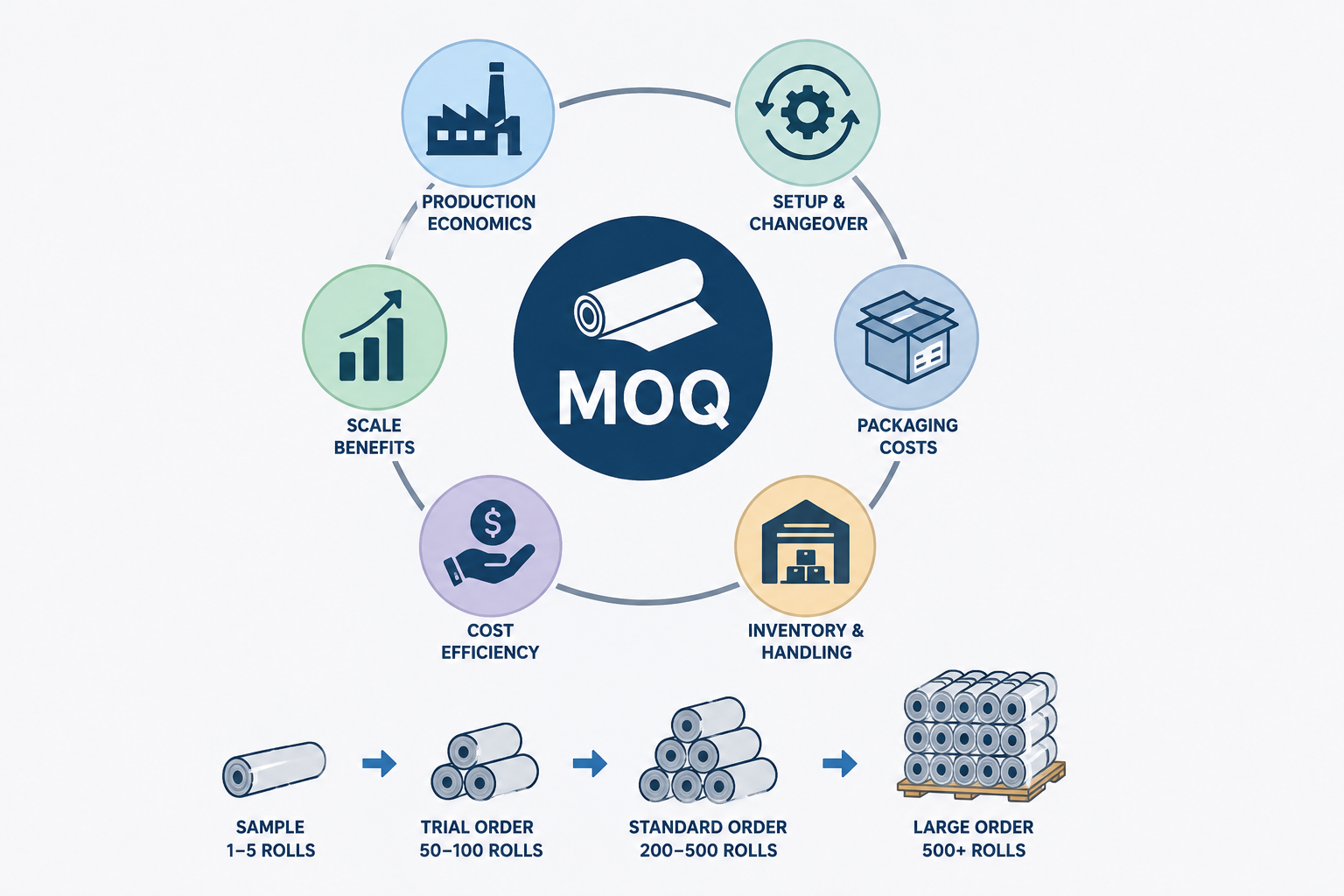
Production economics: Window film is produced in large master rolls. A sputtering line or coating line runs most efficiently at scale — stopping and starting production for a 20-roll order is expensive relative to running 500 rolls continuously. MOQs exist partly to ensure that when the line runs for your order, it makes economic sense to run it.
Setup and changeover costs: Switching between product specifications — different VLTs, different film technologies, different coating chemistries — involves changeover time, materials used in the setup process, and quality verification before production resumes. These costs get amortized across the production run. Small runs mean high per-unit overhead.
Packaging and labeling costs: For OEM and private label orders, custom cores, labels, and boxes are typically ordered separately with their own minimums. The packaging MOQ and the film MOQ may be different — and both need to be met.
Inventory and handling: A factory that holds finished goods inventory needs a threshold quantity to justify the warehouse space, pick-and-pack time, and documentation overhead per order.
Understanding these reasons matters because it changes how you negotiate. Asking for a lower MOQ isn’t just asking for a favor — it’s asking the factory to absorb costs they’ve built into their pricing model. Which means there’s usually a tradeoff available.
Typical MOQ Ranges in the Window Film Industry
MOQs vary significantly by supplier type, product category, and relationship stage. Here’s a realistic picture:
Direct Factory, Standard Stock Product
For widely produced SKUs — standard carbon automotive tint, common architectural solar control — direct factories will often accommodate:
- First sample order: 1–3 rolls (sometimes free, sometimes at a premium per-roll rate)
- Trial production order: 50–100 rolls at a price premium over full-production pricing
- Regular production order: 200–500 rolls at standard pricing
These numbers vary. A large factory that’s used to shipping containers to major distributors may have true production MOQs of 500+ rolls per SKU. A mid-size factory focused on export relationships may work at 200 rolls.
Direct Factory, OEM / Custom Specification
For products that require custom formulation, custom branding, or non-standard specifications, MOQs are higher because setup costs are higher:
- OEM film formulation (custom spec): 500–1,000 rolls per SKU as a typical starting point; some manufacturers require more for custom coating runs
- Private label (stock product with custom branding): 200–500 rolls, with separate packaging MOQs
- Custom packaging only (standard film, branded packaging): Film MOQ as above; label MOQ typically 500–1,000 units; box MOQ 300–500 units
The OEM model and its implications for MOQ are covered in depth in OEM Window Film vs Private Label: Which Is Better?
Trading Company
Trading companies aggregate demand from multiple buyers, which means they often offer lower effective MOQs on standard products — because they’re fulfilling your 100-roll order as part of a 1,000-roll factory run they’re managing across several clients.
The tradeoff: less control over the production process, typically less flexibility on custom specifications, and a price that includes the trading company’s margin. For buyers who need a broad range at low volumes per SKU, this is often the right tradeoff. The Window Film Factory vs Trading Company guide covers when each model makes more sense.
How MOQ Affects Your Buying Strategy
Understanding MOQs isn’t just about the minimum — it’s about how the minimums interact with your product range decisions, cash flow, and supplier structure.
The Range vs. Depth Tradeoff
More SKUs means more MOQ commitments across your range. A distributor carrying 15 window film SKUs with a 200-roll MOQ each needs to commit to 3,000 rolls of inventory to cover the full range — even if half those SKUs turn slowly. This capital commitment is what pushes many distributors toward a narrower, deeper range rather than a broad, thin one.
Before committing to new SKUs, ask whether the likely volume per SKU over the next 6 months justifies the MOQ commitment. SKUs that sit in your warehouse for more than 90 days before selling represent capital that could be better deployed.
Tiered Pricing and MOQ Thresholds
Most suppliers have price tier structures where the per-unit cost drops meaningfully at higher quantities. The relationship between MOQ and pricing tiers matters:
- Ordering exactly at the MOQ gets you the product but at the highest per-unit price tier
- Ordering at 2–3× the MOQ may cross into a significantly lower price tier
- The break-even on ordering more (lower unit cost vs. higher inventory carrying cost) is worth calculating before placing each order
The Wholesale Window Film Buying Guide for Distributors covers the pricing tier math in more detail.
Consolidating Orders to Hit MOQ
If you want a product but can’t justify the MOQ on its own, there are a few practical approaches:
Bundle SKUs in one production run: Some factories will combine related SKUs (same technology, different VLTs) into a single production run and apply the total quantity toward a combined MOQ. Not all factories offer this, but it’s worth asking.
Time orders with seasonal demand: Rather than ordering 100 rolls per month, accumulating demand and placing a 300-roll order quarterly may both meet the MOQ and result in better per-unit pricing.
Use a trading company for tail SKUs: For products you need to stock but can’t consistently order at factory MOQs, a trading company can often source them in smaller quantities. Keep your high-volume SKUs direct and your long-tail through a trading company.
Negotiating MOQ: What Works and What Doesn’t
MOQs are almost always negotiable to some degree. The question is how to negotiate without signaling that you’re a low-volume buyer who isn’t worth the factory’s attention.
What works:
Pay more per unit for a lower quantity. This is the cleanest negotiation: “I understand your standard price is at 200 rolls. Can we do 100 rolls at a 10% premium while we validate this product in our market?” Most factories will accept this because they’re not losing money — they’re just getting a higher margin on a smaller run.
Commit to a purchase plan. “I’d like to start with 100 rolls, with a commitment to a 300-roll follow-up order within 60 days if the product performs as expected.” This gives the factory forward visibility on volume, which matters to them more than the single-order size.
Frame it as market entry. “We’re entering a new product category and want to validate the market before committing to full production quantities.” Most experienced manufacturers understand market validation — they’ve seen it work and fail. This framing is honest and positions you as a buyer with potential upside.
What doesn’t work:
Pushing hard on MOQ without offering anything. Asking a factory to take on lower-MOQ production economics without any compensation (higher price, committed follow-on order, longer relationship) is asking them to absorb your risk. It rarely results in a good long-term relationship.
Inflating your claimed volume. Telling a factory you’re “looking to order 500 rolls per month” to get their attention, then placing a 100-roll order, damages trust from the first transaction. Factories talk to each other, particularly in the same export network. Be honest about your starting volume and let the relationship grow naturally.
Treating MOQ as an arbitrary obstacle. If you’ve understood why MOQs exist, you’ll negotiate them differently — as a business constraint to find a creative solution for, rather than a policy to overcome.
MOQ Red Flags From Suppliers
Just as buyers sometimes misrepresent their volume, suppliers sometimes misrepresent their MOQs — in both directions.
Suspiciously low MOQ from a claimed manufacturer: A factory claiming to produce nano-ceramic film at 10-roll MOQs is almost certainly a trading company sourcing from elsewhere, not a manufacturer. Real coating operations don’t run profitably at that scale.
MOQ that changes after you’ve engaged: “Our standard MOQ is 100 rolls” in the initial pitch, followed by “actually, for your specific product it’s 500 rolls” after you’ve committed time to the evaluation. This isn’t always bad faith — product-specific constraints are real — but a significant change in stated MOQ mid-negotiation is worth probing.
MOQ that exists only when it’s convenient: Some suppliers quote an MOQ, then immediately offer to “make an exception” with no change in pricing or terms. If the MOQ evaporates at the first question, it was never a real constraint — which raises the question of what else in the quote isn’t real.
A Practical Reference: MOQ by Scenario
| Scenario | Typical MOQ Range | Notes |
|---|---|---|
| Sample rolls | 1–5 rolls | Often at a premium or sample price |
| First trial order (stock product, direct factory) | 100–300 rolls | Price premium over standard tier typical |
| Regular order (stock product, direct factory) | 200–500 rolls | Standard pricing kicks in |
| Private label (branded, stock formulation) | 300–500 rolls | Separate packaging MOQs apply |
| OEM (custom formulation) | 500–1,500 rolls | Varies significantly by factory and spec complexity |
| Via trading company (standard SKUs) | 50–200 rolls | Higher per-unit cost; lower capital commitment |
These are reference ranges, not rules. The only way to know a specific factory’s real MOQ structure is to ask — and then verify whether what they’ve told you is consistent with their behavior when you actually place an order.
FAQ
Q1: What does MOQ mean in the window film industry?
MOQ stands for Minimum Order Quantity, which is the lowest quantity a supplier requires for production or purchase.
Q2: Why do window film manufacturers set MOQ requirements?
MOQ helps manufacturers manage production costs, raw material usage, packaging, and manufacturing efficiency.
Q3: Does OEM or custom packaging increase the MOQ?
Yes. Custom logos, labels, cartons, and private label packaging usually require higher minimum order quantities.
Q4: Can buyers negotiate MOQ with window film suppliers?
Some suppliers may offer flexible MOQ options depending on product type, stock availability, or long-term cooperation potential.
Q5: What products usually have lower MOQ requirements?
Standard window films with regular packaging often have lower MOQ requirements than customized or specialty films.
Q6: Why is understanding MOQ important before placing an order?
Understanding MOQ helps buyers plan budgets, inventory, shipping costs, and product sourcing strategies more effectively.
Trying to work out whether a factory’s MOQ structure works for your buying plan? Send us an inquiry — we help match buyers with suppliers whose minimums and pricing structure fit their actual volume.
Further Reading
On this site:
- OEM Window Film vs Private Label: Which Is Better? — How MOQ connects to your sourcing model choice
- Window Film Factory vs Trading Company: What’s the Difference? — Using each supplier type to manage MOQ constraints
- How to Compare Window Film Quotes from Different Suppliers — Incorporating MOQ into a like-for-like quote comparison
- Wholesale Window Film Buying Guide for Distributors — Building a range around realistic MOQ commitments
- How to Source OEM Window Film from China: A Step-by-Step Guide — OEM-specific MOQ considerations
External:
- Alibaba Trade Assurance — Dispute mechanism useful for first orders where you’re testing stated MOQs and specs
- IWFA Industry Resources — Industry body context for understanding professional market volume norms
Get a Free Sample or Quote
Looking for a reliable window film supplier? Contact us today for fast response and professional support.