Published: June 6 , 2026 · 10 min read · Category: Brand Building
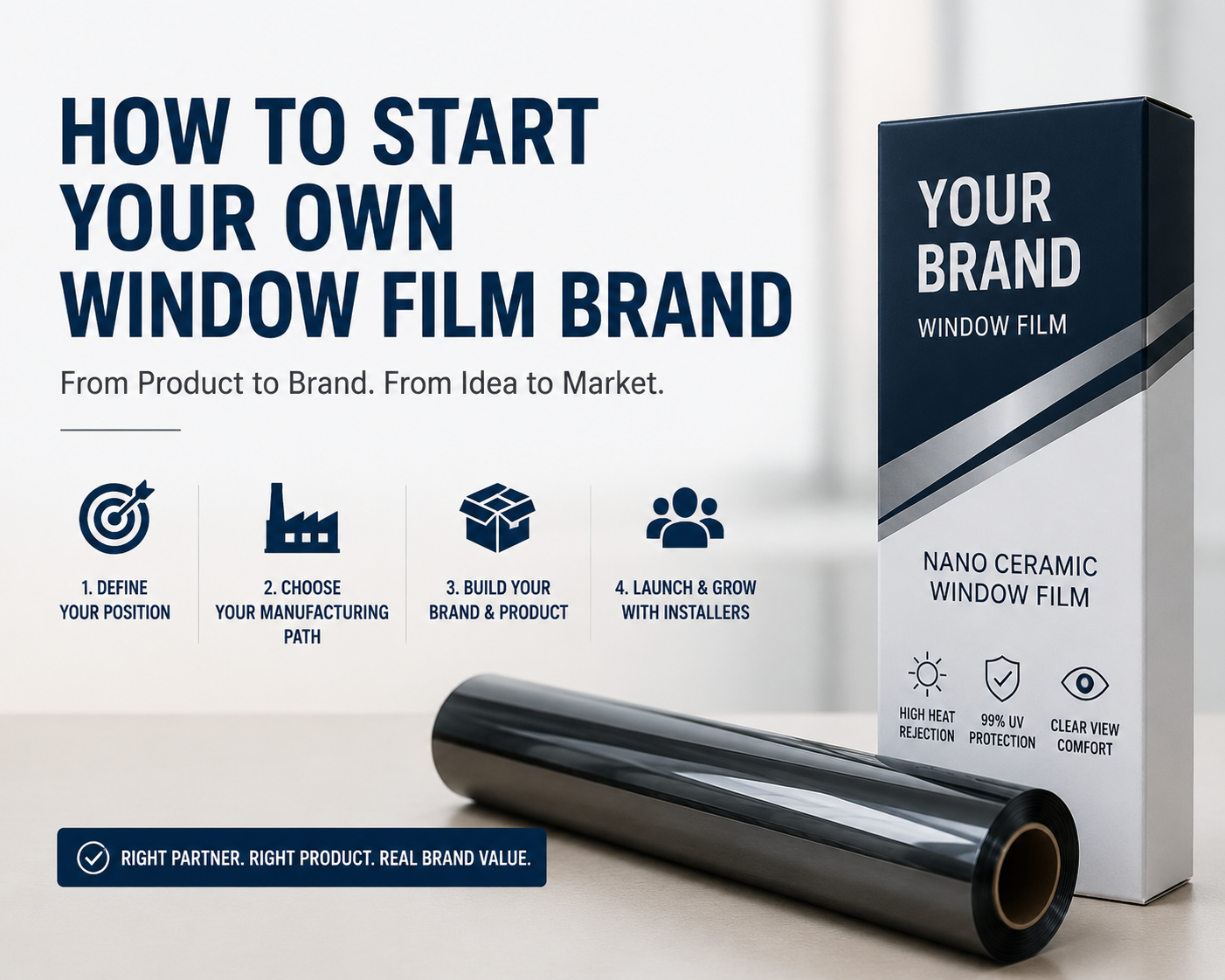
There’s a moment that a lot of window film distributors eventually reach — usually somewhere around year two or three, when they’re moving decent volume, they know their market well, and they look at the rolls in their warehouse and think: why is someone else’s name on this?
Starting your own window film brand is more achievable than most people assume. You don’t need a factory. You don’t need millions in investment. You need a clear market position, a reliable manufacturer, and the patience to build something that takes more than one product cycle to get right.
This guide covers the full picture — from figuring out whether a brand is the right move, through product development and packaging, to getting it in front of installers and building the kind of reputation that actually drives repeat orders.
First, Be Honest About Why You’re Doing This
Branding for its own sake is a money pit. Before you spend a dollar on logo design or packaging, answer these questions clearly:
Who specifically are you selling to? “Window film installers” is not an answer. Are you targeting high-end automotive tinters who install on luxury vehicles and charge $800 for a full car? Regional glazing contractors who do commercial building projects? Mid-volume retailers who need a reliable private-label product at a competitive price? The answer shapes everything downstream — product specs, price positioning, packaging, how you sell, and what claims you make.
What does your brand actually offer that existing brands don’t? “Better quality” is not an answer. Better quality at what? For whom? Compared to what? If you can’t articulate a specific, defensible reason someone should choose your brand over what they’re already buying, the brand won’t stick — no matter how good the logo looks.
Can you support the volume a brand requires? A brand without consistent supply is worse than no brand. Backorders, quality variation, packaging changes, discontinued SKUs — these things destroy distributor and installer trust faster than they build it. Before you commit to a brand, commit to the supply chain behind it.
If you’ve answered these honestly and still want to proceed, you’re in the right place.
Step 1: Define Your Market Position
The window film market has brands at every tier. Trying to compete everywhere is the surest way to compete nowhere.
The Three Viable Positions
Premium performance. Your brand leads with technical specs — IR rejection percentages, TSER ratings, ceramic or nano-ceramic technology. Your customers are professional installers who have educated clientele willing to pay for demonstrable performance. Margin is high. Volume is lower. You need strong third-party test data and the credibility to back up your claims.
Value-for-money. Your brand competes on price-to-performance ratio — not the cheapest, but the best product at its price point. This is a crowded position, but winnable if you’re honest about the specs and consistent in delivery. Your customers are mid-volume installers who want a reliable product they can recommend without hesitation and still make margin on.
Niche specialist. Your brand owns a specific application category — marine window film, anti-graffiti film, architectural safety film for schools, or ultra-clear paint protection-adjacent products. Less competition, more loyal customers, higher tolerance for premium pricing. The trade-off is smaller addressable market.
Pick one. You can expand later once the brand has equity. Launching with a confused positioning is almost impossible to recover from.
Step 2: Choose Your Manufacturing Path
Your brand needs a product behind it. There are two realistic routes: private label and OEM. They have very different implications for how your brand is built and protected.
Private Label: The Faster Start
With private label, you take an existing factory product and put your brand on it. The film is already formulated, tested, and in production. You choose from the manufacturer’s existing range, agree on branding, and place your order.
The advantages are speed and lower risk. You can have branded product in market in 6–8 weeks. You’re not funding product development. The formulation has a track record.
The disadvantage is that your product is essentially the same as what competitors could buy from the same factory. Your brand’s differentiation lives in your marketing, your service, and your customer relationships — not in the product itself.
For most people starting a window film brand for the first time, private label is the right entry point. Validate the market before you invest in OEM development.
OEM: The Brand-Builder’s Route
OEM means working with a manufacturer to develop a product to your specifications. You define the performance targets — VLT levels, IR rejection, adhesive chemistry, base film quality — and the factory engineers it. The resulting product belongs to your account. No one else can buy the same spec.
This is how genuine product differentiation is built. When a competitor installs your film next to theirs and your numbers are better, that’s an OEM product doing what it’s supposed to do.
The trade-off is time, cost, and minimum commitment. OEM development typically takes 8–14 weeks before a single roll ships. MOQs are higher. And if the development process reveals that hitting your target spec isn’t feasible at your target price, you’ve lost time.
For a detailed breakdown of how these two models compare — and when to make the switch from one to the other — see OEM Window Film vs Private Label: Which Is Better?.
Step 3: Find the Right Manufacturing Partner
The manufacturer behind your brand is, in practical terms, your most important business partner. Their quality consistency is your brand’s quality consistency. Their production delays are your backorder problems. Their documentation gaps are your compliance headaches.
What to Look For
A manufacturer capable of supporting a serious branded product line should be able to demonstrate:
- Consistent production quality across batches — not just on the sample roll, but on the 200th roll of the 15th order
- Current third-party test reports (SGS, Intertek, or equivalent) for the specific products you’ll be selling
- OEM experience, including exclusivity agreements and proper handling of your brand assets
- Export experience to your specific market — someone who understands the labeling requirements, documentation, and compliance expectations of US, EU, or Australian buyers isn’t the same as someone who’s been shipping containers of dyed film to Southeast Asia
See the Top 7 Window Film Manufacturers in China (2026 Verified List) for vetted starting points across different product categories.
The Exclusivity Question
If you’re private labeling, push for geographic exclusivity on your specific SKUs — meaning the manufacturer won’t sell the same product under a competing brand in your market. Not all manufacturers will agree, and enforcement is imperfect, but the conversation is worth having. For OEM products, exclusivity on the formulation itself is standard and should be written into your agreement.
Do the Due Diligence
Don’t skip supplier verification because you’re eager to launch. A promising sales conversation is not a substitute for an actual factory assessment. Use the Window Film Factory Audit Checklist to run through the questions that matter — production capability, QC processes, certification validity — before you commit.
Step 4: Build the Brand Identity
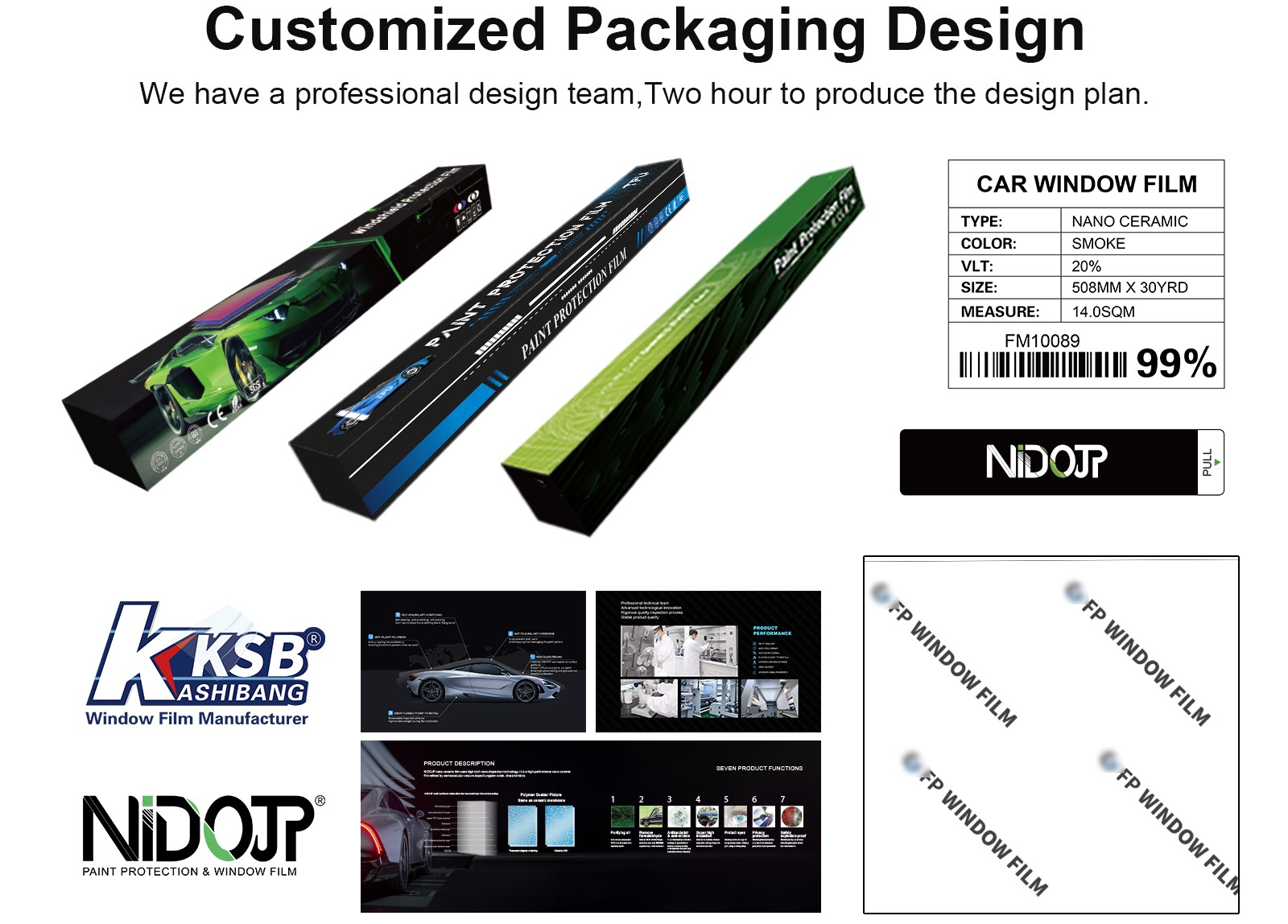
This is the part people usually jump to first. Don’t. Brand identity without product clarity and market position behind it produces logos that look good on a business card and mean nothing to the person deciding which film to install.
That said, once you know who you’re talking to and what you’re offering, brand identity matters more in window film than most people give it credit for. Professional installers have opinions about the brands they carry. A brand that looks credible and premium on the packaging signals something to their customers before a single square foot of film is on a window.
What Your Brand Identity Needs
A name that travels. If you’re selling internationally — or planning to — make sure the name doesn’t have an unfortunate meaning in another language, doesn’t create trademark conflicts in your target markets, and works phonetically in the languages your customers speak. Simple testing: say it out loud to someone who hasn’t heard it before. If they can’t spell it or repeat it back correctly, that’s a problem.
Packaging that communicates performance. Roll labels and boxes in the window film industry are not just cosmetic. Installers read them. Technical specs, VLT percentage, product series name, installation instructions — these should be accurate, legible, and formatted consistently. Inconsistent or inaccurate packaging creates returns and complaints.
A product naming system that scales. Don’t name your first product something that paints you into a corner. If your first product is “UltraMax Pro,” what do you call the next one? Build a product line architecture from the beginning: series names that allow you to add SKUs logically as your range expands.
A technical data sheet for every SKU. Not a marketing brochure. An actual TDS with VLT, VLR, TSER, UV rejection, IR rejection (at relevant wavelengths), adhesive specifications, and warranty terms. Professional buyers will ask for this. Not having it ready signals that your brand isn’t serious.
Step 5: Get the Performance Claims Right
This is where brands get themselves into trouble — especially first-time brand builders who are eager to lead with headline numbers.
Window film performance claims are regulated in most mature markets. In the United States, the FTC has clear guidance on how energy-related claims must be substantiated. Australia’s consumer law has similar bite. The EU is tightening on misleading technical claims across product categories.
The practical rules:
Only claim what you can prove with current, product-specific third-party test reports. “Up to 99% UV rejection” is a common claim. If your SGS report says 99.2% for a specific product, you can say it for that product. You cannot extrapolate across your entire range unless every SKU has been tested.
IR rejection claims are the most commonly abused. Some manufacturers quote IR rejection at a narrow wavelength band (e.g., 950nm) where their film performs well, rather than across the full solar IR spectrum. Make sure you understand what the test methodology actually measures before you put a number on your packaging.
Warranty terms need to be supportable. A “lifetime warranty” that has no practical claims process behind it is both a regulatory risk and a brand credibility risk. Define what your warranty covers, what the claims process is, and what you’ll actually do when someone makes a claim — before you print it on the box.
Step 6: Go to Market
Having a brand and getting it on installers’ shelves are two different problems. The go-to-market phase is where many new window film brands stall — good product, no distribution traction.
Start With a Small Network, Not a Large One
The instinct is to reach as many installers as possible as quickly as possible. The reality is that your first 10–20 installer accounts will define your brand’s reputation in the market. Choose them deliberately: professional operations with good customer bases, realistic volume, and the kind of feedback culture that will tell you honestly when something isn’t right.
Don’t try to get into 200 shops in your first six months. Get 15 shops using your product consistently, reordering without being chased, and telling other installers about it. That’s how window film brands actually build.
What Installers Need to Switch Brands
Installers are not particularly loyal to brands in the abstract — they’re loyal to products that install well, perform as claimed, and don’t generate callbacks. To get them to switch from what they’re already using, you need to address the actual switching costs:
- Sample product for test installs. Don’t ask an installer to buy your brand on spec. Give them enough film to do a few real jobs and form an opinion.
- Technical data they can show customers. If your film has better IR rejection than what they’re currently selling, that’s a story they can tell to justify the price. Give them the documentation to tell it.
- Responsive support when they have questions. The installer who calls with an adhesive question at 7am on a Saturday is either going to get an answer or go back to their previous supplier. Be available.
Trade Shows and Industry Events
The IWFA Window Film Conference and regional tinting industry events are worth attending, especially in the launch phase. These are where professional installers and distributors make buying decisions — not just at the trade show floor, but in the hallway conversations before and after. Having physical product to put in people’s hands is more valuable than any digital marketing in the early stages.
Step 7: Build the Systems That Protect the Brand
A brand is only as good as its consistency. The operational systems behind your brand — supplier quality management, incoming inspection, warranty handling, customer feedback loops — are what separate brands that grow from brands that stall after the initial push.
Quality management. Define your incoming inspection process for every shipment. Pull samples, run basic VLT checks, inspect packaging integrity. Don’t assume a supplier you’ve worked with for six months has maintained the same quality standards they showed you at the start. They may have — but verify it.
Complaint and warranty handling. When an installer has a problem — and eventually one will — how it gets resolved is what they’ll remember. A fast, no-argument replacement policy on a defective roll costs far less than the account it would lose. Build this cost into your margin model from the beginning.
Feedback loops. Actively solicit installer feedback on product performance, installation behavior, and customer reactions. Not through a survey form — through actual conversations. What installers tell you at six months will inform product development decisions at 18 months.
Realistic Timeline and Investment
There’s no universal number here — it depends on your market, your product range, your existing relationships, and whether you’re starting from scratch or converting an existing distribution operation to your own brand. But realistic reference points:
Private label brand launch: 3–4 months from manufacturer selection to branded product in market. Initial investment: packaging design, sample orders, initial inventory. Viable to start at relatively modest scale.
OEM brand launch: 9–14 months from concept to market, including development, testing, and production lead time. Higher upfront investment in development, higher MOQ commitment, but a defensibly differentiated product at the end of it.
Break-even timeline: Most new window film brands that survive reach consistent profitability in year 2–3. Year one is typically margin-negative on a fully-loaded basis once you account for brand building costs, higher per-unit costs on small orders, and the inefficiency of working out processes with a new supplier.
Plan for a longer runway than feels comfortable. Brands that get undercapitalized and cut corners on quality or service in the first year rarely recover.
FAQ
1. Do I need a factory to start my own window film brand?
No. Most new brands begin with private label manufacturing from established window film factories.
2. What is the difference between private label and OEM window film?
Private label uses existing factory products with custom branding, while OEM involves custom film specifications and formulation development.
3. How long does it take to launch a window film brand?
Private label brands usually launch within 3–4 months, while OEM projects may take 9–14 months.
4. What should I look for in a window film manufacturer?
Focus on product consistency, OEM experience, third-party test reports, export capability, and quality control systems.
5. Why are third-party test reports important for a window film brand?
They verify performance claims such as IR rejection, UV protection, and VLT accuracy for customer trust and compliance.
6. How can a new window film brand attract installers?
Provide sample rolls, reliable technical data, responsive support, and consistent product quality to build installer confidence.
Thinking About Launching a Window Film Brand?
The biggest variable in whether a new window film brand succeeds is usually the manufacturer relationship behind it — the quality consistency, the OEM capability, the willingness to grow with you as your volume increases.
We’ve spent years helping brand builders and distributors find the right manufacturing partners in China — based on their specific product requirements, target markets, and volume trajectory. If you’re at the early stages of planning your brand and want to talk through what’s realistic, we’re happy to have that conversation.
→ Send us an inquiry and we’ll get back to you within one business day.
Further Reading
On this site:
- OEM Window Film vs Private Label: Which Is Better? — The foundational sourcing model decision for any new brand
- How to Source OEM Window Film from China: A Step-by-Step Guide — The OEM development process in detail
- Top 7 Window Film Manufacturers in China (2026 Verified List) — Vetted manufacturer starting points
- Window Film Factory Audit Checklist: 12 Questions to Ask Before You Partner — Supplier qualification before you commit
- How to Import Window Film from China: Complete Buyer’s Guide — Getting your product from factory to warehouse
- Wholesale Window Film Buying Guide for Distributors — Scaling the distribution operation behind your brand
External resources:
- IWFA (International Window Film Association) — Industry body for standards, installer certification, and trade events; useful for any brand building credibility in professional markets
- USPTO Trademark Search — Check brand name availability in the US before committing to it
- EUIPO Trade Mark Register — EU trademark search for brands targeting European markets
- SGS Certification Services — Third-party performance testing for window film product claims
- FTC Endorsement & Testimonial Guidelines — Relevant if you plan to use installer testimonials or performance claims in US marketing
Get a Free Sample or Quote
Looking for a reliable window film supplier? Contact us today for fast response and professional support.