Published: June 8, 2026 · 7 min read · Category: PPF Guide
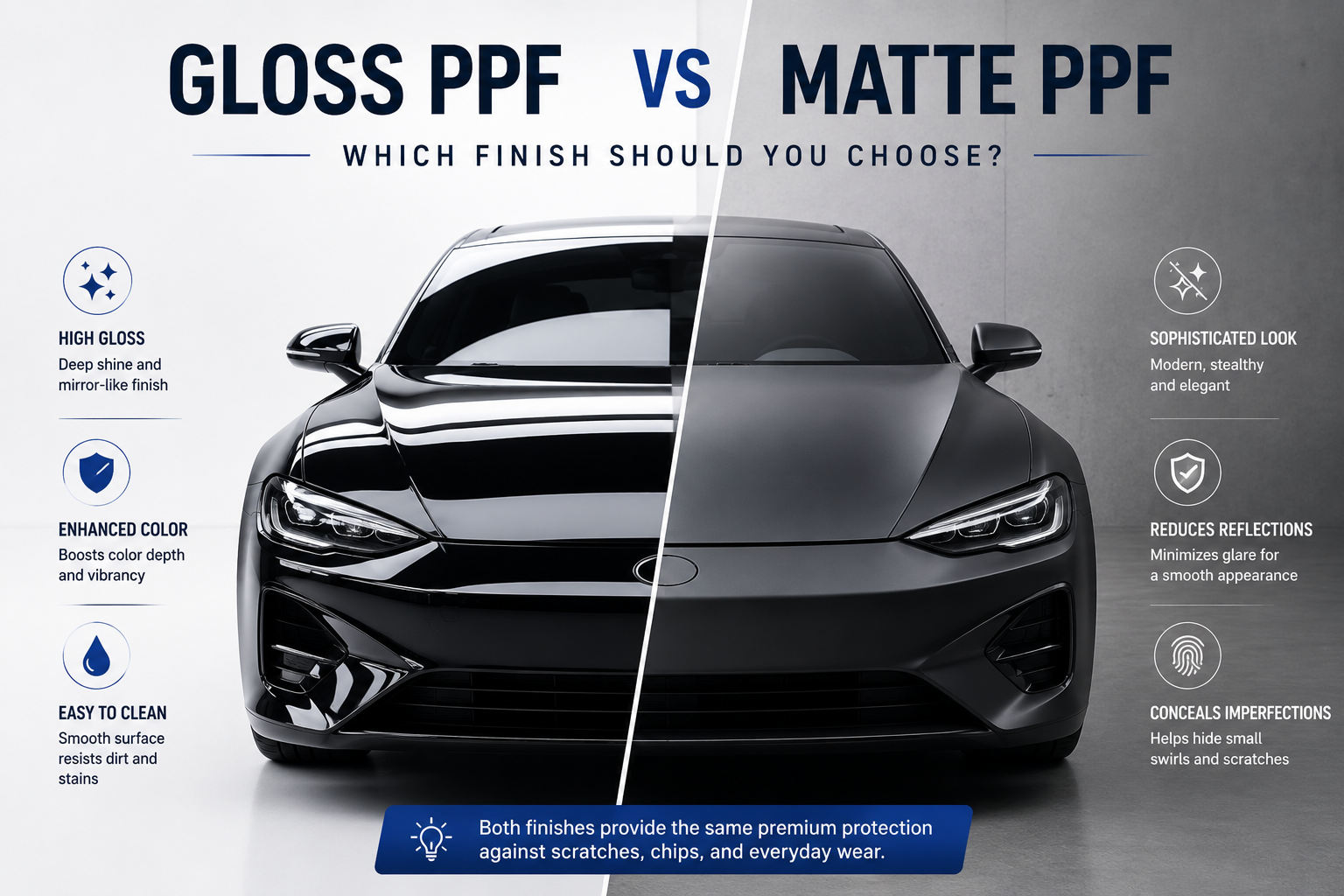
Until relatively recently, paint protection film came in one finish: clear. The whole point was invisibility — a film you couldn’t see, protecting paint you could.
Then matte PPF arrived, and the conversation changed. Now a single product decision — gloss or matte — carries aesthetic weight alongside the protection calculation. It’s not just about what the film does, but what it makes the car look like.
If you’re trying to decide between the two, or if you’re a distributor figuring out what to carry, this guide cuts through the noise.
What Gloss PPF Does
Gloss PPF is optically clear and designed to be invisible on a correctly installed vehicle. Its surface finish matches or enhances the reflective quality of automotive clear coat — on a well-detailed, paint-corrected vehicle, quality gloss PPF doesn’t just disappear, it can make the paint look slightly deeper and more polished.
This is the default for most PPF applications. If a customer wants to preserve the original look of their vehicle’s paint — especially a factory color they love — gloss PPF is the answer.
Best for:
- Original factory paint preservation
- Any customer who wants the car to look exactly as it came from the factory (or better)
- Light and metallic colors where film visibility is a concern
- Vehicles that will have ceramic coating applied over the PPF
What Matte PPF Does
Matte PPF has a diffused, non-reflective surface finish that creates a satin or flat appearance on the protected surface. When applied over gloss paint, it transforms the finish — a glossy factory color becomes a satin/matte finish without respray, without commitment, and with full paint protection in place.
The transformation is significant. A gloss white vehicle covered in matte PPF looks fundamentally different — not just a color change, but a texture and depth change that can make a mass-market car read as considerably more distinctive.
Matte PPF also has a more forgiving relationship with surface preparation than gloss PPF — the diffused finish hides minor surface imperfections (fine swirls, light etching) that gloss film would magnify.
Best for:
- Customers who want a matte or satin aesthetic without permanent paint change
- Vehicles being used to test a matte finish before committing to a matte respray
- Any surface where existing minor paint imperfections would show under gloss film
- Style-focused buyers who want the car to stand out
The Key Practical Differences
Appearance Matching
The most common gloss PPF installation problem is a noticeable sheen difference between the protected area and the surrounding unprotected paint. On a vehicle with moderately aged clear coat — slightly oxidized, mildly dulled — a fresh gloss PPF section on the bonnet can look noticeably brighter than the adjacent painted areas.
The solution is paint correction before installation. On freshly detailed paint, the gloss PPF section matches well. On aging paint, the film section can actually make the difference in paint condition more visible rather than less.
Matte PPF sidesteps this problem by being a deliberate finish change — there’s no expectation that matte sections match adjacent gloss paint, because that’s not the intent.
Maintenance
Both finishes require the right care products, but the requirements are different.
Gloss PPF maintenance: Most ceramic coatings and spray waxes are compatible. Avoid abrasive products directly on the film. Automated car washes with soft-touch brushes carry some risk of micro-scratching — touchless or hand washing is preferred for maintaining a gloss film’s optical quality.
Matte PPF maintenance: More sensitive to product choice. Waxes, certain sealants, and any product with gloss-enhancing agents can alter the matte finish — creating shiny patches that are difficult to reverse. Matte-specific detailing products exist and should be used. Automated car washes with wax cycles are a problem. The maintenance protocol for matte film needs to be communicated clearly to the vehicle owner at handover.
Self-Healing Visibility
Self-healing on gloss PPF is clear-cut — a scratch disappears, the surface returns to a smooth reflective finish. Easy to assess.
On matte PPF, self-healing is more nuanced. The diffused surface structure means scratches may not be as immediately visible in the first place, and after healing, the matte texture should return to its original state. In practice, deep scratches in matte film that partially heal can sometimes result in sections with a slightly different texture than the surrounding area — more noticeable on matte than on gloss because the texture itself is the finish.
Partial vs. Full Coverage Considerations
For partial coverage installations — a bonnet and bumper only, for example — the finish choice matters aesthetically:
- Partial gloss: Ideally invisible if paint condition and installation quality are both high. Can be noticeable if there’s a condition mismatch or reflectivity difference at the film edge.
- Partial matte: Creates a deliberate visual contrast between the matte protected section and the surrounding gloss paint. This looks intentional on some vehicles (a matte bonnet on a gloss car has a motorsport/custom aesthetic for some buyers). On others, it reads as unfinished. It depends on the customer’s intent.
For matte finish across the entire vehicle, a full-cover installation is the only way to achieve a consistent look.
Can You Combine Both?
Yes — and this is actually more common than buyers realize.
Some vehicles receive gloss PPF on high-impact protection zones (full front end, rocker panels, door edges) where protection is the primary concern, and matte PPF on aesthetic panels (bonnet, roof, full doors) where the customer wants the visual transformation.
The contrast between gloss and matte sections is deliberate in these applications. Done well, it can create a two-tone finish effect without any paint change.
The installation complexity increases — two different films, film edge management where the sections meet — and so does the requirement for installer skill. This is not a job for an inexperienced PPF installer.
Matte PPF as a Respray Alternative
One of the strongest use cases for matte PPF is as an alternative to a matte respray for customers who want a matte finish but aren’t ready to commit to it permanently.
A matte respray is irreversible without significant cost and effort. Matte PPF achieves essentially the same aesthetic result and can be removed — returning the vehicle to its original factory finish — when the owner is ready to sell the vehicle, change the look, or replace aging film.
For customers considering a matte custom paint job, a matte PPF full cover is often a smarter first step: get the look, live with it, see if you still love it in three years, and then decide whether to commit to paint.
Price Difference
Matte PPF film costs slightly more than equivalent gloss film at the material level — typically 10–25% more per roll, depending on the product and manufacturer. Installation labor is comparable.
For distributors and installers, the price premium on matte is generally easy to pass through to customers because the value proposition is clear — it’s a finish transformation, not just a protection layer, and customers who want that transformation understand they’re paying for more than clear film.
The Decision in Plain Terms
If the goal is paint preservation with no visible change to the vehicle’s appearance — gloss PPF.
If the goal is paint protection plus a satin/matte aesthetic transformation — matte PPF.
If the vehicle has minor paint imperfections that would show under a high-gloss film — matte PPF (or paint correction first, then gloss).
If the budget allows and the customer wants a specific look on some panels but maximum protection on high-impact zones — combination of both.
FAQ
1. what is the difference between gloss ppf and matte ppf?
gloss ppf keeps the original shiny paint appearance, while matte ppf creates a satin or flat finish for a more customized look.
2. does matte ppf protect paint as well as gloss ppf?
yes. both gloss and matte ppf provide strong protection against scratches, stone chips, stains, and uv exposure.
3. can matte ppf be applied over gloss paint?
yes. matte ppf can transform glossy factory paint into a satin or matte appearance without repainting the vehicle.
4. is gloss ppf easier to maintain than matte ppf?
generally yes. gloss ppf works with most ceramic coatings and detailing products, while matte ppf requires matte-safe maintenance products.
5. does matte ppf have self-healing properties?
high-quality matte ppf can self-heal light scratches with heat, although texture recovery may vary compared to gloss ppf.
6. which is more expensive, gloss ppf or matte ppf?
matte ppf usually costs slightly more than gloss ppf because of its special finish and visual transformation effect.
Sourcing gloss or matte PPF for your product range? Contact us — we can connect you with TPU film manufacturers producing both finishes to verified performance standards.
Further Reading
On this site:
- What Is Paint Protection Film (PPF)? Complete Guide for Beginners — Foundation overview before the finish decision
- TPU vs PVC PPF: Which Paint Protection Film Is Better? — Why material quality matters regardless of finish
- 6.5mil vs 7.5mil vs 8.5mil PPF: What’s the Difference? — Thickness as the third major product variable
- How Long Does Paint Protection Film Last? — Lifespan considerations for both finish types
- How to Start Your Own Window Film Brand — Brand building guidance applicable to PPF product lines
External:
- SEMA New Products Showcase — New product trends in automotive protective films
- Detail King PPF Training Resources — Professional installation resources for PPF installers
- XPEL Product Resources — Reference for how established PPF brands communicate finish options
Get a Free Sample or Quote
Looking for a reliable window film supplier? Contact us today for fast response and professional support.