Published: June 9, 2026 · 7 min read · Category: PPF Guide
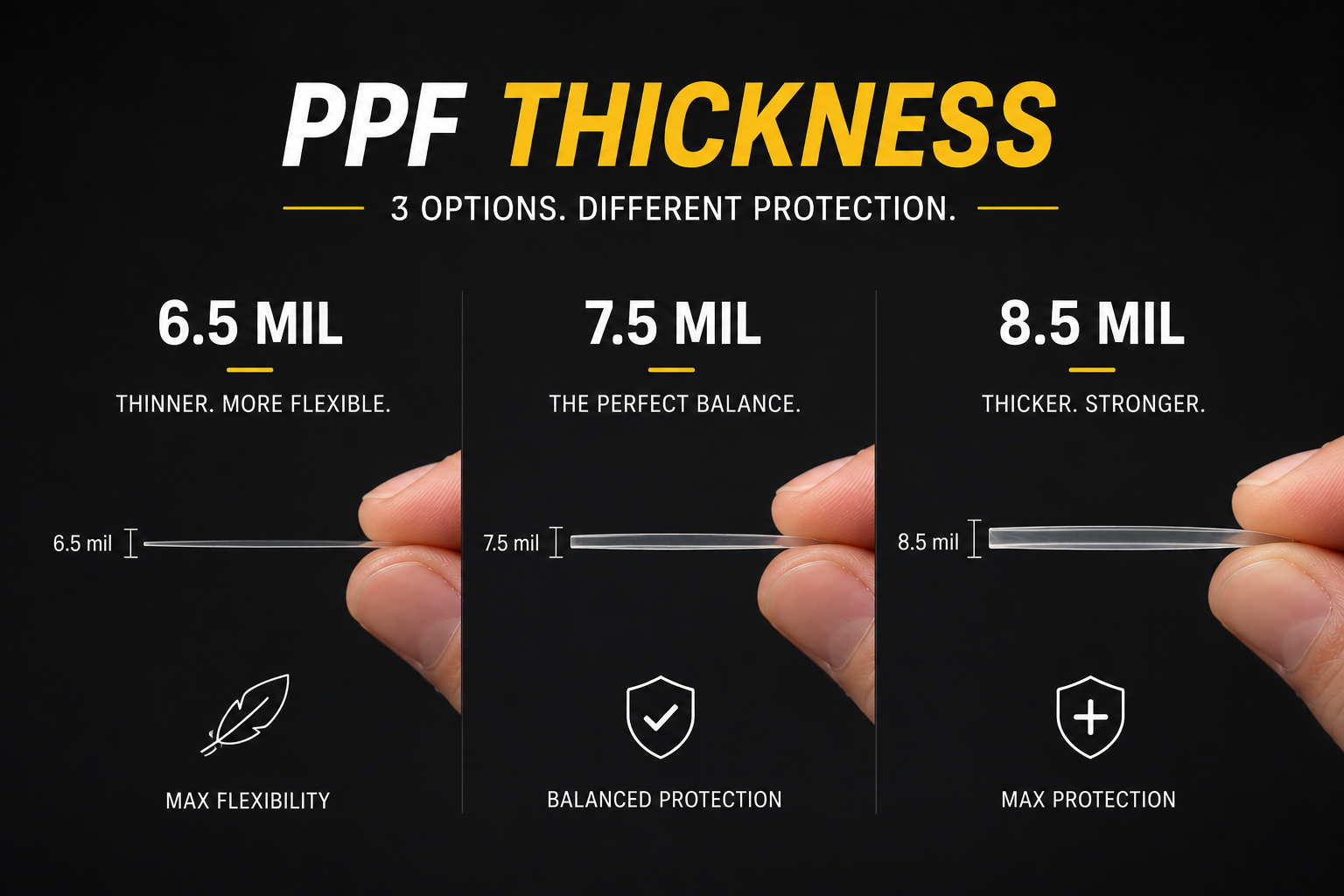
Thickness is one of the most cited — and most misunderstood — specs in paint protection film. Walk into any PPF conversation and you’ll hear numbers thrown around: “We use 8.5 mil, which means better protection.” “Our 6.5 mil installs better on complex curves.” “Thicker is always better.”
Most of it is either oversimplified or wrong.
This guide explains what PPF thickness actually measures, what it affects, what it doesn’t, and how to use thickness as one variable in a broader product evaluation — not a shortcut for skipping that evaluation entirely.
What “Mil” Means
One mil equals one thousandth of an inch — 0.001 inches, or approximately 0.0254 millimeters. It’s a unit of measurement borrowed from the packaging and film manufacturing industry and standard in the North American PPF market. European and Asian manufacturers sometimes specify thickness in microns (1 mil ≈ 25.4 microns).
A typical automotive PPF product ranges from roughly 6 to 10 mils total thickness. Within that range, the most common product tiers cluster around 6.5 mil, 7.5 mil, and 8.5 mil — which is where most buyer questions focus.
What Total Thickness Includes
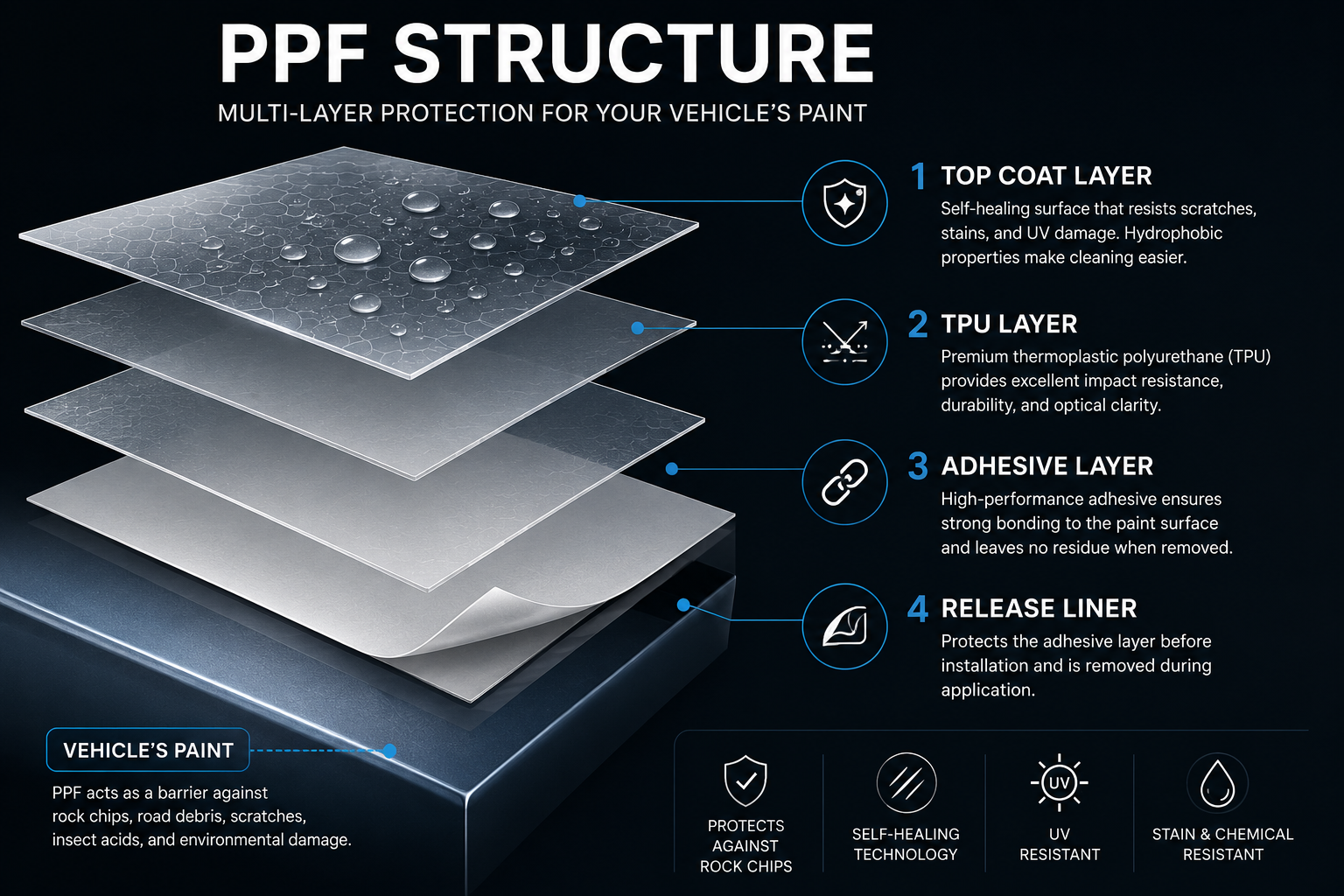
Before drawing conclusions from thickness specs, understand that total film thickness is the sum of all layers:
- Top coat (clear coat / self-healing layer): Typically 0.5–1.5 mils
- TPU base film: The primary structural layer, varies by tier
- Adhesive layer: Typically 1.0–1.5 mils
- Release liner: Not part of the installed product, so usually excluded from the stated spec — but confirm this
Two films stated at “8 mil” may have very different structures. One might have 6 mils of TPU and 2 mils of adhesive. Another might have 4.5 mils of TPU, 2 mils of top coat, and 1.5 mils of adhesive. The total is the same. The protection characteristics are different.
This is why thickness alone is an incomplete specification. A film with 7.5 mils of dense, high-quality TPU core protects differently from a film padded to 7.5 mils with a thick adhesive layer and a thin structural layer.
What Thickness Affects
Impact Resistance
The TPU base layer is what absorbs the kinetic energy of a stone strike. More TPU = more material to arrest the impact before it reaches the paint. In this specific sense, a genuinely thicker TPU layer provides better rock chip resistance.
The relationship isn’t linear — doubling the TPU thickness doesn’t double protection — but at the margins we’re talking about (6.5 vs. 8.5 mil), real-world testing does show reduced chip penetration frequency on thicker films under equivalent impact conditions.
Conformability and Installation Behavior
Thicker film is stiffer film. This is the fundamental tradeoff in PPF thickness selection.
A 6.5 mil film conforms more easily to complex compound curves, tight radii (wing mirror housings, door handle recesses), and narrow channels than an 8.5 mil film. It requires less heat for manipulation during installation and is more forgiving if a section needs to be repositioned.
An 8.5 mil film provides better impact resistance but is more challenging to install on complex geometry. On flat or gently curved panels — a bonnet, roof, or door skin — the difference in installation difficulty is minimal. On a modern vehicle with complex sculptural body lines and tight curves, the difference becomes significant, particularly for less experienced installers.
Durability Against Sustained Abrasion
Thicker film has more material to sacrifice before through-film abrasion reaches the paint. For applications with frequent low-velocity abrasion — door edges in tight parking environments, lower rocker panels in off-road use, rear bumpers on vehicles regularly loaded — additional thickness provides a proportionally longer service life before the film needs replacing.
Edge Lifting
Counterintuitively, thicker film can be more prone to edge lifting in certain installation scenarios. A thicker film that was stressed during installation around a complex curve holds more residual tension at the edge. If the adhesive bond isn’t sufficient to counteract that tension, the edge lifts over time.
This is an installation quality issue as much as a product issue — it’s why the combination of product choice, installer skill, and panel geometry all matter for long-term installation success.
The Three Tiers in Practice
6.5 mil: The Conformability-First Option
Films in the 6.5 mil range are typically specified for:
- Complex body shapes where conformability is the priority
- Full-vehicle coverage where consistent application across dozens of varied panels matters more than maximum impact resistance on any single panel
- Installers who prioritize finish quality and want maximum forgiveness during application
- Applications where the film will be replaced on a shorter cycle (leased vehicles, fleet applications) and extreme durability is less critical
The protection is real — a quality 6.5 mil TPU film stops the vast majority of rock chips encountered in normal driving. The argument that 6.5 mil is “not protective enough” only holds at high-impact speeds or with unusually large debris.
7.5 mil: The Middle Ground
The 7.5 mil range represents a genuine balance point. Enough thickness for meaningful impact resistance on high-velocity debris; enough conformability for most installation scenarios a competent installer encounters.
This tier is the most common for full-vehicle installs on premium vehicles where both protection performance and installation quality matter. It’s the default specification for many established PPF brands’ main product line.
For most buyers evaluating their first PPF product or building a distributor range, 7.5 mil quality TPU products cover the largest proportion of use cases without compromise.
8.5 mil: The Protection-First Option
Films in the 8.5 mil range are specified for:
- High-impact zones on vehicles regularly driven on motorways with high debris exposure (construction zones, quarry roads, rural roads)
- Leading edges — the front 20–30cm of a bonnet and the full bumper — where impact frequency is highest
- Off-road and performance driving applications
- Customers who prioritize maximum chip protection over all other considerations
At 8.5 mil, the installation demands on the installer increase noticeably. Complex curves require more heat and more patience. Edge finishing is less forgiving. Installations with noticeable lifting at curves or wrinkles at tight edges are more commonly associated with thicker film products on vehicles with complex body lines.
Many professional installers use 8.5 mil selectively — on the bonnet and front bumper where protection is the primary concern — and drop to 7.5 mil on more complex panels where conformability matters more.
What Thickness Doesn’t Tell You
This deserves its own section because the emphasis on thickness numbers in PPF marketing can create the impression that it’s the primary quality indicator. It isn’t.
Thickness doesn’t tell you about TPU quality. A film with 8.5 mils of low-density, low-grade TPU protects less than a film with 7 mils of premium, high-density TPU from a quality polymer supplier. The material grade matters as much as the quantity.
Thickness doesn’t tell you about the top coat. The self-healing capability, scratch resistance, and optical clarity of the installed film come primarily from the top coat formulation — not the base thickness. A 6.5 mil film with an excellent self-healing top coat performs better in daily use than an 8.5 mil film with a mediocre top coat.
Thickness doesn’t tell you about adhesive performance. Adhesion stability over time — particularly in temperature extremes — depends on adhesive chemistry, not film thickness.
Thickness doesn’t tell you about yellowing resistance. UV stability is a material property, not a thickness property. A thicker PVC film yellows just as surely as a thin one, and sooner than a quality TPU film at any thickness.
The right way to use thickness: as one specification among several, evaluated alongside material type (TPU vs PVC), top coat quality, manufacturer reputation, and third-party test data.
A Practical Decision Guide
Choosing thickness for specific applications:
| Application | Recommended Thickness | Reasoning |
|---|---|---|
| Full vehicle, daily driver | 7.5 mil | Balance of protection and conformability |
| Front-end high-impact zones | 8.5 mil | Prioritize chip resistance where exposure is highest |
| Complex curves and mirrors | 6.5–7.5 mil | Conformability matters; film edge quality |
| Off-road or rural highway use | 8.5 mil | Higher debris frequency justifies thickness premium |
| Leased vehicle, short-term | 6.5–7.5 mil | Lower cost, easier removal |
| Luxury / exotic vehicle | 7.5 mil (skilled installer) | Finish quality as important as protection |
For Distributors: How to Position Thickness in Your Range
If you’re building a PPF product range, carrying multiple thickness options serves different installer needs and creates natural product tier structure:
- Entry product: 6.5 mil — competitive price point, good conformability, positions against budget alternatives
- Main line: 7.5 mil — your flagship product, positioned as the professional standard
- Premium / protection-focused: 8.5 mil — marketed for high-impact applications, front-end focus, performance and off-road use
This structure gives your installer accounts a product for every customer conversation without requiring them to sell a single option for all applications.
FAQ
1. What does PPF thickness mean?
PPF thickness refers to the total film thickness measured in mils, including the top coat, TPU layer, and adhesive layer.
2. Is thicker PPF always better?
Not always. Thicker PPF offers stronger impact resistance, but thinner films are easier to install on complex curves.
3. Which PPF thickness is best for daily driving?
7.5mil PPF is the most balanced option for daily vehicles, offering both protection and good conformability.
4. What is 8.5mil PPF best for?
8.5mil PPF is ideal for high-impact areas, off-road driving, and vehicles exposed to frequent road debris.
5. Does thicker PPF last longer?
Thicker PPF can improve abrasion resistance, but overall durability also depends on TPU quality, adhesive, and top coat technology.
6. Is 6.5mil PPF still protective?
Yes. Quality 6.5mil TPU PPF still provides effective protection against common rock chips and daily road damage.
Building a PPF product range and want to match thickness tiers to the right manufacturer? Contact us — we work with TPU film manufacturers across product specifications and can help structure a range for your market.
Further Reading
On this site:
- What Is Paint Protection Film (PPF)? Complete Guide for Beginners — Foundation overview before the thickness decision
- TPU vs PVC PPF: Which Paint Protection Film Is Better? — Why material type matters more than thickness numbers alone
- Gloss PPF vs Matte PPF: Which Finish Should You Choose? — Finish options available at any thickness tier
- How Long Does Paint Protection Film Last? — How thickness affects long-term durability
- Wholesale Window Film Buying Guide for Distributors — Product range strategy applicable to PPF distribution
External:
- ASTM International — Film Testing Standards — Testing standards for thickness, tensile strength, and impact resistance applicable to PPF
- SEMA Automotive Film Resources — Industry context for PPF specification and performance standards
- Paint Protection Film Alliance — Industry resources on PPF installation and product standards
Get a Free Sample or Quote
Looking for a reliable window film supplier? Contact us today for fast response and professional support.