Published: June 11, 2026 · 9 min read · Category: Manufacturing
Here’s a scenario that plays out more often than most distributors want to admit: your first order from a new supplier is excellent. Samples are clean, specs match the datasheet, your installers are happy. You place a second order. Then a third. Somewhere around the fourth or fifth order, something shifts — a batch of film that installs with more bubbling than usual, or a VLT reading that’s consistently off by a few percentage points, or an adhesive that’s behaving differently in cold temperatures.
The supplier assures you it’s within tolerance. Your installers disagree.
What you’ve just experienced is what happens when quality control is performative rather than systematic. The first few shipments were good because the supplier was paying attention. The problems emerged when attention drifted — because there was no process robust enough to catch variation before it shipped.
This article explains what a serious window film quality control system actually looks like, why it matters more than most buyers realize, and how to evaluate whether your current or prospective supplier has one.
QC Is a System, Not a Department
The most common misconception about manufacturing quality control is that it’s something that happens at the end of the production line — a person with a tint meter checking finished rolls before they go into boxes.
That’s inspection. It’s useful, but it’s the weakest form of QC because by the time you’re checking a finished roll, any problem in the coating, lamination, or slitting process has already consumed materials, time, and production capacity. You’re sorting good product from bad product, not preventing bad product from being made.
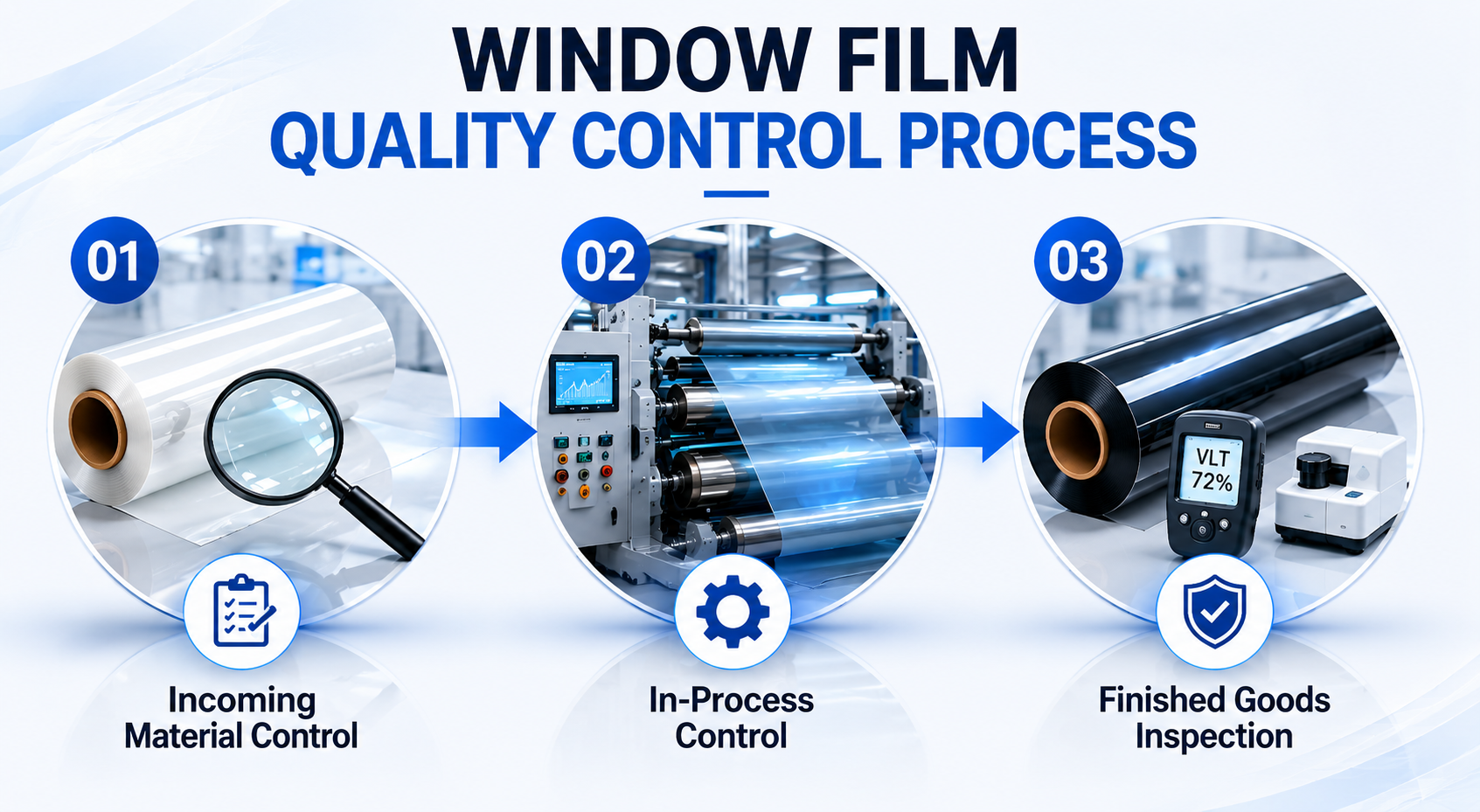
A serious quality control system works at three levels:
- Incoming material control — verifying raw materials before they enter production
- In-process control — monitoring and adjusting the production process in real time
- Finished goods inspection — final verification before shipment
Factories that only do the third step are managing quality reactively. Factories with all three are managing it systematically. The difference shows up in batch-to-batch consistency over time — not just in samples.
Stage 1: Incoming Material Control
Window film quality problems often start before a single meter of film has been coated. The PET base film, adhesive chemistry, coating materials, and release liner all have specifications — and batch-to-batch variation from suppliers is real, even from reputable ones.
What incoming control looks like in a serious factory:
Every inbound shipment of PET base film gets sampled and tested against spec before it’s approved for production use. The tests typically include:
- Thickness measurement (using calibrated micrometers or optical sensors)
- Optical clarity and haze (spectrophotometer)
- Surface energy verification (relevant for coating adhesion)
- Dimensional stability check
Adhesive materials and coating chemicals are similarly sampled and tested for viscosity, chemical composition (where practical), and performance against reference standards.
Material that fails incoming inspection goes into quarantine — physically separated from approved stock, clearly labeled, and processed through a disposition procedure (return to supplier, rework if possible, scrap). A factory that can show you quarantine records and supplier rejection documentation has a functioning incoming control system. A factory that says “we trust our suppliers” and has no incoming testing is running on faith.
What to ask on a factory visit or audit:
- Can you show me your incoming inspection records for the last three PET shipments?
- What’s your incoming rejection rate for base film?
- How do you handle a situation where mid-production you discover a base film problem?
Stage 2: In-Process Quality Control
In-process QC is where serious manufacturers invest most heavily, because it’s where problems are cheapest to catch and correct.
Coating Process Monitoring
During sputtering or wet coating operations, the critical variables — deposition rate, vacuum level, power settings, coating speed, temperature — are continuously monitored. In a well-equipped factory, this monitoring is automated, with process control software logging parameters and alerting operators when values drift outside acceptable ranges.
Automated inline optical sensors can detect coating weight variation, surface defects, and thickness non-uniformity in real time. A factory running blind — no inline sensing, just periodic manual sampling — is producing film whose quality is only as good as how often an operator happens to check.
Frequency of in-process sampling matters too. Pulling one sample per 500-meter master roll is meaningfully different from sampling every 100 meters. The sampling frequency should be documented in the manufacturer’s quality plan.
Film Web Inspection Systems
Modern film factories use camera-based web inspection systems that scan the entire film surface continuously as it moves through production — looking for inclusions (dust, fiber, contamination), coating defects (pinholes, streaks, uneven coverage), and surface anomalies.
When a defect is detected, the system typically marks the location on the roll (using a small ink dot or electronic register) so that either the defective section can be spliced out or the roll can be flagged as a second-quality product.
Factories without automated web inspection are relying on human visual inspection, which misses defects at production speeds. At 50–100 meters per minute, a person watching a film surface will catch the obvious problems and miss the subtle ones.
Adhesive Lamination Control
Adhesive application uniformity is critical — too light and the film won’t adhere properly; too heavy and it becomes difficult to install and prone to edge lifting. Inline weight-per-area monitoring (typically using beta gauge or near-infrared sensors) verifies adhesive coat weight in real time.
The adhesive cure process (UV curing or thermal curing, depending on chemistry) also needs monitoring — cure energy, line speed, and temperature all affect adhesive crosslink density, which in turn affects peel strength and installation behavior.
Stage 3: Finished Goods Inspection
Final inspection before a roll ships should be both systematic and documented.
Visual inspection: Every roll is inspected for surface defects, edge quality, core condition, and winding consistency. Telescoping, deformation, or visible inclusions are grounds for rejection.
Dimensional verification: Width and length are checked against spec. Width variation matters for installation — a roll nominally 1.52m wide that measures 1.50m on one edge creates problems for installers cutting to window dimensions.
Performance sampling: A sample from each production batch (not just each roll) is pulled and tested for VLT, IR rejection, UV rejection, and haze. These results are logged against the batch number, creating a traceable record that links production conditions to performance outcomes.
This batch record is something you can request. For any order you’ve placed, you should be able to ask the factory for the QC test data for that specific batch. If they can’t provide it, or if the records consist of a single line item with no supporting data, you’re dealing with a factory that isn’t running systematic finished goods QC.
The Documentation That Proves the System Exists
A quality system that isn’t documented is just a set of habits — habits that change when people leave, when production pressure increases, or when a batch is running late and someone decides to cut a corner.
Documented QC systems include:
Quality Manual: The top-level document describing the factory’s quality policy, organizational responsibility for quality, and the overall quality system structure. ISO 9001 certification requires this document to exist and be maintained.
Control Plans: For each product type or production process, a control plan specifies what’s being measured, how frequently, what the acceptable range is, and what happens when the range is exceeded.
SOPs (Standard Operating Procedures): Step-by-step documented procedures for each critical process step. Relevant for coating, lamination, slitting, inspection.
Batch Records: The actual recorded data from production — raw material lots used, process parameters run, in-process measurements taken, finished goods test results, and pass/fail disposition for the batch.
Non-Conformance Reports (NCRs): Documentation of quality failures — what happened, which lots were affected, what disposition was taken (rework, scrap, quarantine), and what corrective action was implemented to prevent recurrence.
When you’re evaluating a supplier’s quality system, asking to see recent NCRs is one of the most useful requests you can make. A factory with no NCRs either has perfect production (unlikely) or isn’t documenting failures (more likely). A factory with NCRs that include clear root cause analysis and corrective actions is one where the quality system is actually functioning.
Third-Party Verification: How It Fits In
Third-party test reports from SGS, Intertek, or Bureau Veritas are not a substitute for a factory’s own quality system — they’re periodic external verification that the factory’s own measurements are accurate and that the product meets claimed specifications.
The distinction matters: a factory that relies entirely on third-party certification and has no internal QC infrastructure is in a fragile position. Their product may perform well when a third-party sample is pulled — but without internal control, they have no reliable mechanism for ensuring that every production run matches that sample.
The right relationship between internal QC and third-party testing: internal QC runs continuously to maintain consistency, and third-party testing validates the internal system periodically (typically annually, or when a formulation changes).
For a complete breakdown of which third-party certifications matter and how to verify them, see What Certifications Should a Window Film Manufacturer Have?
Red Flags in a Supplier’s QC Story
After visiting or auditing suppliers, certain patterns show up repeatedly in manufacturers whose quality is unreliable:
“We test every roll.” This sounds thorough. It’s often shorthand for a visual inspection and possibly a VLT check — which misses adhesive problems, IR performance variation, and coating uniformity issues that aren’t visible to the naked eye.
No in-house lab equipment visible on the factory floor. If the only testing happens at a third-party lab, there’s no mechanism for catching problems during production. Third-party labs test what they’re sent; they don’t monitor the factory.
QC records that are suspiciously clean. Real production has variation. If every batch record shows identical measurements with no outliers and no NCRs, someone is either generating records retrospectively or rounding everything to the nearest “acceptable” value.
QC responsibility sits with one person. A single QC manager who does everything — incoming inspection, in-process monitoring, finished goods testing, documentation — is a system that collapses when that person is unavailable or leaves.
Inability to provide historical batch data for orders you’ve already received. A well-organized factory should be able to retrieve production records for any order they’ve shipped within the last 2–3 years.
What Good Looks Like: A Summary
A window film manufacturer with a robust quality system should be able to demonstrate:
- Incoming inspection records for raw materials, with documented disposition of any failed lots
- In-process monitoring data showing parameter control during coating and lamination
- Finished goods test results at the batch level, traceable to production records
- Documented corrective actions from past quality failures
- Third-party test reports (SGS, Intertek, or equivalent) dated within the last 12 months, for specific products — not generic range certifications
- An in-house QC lab with equipment capable of measuring the performance parameters they claim
This isn’t an exhaustive list — it’s the baseline. A supplier who can’t meet this baseline has quality that depends on luck and attention rather than system.
FAQ
Q1: Why is quality control important in window film manufacturing?
Quality control ensures consistent heat rejection, UV protection, optical clarity, and long-term durability in every film roll.
Q2: What tests are commonly used in window film quality control?
Manufacturers typically perform thickness testing, adhesion testing, optical inspection, UV rejection testing, and heat rejection analysis.
Q3: How do manufacturers check optical clarity in window film?
Factories use inspection systems and light transmission testing to detect haze, defects, bubbles, or uneven coating.
Q4: What causes inconsistency in window film production?
Poor raw materials, uneven coating, contamination, and incorrect tension control can affect film quality and performance.
Q5: How can buyers verify a manufacturer’s quality control capability?
Buyers can review factory audits, testing reports, production equipment, and inspection procedures to evaluate quality control standards.
Concerned about quality consistency from your current supplier? Send us an inquiry — we help buyers set quality benchmarks, evaluate supplier QC systems, and find manufacturers whose consistency matches their sample quality.
Further Reading
On this site:
- How Window Film Is Manufactured: From Raw Materials to Finished Rolls — The production process QC is designed to control
- Inside a Modern Window Film Factory: Production Process Explained — What a factory visit reveals about quality capability
- What Certifications Should a Window Film Manufacturer Have? — Third-party verification in context
- Window Film Factory Audit Checklist — Structured questions for evaluating any supplier’s QC system
- Top 7 Window Film Manufacturers in China (2026 Verified List) — Manufacturers with verified quality infrastructure
External:
- ASQ (American Societyfor Quality) — Quality management frameworks and resources, including ISO 9001 implementation guidance
- Intertek Product Testing — Third-party testing services for window film performance verification
- QIMA Quality Inspections — Pre-shipment and factory inspection services for China-based suppliers
Get a Free Sample or Quote
Looking for a reliable window film supplier? Contact us today for fast response and professional support.